Tesla FSD Driver Monitoring Gets Stricter in Europe, Hands-On Above 81 MPH, While US Drivers Get Fewer Nags
Tesla FSD driver monitoring now differs by market: Europe's RDW-approved update adds earlier warnings, full strikes and hands-on above 81 mph, while US FSD v14 nags less. US vs Europe compared.
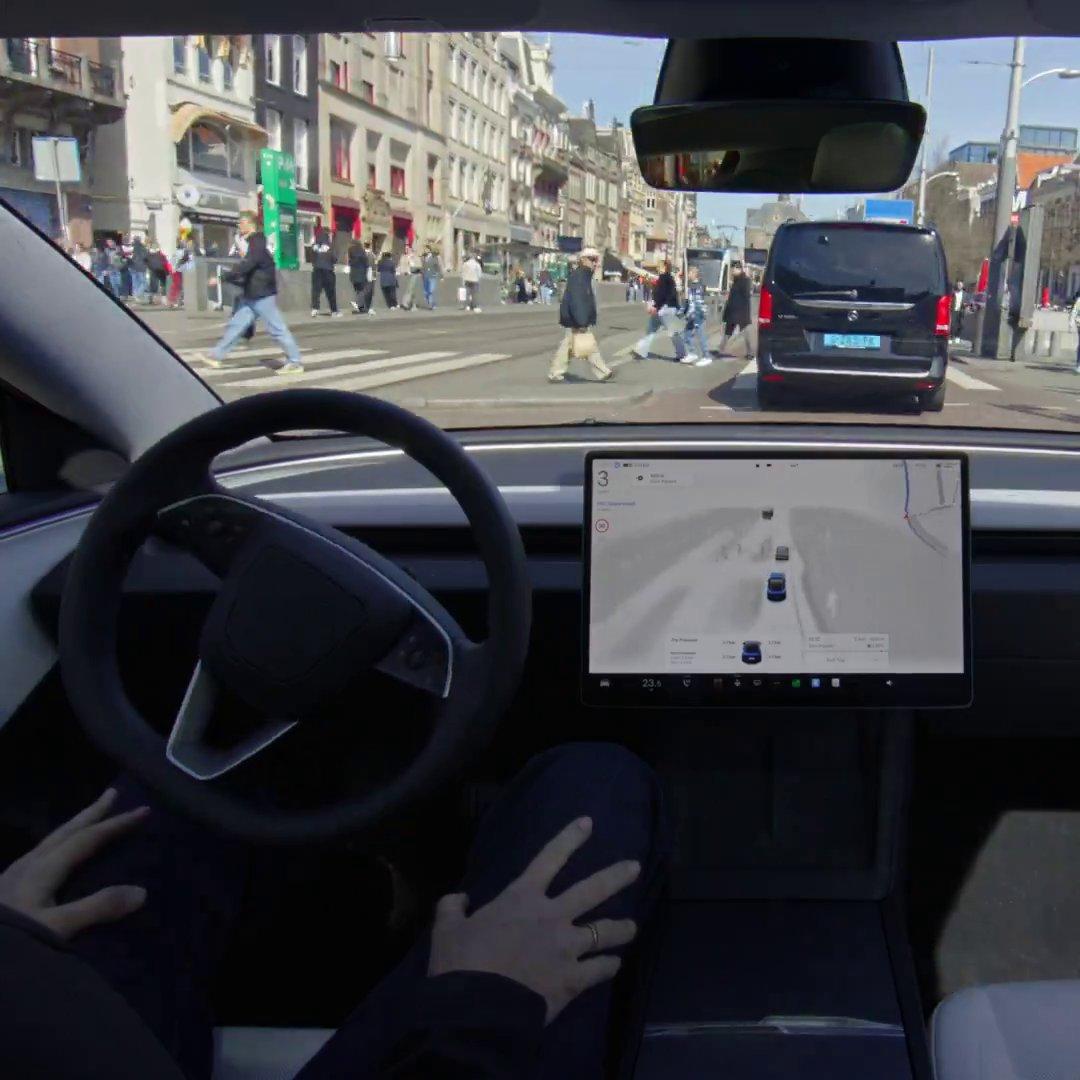
Image: @teslaeurope on X (still from Tesla's official FSD Supervised video, Amsterdam)
Tesla is now running two very different rulebooks for the same driver camera. In Europe, a new update approved on November 16 makes Tesla Assisted Driving, the European name for FSD (Supervised), warn inattentive drivers sooner, hand out a "full strike" for not watching the road during a manoeuvre, and require hands on the wheel above 130 km/h (81 mph).
In the United States, the trend has gone the other way. Over the past year Tesla has eased FSD's attention checks, and Elon Musk has said the system "nags less." The hardware is the same in both markets: a cabin camera above the rearview mirror and the HW4 computer. The difference is who signs off on the software.
Nov 16
RDW approves stricter Tesla Assisted Driving update
130 km/h
Above this (81 mph), hands must stay on the wheel in Europe
60+ sec
Eyes-off time testers reported on US FSD v14.3.3
5 sec
UN DCAS rule: eyes-off-road limit before a warning
What Changes in Europe
The Dutch vehicle authority RDW, which certifies Tesla's system for Europe, says the update applies to cars with Tesla Assisted Driving and Hardware 4 or newer, and arrives over the air when Tesla chooses to release it. According to the RDW, it adds:
Earlier attention warnings, plus a full strike if the driver is not paying attention while the system performs a manoeuvre.
Extra measures against misuse. The RDW did not say what they are.
Hands on the wheel above 130 km/h (81 mph), on roads where that speed is legal.
Speed confirmations. To set a maximum speed above what the system shows, the driver must scroll the wheel up. If the car then exceeds the limit, the speed sign pulses red.
The RDW says it tested the update on a track and on public roads and found "no adverse or unintended effects." The approval is recognized in 10 other EU countries: Belgium, Croatia, the Czech Republic, Denmark, Estonia, Finland, Latvia, Lithuania, Slovakia and Slovenia. A vote on EU-wide approval is still pending at the Technical Committee on Motor Vehicles (TCMV).
This update is separate from the early-November change that capped the speed margin at 10% over the limit and renamed the system. We covered that in our story on the 10% speed cap.
Tesla's launch video for the Netherlands shows the system steering through Amsterdam with the driver's hands in their lap. Hands-free use is still allowed in Europe below 130 km/h; the cabin camera above the mirror watches the driver's eyes. Image: @teslaeurope on X
How FSD Driver Monitoring Got Looser in the US
In the US, Tesla has relaxed monitoring step by step, mostly without spelling it out in release notes:
December 2025, FSD v14.2.1: Asked on X whether the update allowed texting and driving, Musk replied, "Depending on context of surrounding traffic, yes." Texting while driving remains illegal in nearly every US state.
May 2026, FSD v14.3.3: Musk posted that "14.3.3 nags less too." Not a Tesla App reported early testers getting up to a minute or more before a prompt to look forward, versus about 20 to 30 seconds on v14.2.2. Monitoring still tightens when the car is less confident, and the aggressive "Mad Max" profile shows an "Increased attention required" message.
June 2026, software 2026.14.6.7: Release notes list improved "driver monitoring system sensitivity with better eye gaze tracking, eye wear handling." Tesla says the change had already shipped quietly.
November 17, 2026, software 2026.44.1 (FSD v14.3.13): The same eye-tracking language appears in the newest US release notes.
The US strike system is lenient by comparison. Tesla's owner's manual says FSD is suspended for a week after five "strikeouts," and each strike is forgiven after 3.5 days without another one. Tesla cut that window from seven days in 2025. There is no speed above which US drivers must keep their hands on the wheel.
Advertisement
FSD Driver Monitoring: US vs Europe
Rule
United States (FSD Supervised)
Europe (Tesla Assisted Driving)
Who approves updates
Tesla self-certifies; NHTSA acts after the fact
RDW tests and approves before release
Hands-free driving
Allowed at any speed with eyes on road
Allowed only up to 130 km/h (81 mph)
Attention warnings
Eased in v14.3.3; testers report 60+ seconds
Earlier warnings in the November update
Strikes
5 strikeouts = 1-week suspension; each forgiven after 3.5 days
Adds a "full strike" for inattention during a manoeuvre
Hardware
Cabin camera; HW3 and HW4
Cabin camera; HW4 or newer only
Phone use
Musk said texting OK "depending on context"
No such allowance; RDW added anti-misuse measures
Sources: RDW (Nov. 16, 2026), Tesla owner's manual, Tesla release notes via Not a Tesla App, Musk posts on X.
Advertisement
What European Rules Expect From Driver Monitoring
Europe's baseline for advanced driver assistance is UN Regulation 171, the Driver Control Assistance Systems (DCAS) rule adopted through the UNECE in 2024. UNECE says DCAS systems must monitor the driver's visual engagement and trigger warnings after 5 seconds of looking away from the road.
Tesla's system goes beyond what current regulations cover, so the RDW approved it under Article 39 of EU Regulation 2018/858, an exemption route for new technology. That gives the regulator leverage: each change goes through RDW testing, and other countries can decline to follow. A US owner's car, with the same camera, receives whatever monitoring logic Tesla ships.
Regulators Are Watching the US Side
NHTSA has not ordered changes, but monitoring is part of several open files:
EA26002: NHTSA's engineering analysis of FSD crashes in low-visibility conditions covers about 3.2 million vehicles. In a July 2, 2026 information request, the agency listed Musk's texting reply among marketing claims it asked Tesla to justify. It also asked for Tesla's assessment of its driver monitoring system and "all forms of potential misuse or abuse" it considered. Tesla's answers were due August 12.
RQ24-009: A recall query, open since April 2024, into whether Tesla's December 2023 Autopilot recall (23V838), which strengthened driver-engagement controls on about 2 million vehicles, actually works.
Congress: In September, Rep. Raja Krishnamoorthi asked the Transportation Department whether NHTSA has evaluated Tesla's safeguards when the cabin camera is blocked or drivers wear sunglasses or hats, after NBC News counted 43 videos of apparently sleeping Tesla drivers.
The timing is awkward for Tesla. This week, NHTSA's Standing General Order data showed Autopilot or FSD was "Verified Engaged" at 71 mph in the Naples, Florida, I-75 crash that killed three people. The same batch includes two more fatal crashes, in El Dorado Hills, California, and Naples. Tesla redacted the narratives, and none of the reports shows the driver's attention level or whether monitoring played a role.
What US FSD Owners Should Know
FSD (Supervised) is a Level 2 system. Tesla's manual says you must "remain attentive and be ready to take over at all times."
Fewer nags do not change the law. Texting and phone bans in your state still apply, whatever the software allows.
In a crash, you are the driver. Police, courts and your insurer will treat it that way, not as Tesla's fault by default.
Sunglasses do not turn off monitoring. The manual says the system stays active, and Start Self-Driving from Park requires an unobstructed cabin camera.
Five strikeouts suspend FSD for a week, even though you keep paying the subscription.
"14.3.3 nags less too" — Elon Musk, Tesla CEO, on X, May 18, 2026
The bottom line: Tesla has shown it can build stricter driver monitoring when a regulator requires it. Europe got earlier warnings, tougher strikes and a hands-on rule above 81 mph. US owners got fewer nags on the same camera. Until NHTSA acts, a US driver's attention is up to the driver, and so is the liability.