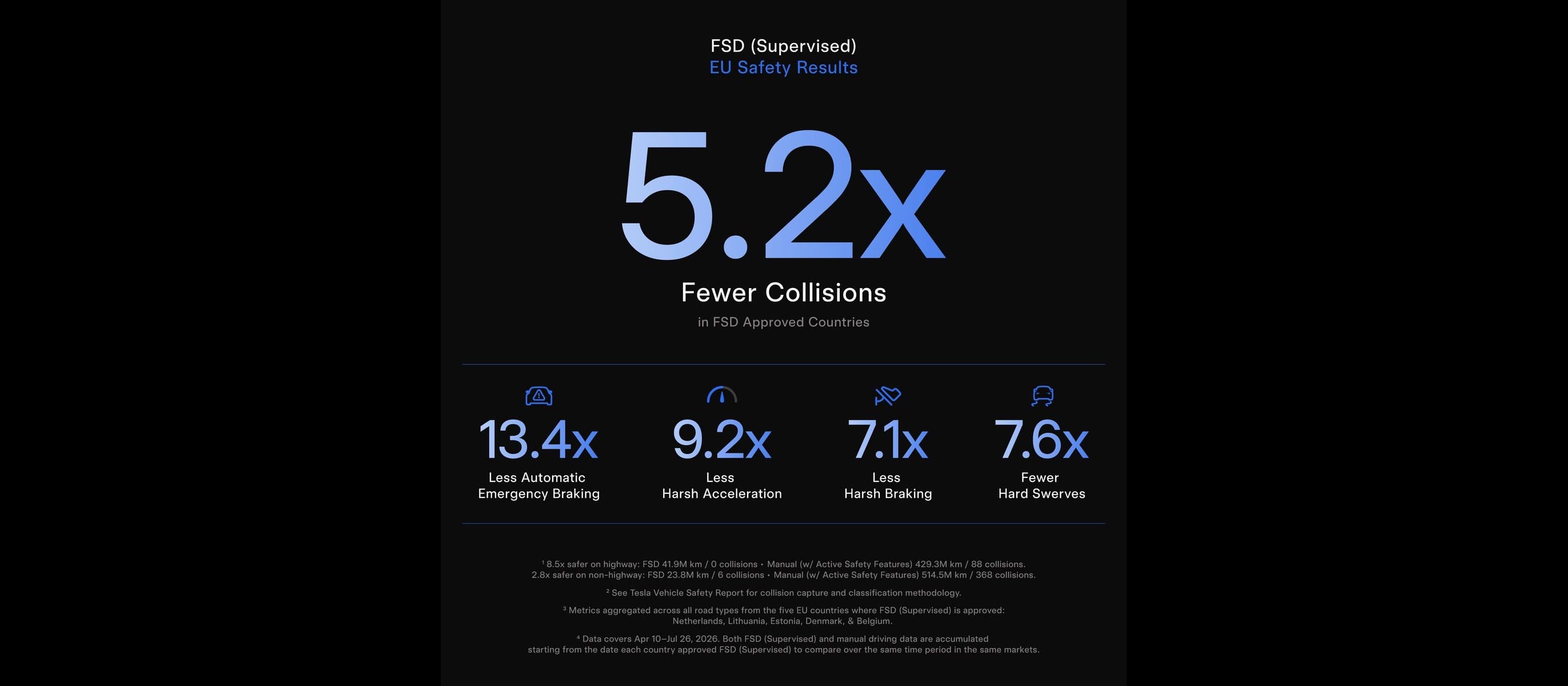
Tesla has published its first batch of real-world FSD (Supervised) safety data drawn specifically from its European Union fleet, covering four months of driving across the five EU countries where the system is currently approved. The company says FSD (Supervised) has been over 5.2 times safer than manual driving across roughly 65 million kilometers of combined driving in that window.
5.2x
Fewer collisions overall vs. manual driving
65M km
Combined FSD driving across 5 EU countries
0
Collisions across 41.9 million highway kilometers
Where the Data Comes From
The figures cover April 10 through July 26, 2026, and are aggregated across all road types from the five EU countries where FSD (Supervised) is currently approved: the Netherlands, Lithuania, Estonia, Denmark, and Belgium. The Netherlands was first, after its vehicle authority (RDW) granted type approval on April 10, 2026 — the first sign-off of its kind anywhere in the EU. Lithuania, Estonia, Denmark, and Belgium each authorized the system afterward, each leaning on that initial Dutch decision to fast-track their own approvals.
The full breakdown Tesla published
- 5.2x fewer collisions overall across FSD-approved countries
- Highway driving: FSD logged 41.9 million km with zero collisions, versus manual driving (with active safety features) at 429.3 million km and 88 collisions over the same comparison period — an 8.5x difference
- Non-highway driving: FSD logged 6 collisions across 23.8 million km, versus manual driving at 514.5 million km and 368 collisions — a 2.8x difference
- 13.4x fewer automatic emergency braking interventions
- 9.2x less harsh acceleration
- 7.1x less harsh braking
- 7.6x fewer hard swerves
Tesla's own footnotes specify that both the FSD and manual-driving figures are accumulated starting from the date each country approved FSD (Supervised), so the comparison is measured over the same calendar window in the same markets rather than against older, unrelated baseline data.
The highway and non-highway figures roughly add up to the total 65 million km headline number, and the pattern is consistent with what Tesla has previously reported in the U.S.: highway driving, which is more structured and predictable, shows a bigger safety margin than mixed non-highway driving with intersections, pedestrians, and cyclists.

How This Compares to Tesla's U.S. Numbers
Tesla's own U.S. data shows a similar directional pattern using a different metric: miles driven between collisions rather than a collision-rate multiplier. The company reports Teslas on FSD average 5.5 million miles between major collisions in the U.S., compared to 2.2 million miles for manual driving with active safety features enabled, and 1.6 million miles before minor collisions versus 717,000 miles manually. The European figures and the U.S. figures aren't directly interchangeable since they use different measurement approaches, but they point in the same direction.
Why some regulators are reading this data cautiously
- These are Tesla's own self-published figures, not numbers independently verified by an outside safety body
- Reuters reported in June 2026 that separate U.S.-derived marketing statistics Tesla shared with Dutch and Swedish regulators — including a claim that FSD is "up to 10 times safer than human drivers" — were called misleading by 10 of the 11 independent traffic-safety researchers who reviewed the methodology, largely due to mismatched crash-severity thresholds and Tesla's much younger fleet compared to the national vehicle average
- The Netherlands' RDW has said its own type approval doesn't rely on Tesla's marketing claims or external statistics, and is based on the agency's own testing of the EU-specific software build
- A bloc-wide vote to make FSD (Supervised) legal across all 27 EU member states hasn't happened yet; it requires a qualified majority in the EU's Technical Committee on Motor Vehicles and has been targeted for later in 2026, though some trackers expect it to slip into 2027
- France has rejected FSD over safety concerns, and Sweden has also pushed back, so approval is far from a formality even with this new data in hand
The Bigger Picture: Expansion Is Still Piecemeal
FSD (Supervised) remains restricted to Hardware 4 (HW4/AI4) vehicles in the countries where it's approved, and each approved country gets a localized build of Tesla's software tailored to its specific road rules and signage rather than a single one-size-fits-all European release. That patchwork rollout is a big part of why this new dataset matters to Tesla commercially: European sales have been under pressure, and a bloc-wide approval would remove the country-by-country friction currently slowing adoption.
The bottom line: The topline numbers are genuinely impressive if they hold up — zero collisions across 41.9 million highway kilometers is a real result, not a rounding trick. But this is still Tesla grading its own homework, in a regulatory environment where outside researchers have already found problems with how the company has framed similar statistics elsewhere. Treat this release as a data point Tesla wants regulators and buyers to see, not as independently confirmed proof, while the actual EU-wide approval decision — the one that matters most for whether this becomes standard across the continent — still hasn't happened.