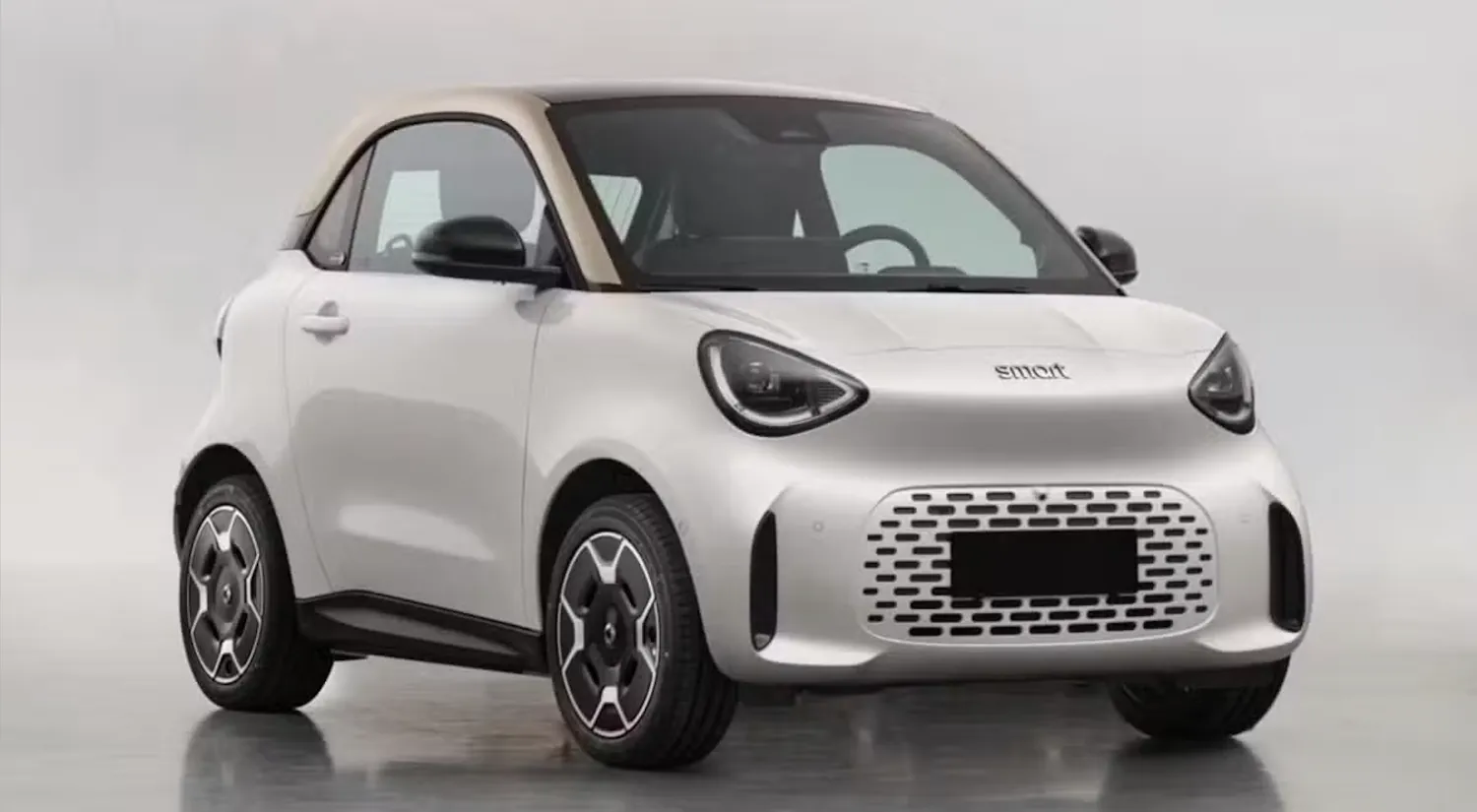
Smart spent the last few weeks building anticipation the old-fashioned way: giant murals painted across cities worldwide, teasing a fortwo successor called the #2 ahead of a planned world premiere at the Paris Motor Show in October. Then China's Ministry of Industry and Information Technology published its latest batch of vehicle homologation filings on August 7 — and the entire car, specs and all, was suddenly public months ahead of schedule.
186 mi
WLTP-rated range, nearly double the old fortwo EQ
80 hp
Output from the rear-mounted electric motor
2
Seats — the #2 is a dedicated two-seater
What the Filing Actually Confirms
The Smart #2 is a joint-venture product between Mercedes-Benz and Geely, built on a bespoke Electric Compact Architecture developed by Geely specifically for small EVs. It's a strict two-seater, continuing the fortwo's original city-car formula rather than growing into something bigger. Production will happen in China under Zhejiang Haoqing Automotive Co., the manufacturing entity behind the Geely-Mercedes smart partnership.
Smart #2 specs, per the China filing
- Length: 2,751-2,764mm depending on trim (about 56-69mm longer than the old fortwo)
- Width 1,669mm, height 1,555mm, wheelbase 1,875mm
- Curb weight 1,130kg (2,491 lbs); gross weight 1,315kg
- Rear-mounted motor: 80hp / 60kW, top speed electronically limited to 140 km/h (87 mph)
- LFP battery, 35.7kWh, CATL cells assembled by Geely
- Range: 300km WLTP (186 mi) / 400km CLTC; 10-80% DC fast charge in under 20 minutes
- Supports Vehicle-to-Load (V2L) power output
That range figure is the headline number: the outgoing fortwo EQ topped out around 99 miles WLTP, so the #2 is landing at nearly double that on paper, while keeping the same 22.8-foot turning circle that made the original fortwo famous for parking in impossibly tight city spots.
How the Production Car Differs From the Concept
Smart showed a Concept #2 at April 2026's Beijing Auto Show, penned by Mercedes designers, and the production version leaked in this filing stays visually close to it. The changes are mostly practical: smaller wheels wrapped in regular production tires instead of concept-spec rubber, a simplified grille and bumpers, a new hood shutline, toned-down LED lighting graphics, a conventional license-plate mount on the tailgate, and normal door handles in place of the concept's flush units. Some outlets described the result as slightly more aggressive-looking than the show car, with a more crossover-like stance than the outgoing fortwo's rounder, bubble-like shape.
Customization options revealed in the filing
- Bi-tone paint schemes and a choice of wheel designs
- A concept-inspired grille cover styled to resemble a suitcase latch
- Black roof, body-colored roof, or hardtop options
- Aero add-ons for the lower body, plus configurable side and rear trim panels
- Two tire/wheel size options that change the car's track width