Nuro Pulls Safety Drivers From Lucid Gravity Uber Robotaxis in 4 Bay Area Cities, but Public Rides Wait for Q1 2027
Nuro, Lucid and Uber began driverless robotaxi testing in Palo Alto, Mountain View, Los Altos and Sunnyvale with 100+ Lucid Gravity SUVs. How to ride, the sensor halo, and Waymo vs Tesla.
Photo: Nuro. A Lucid Gravity robotaxi with the Nuro Driver and its roof-mounted sensor halo, shown in Houston, where Nuro has also been testing.
Nobody is behind the wheel anymore. Nuro, Lucid and Uber said on November 24 that their Lucid Gravity robotaxis have started fully driverless testing on public roads in the San Francisco Bay Area, with no safety driver in the car. Testing starts in Palo Alto, Mountain View, Los Altos and Sunnyvale, with more Bay Area cities planned for next year.
Uber employees will be the first to ride "soon," the companies said. The public can't book one yet. The launch that was first promised for 2026 is now expected in the first quarter of 2027, and Houston is next in line. Here is what changed, how the car sees the road, how you'll ride one and how it stacks up against Waymo and Tesla in the Bay Area.
4
Bay Area cities with driverless testing: Palo Alto, Mountain View, Los Altos, Sunnyvale
100+
Lucid Gravity robotaxis delivered for the program
Q1 2027
Expected public launch in the Bay Area, after a 2026 target slipped
35,000+
Lucid vehicles with the Nuro Driver that Uber has committed to buy
What Changed This Week
Since December 2025, Nuro has tested the Gravity robotaxi around the clock on public roads in the Bay Area and Houston, always with a safety driver aboard. Now the driver's seat is empty on the Peninsula and South Bay test routes. Nuro marked the moment on X with four words: "The driver is officially out."
Before pulling the driver, Nuro says it ran no-vehicle-operator testing at its closed course in Las Vegas, covering pedestrian encounters, right-of-way violations, road hazards and unusual traffic. That work, plus on-road data and large-scale simulation, feeds what Nuro calls its Safety Case Framework, the evidence it uses to decide when the system is ready.
Lucid has delivered more than 100 vehicles for this phase, with updated hardware, software and rider features. Lucid also expects to start building the first vehicles for the commercial launch fleet in the coming weeks, according to Bloomberg, as reported by Transport Topics.
"Driverless isn't new to us, but this marks an exciting first: bringing that experience to a passenger vehicle as we take the next step toward launching our next-generation robotaxi program." — Tilo Schwarz, Vice President of Engineering and Head of Nuro Driver, Nuro
That line is accurate. Nuro has run driverless delivery pods in California since 2020, but this is its first driverless passenger vehicle.
The Permits Behind It
Nuro picked up two California permits for the Gravity earlier this year:
California DMV Driverless Testing Permit: lets Nuro test on public roads with no one behind the wheel.
CPUC Drivered Pilot Permit: lets it carry passengers, but only with a safety operator aboard.
The DMV's driverless testing list, updated November 5, 2026, has just six names: AutoMo, Nuro, Tensor, Waymo, WeRide and Zoox. Tesla is not on it. Its "Tesla Robotaxi LLC" entity holds only a permit to test with a driver, and it has no California deployment permit.
Not open to the public yet
Driverless rides for paying riders need more approvals. Nuro's current CPUC permit covers passenger rides with a safety operator only. Until the Q1 2027 launch, the empty-seat Gravity SUVs you may see in Palo Alto or Sunnyvale are test vehicles, and only Uber employees will get rides first.
How the Lucid Gravity Robotaxi Sees the Road
The robotaxi is a Lucid Gravity, a three-row electric SUV, fitted with the Nuro Driver, a Level 4 self-driving system. It uses a redundant sensor suite of cameras, lidar and radar, much like Waymo's approach and unlike Tesla's camera-only setup.
The roof "halo": the most visible part. It holds high-resolution cameras, solid-state lidar and radar, with more sensors on the body.
LED lights and a greeting screen: lights built into the halo help riders find their car, and a small screen on the halo greets them.
Computer: the system runs on Nvidia's Drive AGX Thor, according to TechCrunch.
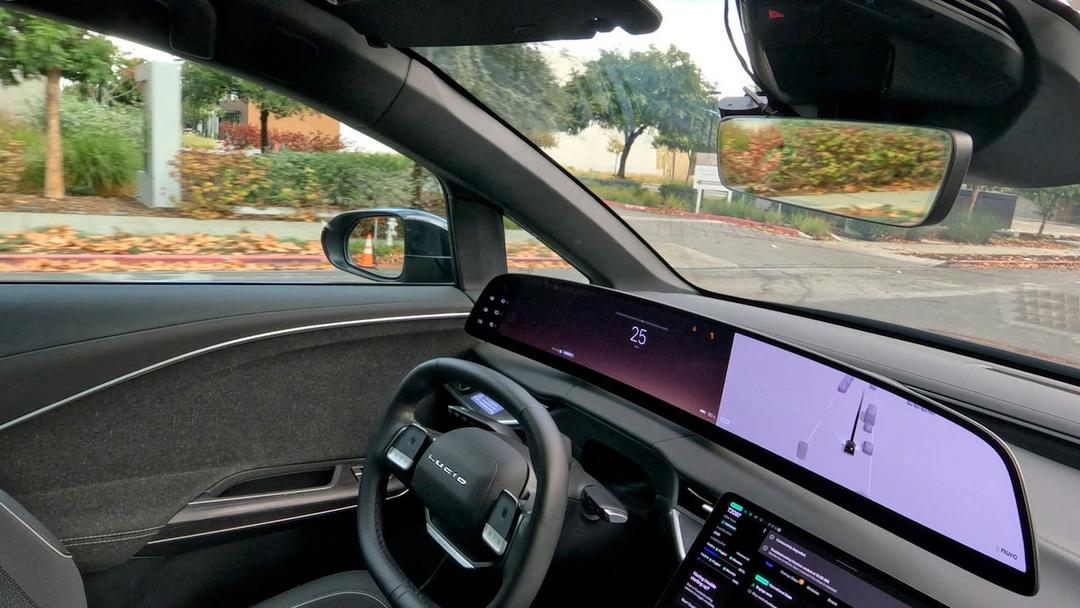
Inside: screens show riders the route and what the car detects around it. Riders get trip time, climate and music controls, plus buttons to call support or ask the car to pull over.
The view from inside a Gravity robotaxi with the Nuro Driver. The dashboard shows what the car sees around it. Photo: Nuro
Advertisement
How to Ride a Lucid Robotaxi on Uber When It Launches
There is no separate app. The robotaxis will be available only through the Uber app, owned and operated by Uber and its fleet partners. Uber is designing the in-cabin experience, including personalization, support and rider controls, while Nuro supplies the visualization of what the car sees.
Have the Uber app and be in the service area once it opens in Q1 2027. The first area hasn't been announced; testing is in Palo Alto, Mountain View, Los Altos and Sunnyvale.
Request a ride in the app as usual. Uber hasn't said which ride types will be matched to a Gravity or what fares will cost.
Find your car by the halo's LED lights and greeting screen.
Use the rear screens to follow the trip, change climate or music, reach support or ask the car to pull over.
Uber has also said it plans to take over remote assistance and monitoring once the service opens to the public, according to an interview with Nuro co-CEO Dave Ferguson cited by Transport Topics.
Nuro/Uber vs Waymo vs Tesla Robotaxi in the Bay Area
Nuro + Lucid + Uber
Waymo
Tesla
Status
Driverless testing; employee rides soon
Paid, fully driverless public service
Ride-hailing with a human safety driver
Public launch
Expected Q1 2027
Already running
Already running (with driver)
Area
Palo Alto, Mountain View, Los Altos, Sunnyvale (testing)
San Francisco, Peninsula and South Bay including San Jose; about 350 sq mi
Bay Area, with driver
Vehicle
Lucid Gravity SUV
Jaguar I-Pace
Tesla Model Y
Sensors
Cameras, lidar, radar, roof halo
Cameras, lidar, radar
Cameras only
DMV driverless testing permit
Yes
Yes
No (with-driver testing only)
How to book
Uber app only
Waymo app
Tesla Robotaxi app
Sources: Nuro/Lucid/Uber release, California DMV permit list (Nov. 5, 2026), Waymo via KALW, Electrek.
Waymo is far ahead. It runs about 4,000 robotaxis across more than a dozen US metro areas and expanded its South Bay map on November 3. It has hit bumps, though: the California DMV recently barred its driverless freeway operations after cars entered construction zones, and Waymo paused freeway rides nationwide. It also paused Bay Area service on November 23 because of weather.
Tesla's Bay Area service still has a person in the driver's seat. Zoox, the other driverless player, offers free rides to select riders in San Francisco but can't charge fares there yet.
Advertisement
What's Next: Houston, Midsize Lucids and 35,000 Cars
Houston: named in June as the second market, targeted for mid-2027. A test fleet is already running there with safety operators.
Fleet size: the deal started in July 2025 at 20,000 Gravity SUVs over six years. It has grown to at least 35,000 Lucid vehicles, adding Lucid's future midsize models.
Money: Uber agreed in April to invest another $200 million in Lucid, bringing its total commitment to $500 million.
Scale: the partners plan to expand to "dozens" of markets worldwide over the coming years.
For Lucid, which delivered 3,806 vehicles in the third quarter, a 35,000-unit fleet order is a big deal. It is a steady buyer at a time when the company is cutting costs and burning cash.
"As we prepare for our first driverless passenger rides in the coming months, we'll be working closely together to refine our operations, infrastructure, and the in-cabin experience to ensure a safer, more comfortable ride." — Samarth Kejriwal, Global Head of Autonomous Mobility, Uber
What It Means for Bay Area Riders
If you live or work around Palo Alto, Mountain View, Los Altos or Sunnyvale, expect to see empty-seat Gravity SUVs with a teal-trimmed halo on local streets. You won't be able to hail one until 2027, and you'll do it through Uber, not a new app. Pricing, ride types and the first public service area are still unannounced.
The Gravity's biggest selling point for riders is space. It is a larger, three-row SUV with more room than Waymo's Jaguar I-Pace, and Uber is pitching it as a premium ride.
The bottom line: Nuro, Lucid and Uber cleared a real hurdle by pulling the safety driver in four Bay Area cities, and they hold a permit Tesla doesn't. But the public launch has already slipped from 2026 to Q1 2027, the fleet is about 100 cars, and Waymo is years ahead with paid driverless rides across 350 square miles of the Bay Area.