August 9, 2026·5 min read·By Learn My EV

Ford's $28,350 Electric Truck Has a Name: Meet the Fathom

Ford has revealed the name, starting price, and headline specs of its long-teased affordable electric truck: the Fathom, starting at $28,350. It's the first vehicle built on Ford's new Universal EV Platform — but Ford still isn't showing what it actually looks like.

Ford's $28,350 Electric Truck Has a Name: Meet the Fathom

After years of teasers, spy shots, and a skunkworks project run in near-total secrecy, Ford's affordable electric truck finally has a name: Fathom. On August 6, 2026, Ford announced the truck will start at $28,350 for a standard-range model, undercutting the $30,000 target the company has been chasing publicly since 2025. Add the $1,595 destination fee and the real starting price lands at $29,945.

$28,350
Starting MSRP, standard-range battery
5
Seats, plus a frunk and a bed
2027
Preorders open early, deliveries begin fall

Ford Still Hasn't Shown What It Looks Like

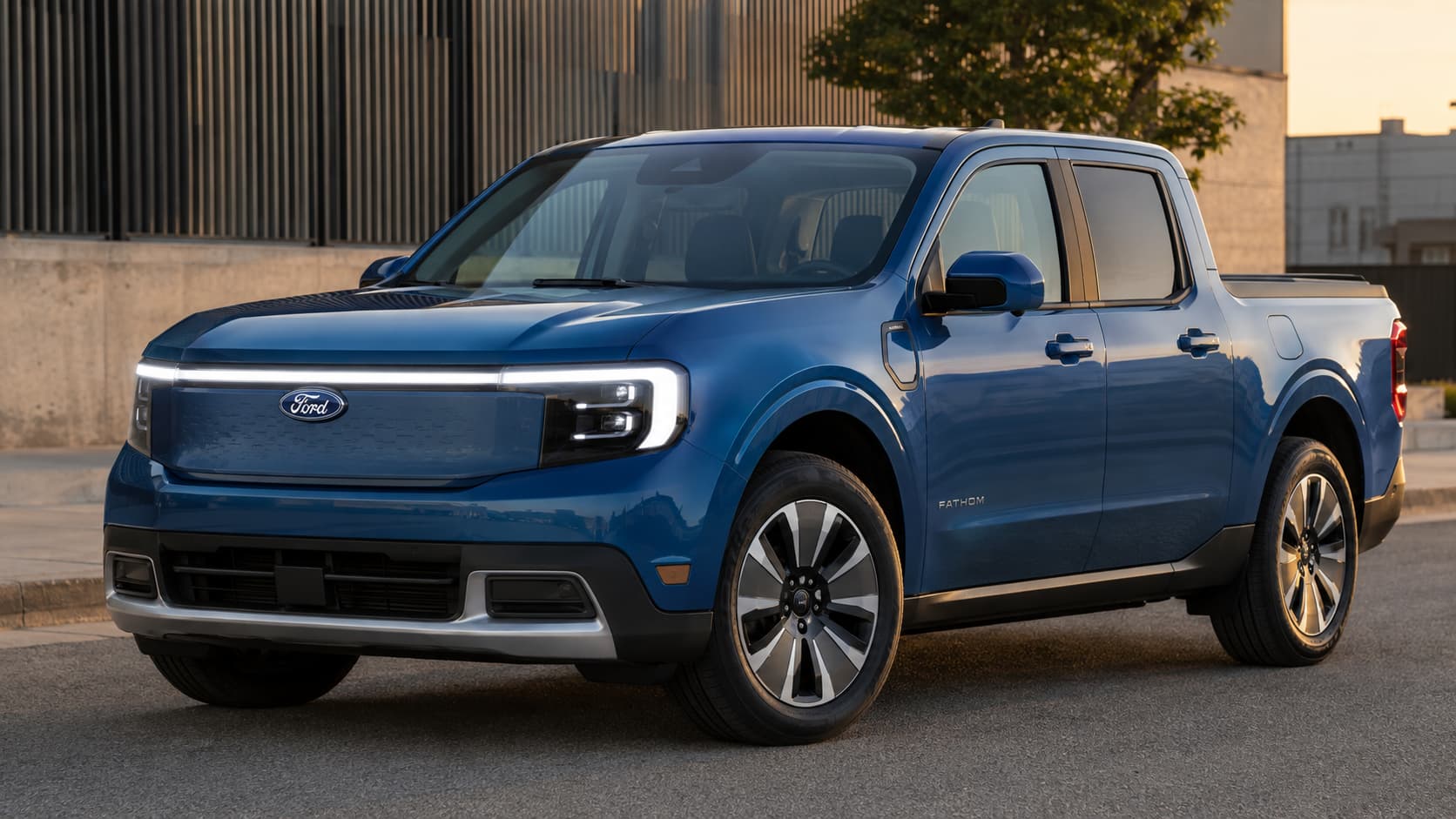
Here's the catch behind all the specs Ford has released: the company has not revealed the Fathom's actual exterior design. What Ford put out on August 6 was an animated teaser video and a name, not real photos. Several outlets have since published renderings based on spy shots and camouflaged prototypes seen testing near Ford facilities, and some of those speculative images have been circulating widely — but they are not official. Ford says the real reveal, including what the truck actually looks like, won't happen until early 2027, timed to when preorders open.

Worth knowing before you look at any "Fathom" photo
  • Any exterior image dated before early 2027 is a rendering or artist's interpretation, not an official Ford photo
  • Renderings are based on spy shots of camouflaged test vehicles, not confirmed final styling
  • Ford has confirmed the name, pricing, platform, and tech features — not the design

What Ford Has Actually Confirmed

The Fathom will seat five adults with more passenger volume than a Toyota RAV4, on top of both a front trunk and a rear bed. Every truck comes standard with a large, high-resolution touchscreen running embedded Apple Maps, a digital key, bidirectional power capability similar to the F-150 Lightning, and hardware for Ford's BlueCruise hands-free highway driving system. Apple CarPlay and Android Auto are both supported — though notably, Ford says the Fathom won't support Apple's newer CarPlay Ultra.

Confirmed so far
  • Starting MSRP: $28,350 (standard-range battery), $29,945 with destination
  • Seats 5, plus front trunk and bed
  • Standard: BlueCruise-capable, bidirectional (V2H) charging, digital key, embedded Apple Maps
  • LFP battery cells built at Ford's BlueOval Battery Park in Marshall, Michigan, using CATL-licensed technology
  • Extended-range variants expected around 300 miles, despite using roughly a third fewer cells than Ford's first-generation EVs
  • Built in Louisville, Kentucky, on a $2 billion investment in the Louisville Assembly Plant

Ford hasn't published an official range number for the entry-level standard-range trim that carries the $28,350 price — only that extended-range versions are targeting around 300 miles. BlueCruise on the Fathom is also getting a upgrade: Ford says a newer, more powerful version will eventually handle supervised driving from start to destination, with fully eyes-off driving targeted for 2028.

The Engineering Bet: Universal EV Platform

The Fathom is the first vehicle built on Ford's new Universal Electric Vehicle (UEV) architecture, a platform designed from a blank sheet for electric powertrains rather than adapted from a gas truck. Large aluminum unicastings cut 27% of weight compared to rival construction methods while reducing parts count by 20%, fasteners by 25%, and factory workstations by 40%. The truck also runs a 48-volt electrical architecture, with a wiring harness that's roughly 4,000 feet shorter and 22 pounds lighter than the harnesses in Ford's first-generation EVs like the Mustang Mach-E and F-150 Lightning.

Production leans just as hard into new manufacturing methods. Ford's $2 billion Louisville Assembly Plant investment replaces the traditional single-file assembly line with a parallel, "tree-shaped" layout meant to build the Fathom faster and cheaper than a conventional line allows.

The Backstory: A Skunkworks Team Racing the Clock

The Fathom traces back to a secretive internal team CEO Jim Farley formed in 2022, led by former Tesla executive Alan Clarke and based in Los Angeles, deliberately isolated from the rest of Ford's corporate structure. The team has since pulled in talent from Rivian, Tesla, and Apple's disbanded car project. Ford reportedly spent nine months just settling on the name, moving from "the span of outstretched arms" to a nautical term for measuring water depth to a metaphor for understanding customers deeply — landing on Fathom.

Sub-$30K electric trucksStarting price (with destination)
Slate Auto pickup$26,400
Ford Fathom$29,945

That table is short because it's basically the whole competitive set. Below $30,000, the Fathom's only real rival is the Jeff Bezos-backed Slate Auto truck, a deliberately bare-bones pickup with crank windows and no speakers. Everything else in that price range is a compact gas-powered vehicle — the average new car in the US costs roughly $50,000, which is the gap Ford is trying to close.

Why Ford Is Betting on a Truck First

Electric trucks haven't had an easy run in the US. The F-150 Lightning — Ford's first all-electric truck, not counting a limited-run Ranger EV from the late 1990s — sold a little over 10,000 units in its best quarter. The Cybertruck hit a higher peak but has since fallen off sharply. Choosing the truck body style for the UEV platform's debut is a real gamble, but Ford is leaning on the success of the gas-and-hybrid Maverick, its top-selling small truck, as evidence that affordable, right-sized trucks still have real demand — just not at Lightning-level prices.

The bottom line: Ford has now confirmed the Fathom's name, price, platform, and headline tech — enough to know this is a serious, close-to-real product, not just a concept exercise. What's still missing is the one thing most people actually want to see: what it looks like. Until Ford's own reveal in early 2027, treat any exterior photo you come across as a guess, not the real thing.