November 4, 2026·6 min read·By Learn My EV

EVgo Gets $2-a-Share Take-Private Offer From LS Power: What It Means for Drivers and Investors

EVgo's controlling shareholder LS Power has offered $2.00 a share in cash to take the fast-charging network private, a 59% premium. Here's what the EVgo take-private offer means for chargers, drivers, the GM partnership and the stock.

EVgo Gets $2-a-Share Take-Private Offer From LS Power: What It Means for Drivers and Investors

Photo: Meijer

EVgo, one of the biggest public fast-charging networks in the United States, may soon stop being a public company. Its controlling shareholder, the private equity firm LS Power, has offered $2.00 a share in cash to buy every EVgo share it does not already own and take the charging company private.

The proposal, disclosed by EVgo on Monday, November 2, is unsolicited and non-binding. EVgo's board has set up a special committee of independent directors to review it, and the company says no decision has been made. The stock had its best day in two years on the news. Here is what the EVgo take-private offer means for shareholders, and for the drivers who plug in at EVgo stations every day.

$2.00
Cash per share offered by LS Power
59%
Premium to EVgo's Oct. 30 closing price
~56%
EVgo voting power LS Power already holds
5,380
EVgo stalls in operation (June 30, 2026)

What Is LS Power Offering for EVgo?

The terms come straight from LS Power's November 2 letter to EVgo's board, which EVgo filed with the Securities and Exchange Commission as part of a Form 8-K.

DetailProposal terms
BuyerLS Power Equity Advisors, LLC and affiliates
Price$2.00 per share, all cash
Shares soughtAll EVgo Class A shares LS Power does not own
Premium59% to the Oct. 30 close; 62% to the 30-day average price
LS Power's current holdingAbout 178 million shares, roughly 56% of voting securities
Planned structureLong-form merger, not a tender offer
Key conditionMust be recommended by an independent special committee
StatusNon-binding; can be withdrawn or changed at any time

LS Power said it chose a long-form merger because it gives public shareholders the fullest disclosure and the right to seek appraisal, a court process to challenge the price. It also made clear that it is a buyer, not a seller. The letter says LS Power has "no interest in a disposition or sale of our holdings" and no interest in an alternative change-of-control deal. In plain terms, a rival bidder would have a hard time getting control of EVgo without LS Power's cooperation.

"We believe that time is of the essence and are prepared to move immediately to negotiate and finalize a transaction with the special committee." — David Nanus, President, LS Power Equity Advisors, in the proposal letter

Who Is LS Power, and Why Does It Already Control EVgo?

LS Power is a New York-based investor in power generation and energy infrastructure. It bought EVgo in early 2020 from Vision Ridge Partners, which had acquired the network in 2016 from NRG Energy. EVgo itself began in 2010 as part of a settlement between NRG and California regulators.

LS Power took EVgo public through a merger with a special purpose acquisition company, and EVgo shares began trading on Nasdaq on July 2, 2021. LS Power kept a controlling stake through the listing and still holds about 56% of the vote. That is why this is a "take-private" proposal rather than a takeover: LS Power is offering to buy out the minority shareholders and own the business outright.

How Did EVgo Stock React?

EVgo shares jumped about 47% on November 2, the stock's best single-day gain since October 2024, according to Yahoo Finance. Intraday trading put the shares around $1.85 to $1.87, still below the $2.00 offer. That gap is normal for a non-binding bid and reflects the chance that no deal gets done. Before the news, EVgo was down roughly 35% for the year.

Other charging stocks moved in sympathy. ChargePoint rose about 10% and Blink Charging about 7% in early trading, according to 24/7 Wall St.

For drivers: does anything change at EVgo stations? Not now. EVgo says shareholders do not need to take any action, and nothing in the proposal affects day-to-day charging. Stations, the EVgo app, accounts and pricing plans keep running as before. Even if a deal closes, the network, its partners and its contracts would continue under private ownership. The main visible change would be that EVgo stops reporting quarterly results to the public.

Advertisement

How Big Is the EVgo Charging Network?

EVgo says it has more than 1,200 fast-charging locations across 47 states. Its most recent stall count comes from its second-quarter 2026 results:

EVgo stalls in operationJune 30, 2026June 30, 2025
Public network3,9303,480
Autonomous-vehicle fleet network120110
EVgo eXtend (partner-owned, EVgo-run)1,330760
Total5,3804,350

EVgo also reported more than 1.8 million customer accounts and 240 Tesla-style NACS (J3400) connectors in service as of July 31. In the same quarter it signed an agreement with Tesla to build EVgo-owned, EVgo-branded V4 Superchargers starting in 2026, with up to 20 stalls per site. Those stations are set to appear in Tesla's in-car navigation and Trip Planner.

The Money Problem Behind the Offer

EVgo's charging business is growing, but the company is still losing money. In the second quarter of 2026:

  • Charging network revenue rose 19% year over year to $61 million.
  • Total revenue fell 16% to $82.6 million, as non-charging revenue dropped.
  • Net loss widened to $46.3 million from $29.8 million a year earlier.
  • Average use slipped to 276 kilowatt-hours per stall per day, from 281.

EVgo's guidance for full-year 2026 calls for $400 million to $430 million in revenue and 1,350 to 1,625 new stalls. Its federal financing has also shrunk. EVgo closed a $1.25 billion loan facility guaranteed by the U.S. Department of Energy in December 2024. In April 2026, that facility was amended down to a maximum of $750 million.

Taken together, those numbers help explain the bid. A low share price, steady losses and heavy building costs make a public listing expensive to maintain. As a private company, EVgo would answer to one owner with deep pockets in energy infrastructure. Neither LS Power nor EVgo has given a reason for the timing, and EVgo has said it will not comment further unless it deems disclosure appropriate.

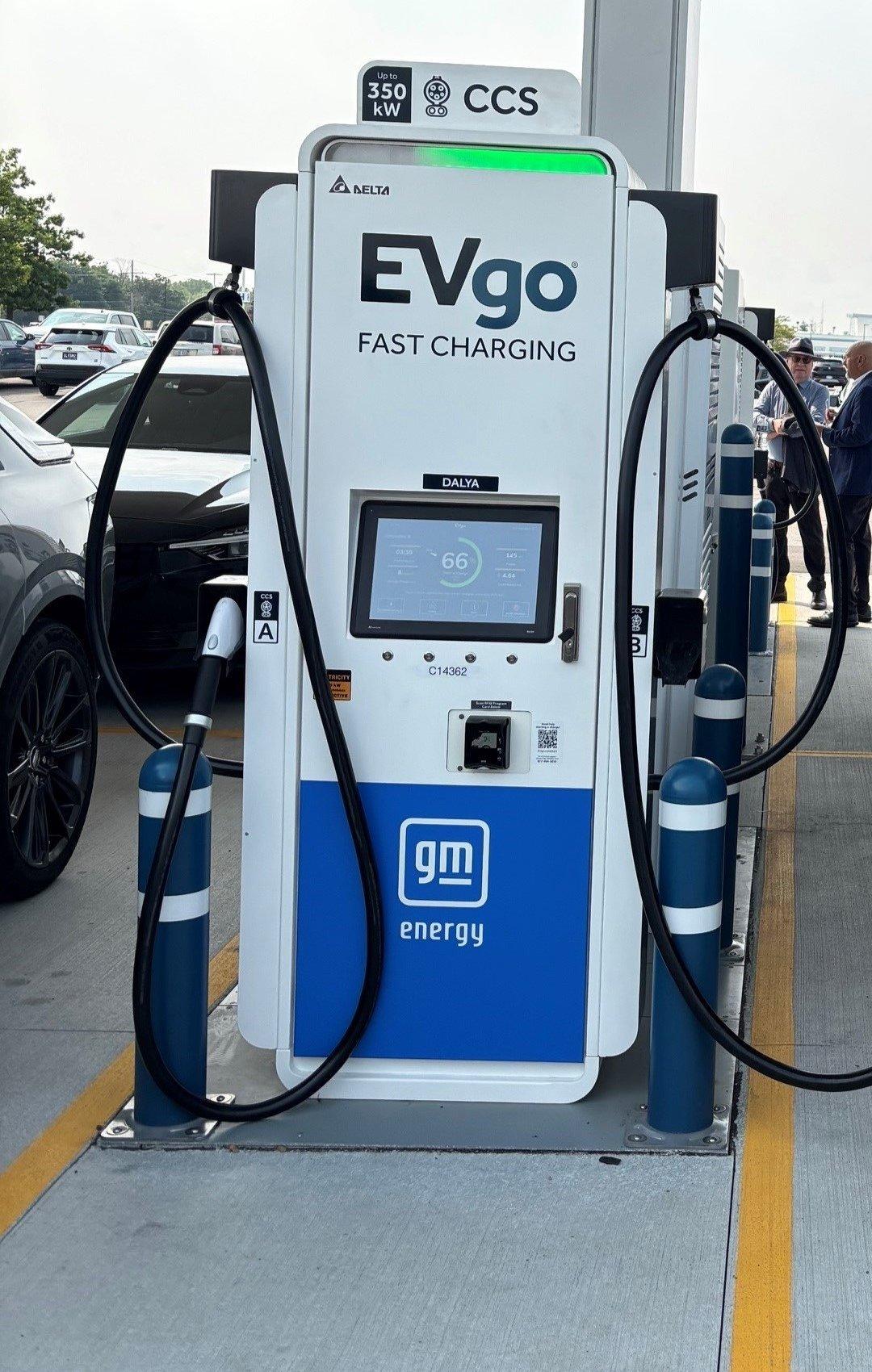
EVgo 350 kW DC fast charger with GM Energy branding at the EVgo flagship station in Warren, Michigan
An EVgo charger rated up to 350 kW at the GM-backed flagship station at the Meijer store in Warren, Michigan. Photo: Meijer
Advertisement

What Happens to the EVgo and GM Partnership?

General Motors is EVgo's most important automaker partner, and nothing in the proposal changes that. According to EVgo, it has built nearly 2,400 stalls across 32 states with GM's support. A separate highway network built with GM and Pilot Company has passed 1,300 stalls at 300 locations in 40 states.

The two companies are now adding large "flagship" sites averaging up to 20 stalls each. In August, EVgo opened one at the Meijer store in Warren, Michigan, across the street from GM's Global Technical Center. It has 12 stalls with a mix of CCS and NACS connectors, chargers rated at 350 kW, and pull-through bays for drivers towing trailers. EVgo said more than 40 flagship stalls were open at the time and that it expects more than 100 by the end of 2026, in states including California, Florida, Georgia, Illinois, Michigan and Texas.

What Happens Next?

  • The special committee of independent directors can hire its own legal and financial advisors. It may accept, reject or negotiate the price.
  • LS Power says it will not proceed unless the committee recommends the deal to the full board.
  • There is no guarantee of a definitive agreement. EVgo says the deal may not be completed on these terms, or at all.
  • If a deal closes, EVgo shares would be delisted from Nasdaq and public holders would be paid in cash.
  • Watch November 9: EVgo is scheduled to report third-quarter 2026 results that day.

The bottom line: LS Power already controls EVgo, and its $2.00-a-share offer would let it own the fast-charging network outright at a 59% premium to the pre-announcement price. For drivers, nothing changes at the plug today: stations, the app and the GM and Tesla partnerships carry on. For shareholders, the decision now sits with an independent committee, and because LS Power has said it will not sell, the real question is whether $2.00 is the final price. We will update this story as the committee responds.

Related: Walmart's EV charging network hits 100 stores · How much does it cost to charge an electric car? · Level 1 vs Level 2 vs DC fast charging