November 7, 2026·6 min read·By Learn My EV

BYD Yangwang U9 Xtreme Hits 312 MPH (503 km/h), First Production Car Over 500 km/h

The BYD Yangwang U9 Xtreme hit 503.17 km/h (312.66 mph) in Abu Dhabi, the first production car past 500 km/h, days after a 280 mph test crash. Driver, location, the one-way asterisk, and how it beats Bugatti and Koenigsegg.

BYD Yangwang U9 Xtreme Hits 312 MPH (503 km/h), First Production Car Over 500 km/h

Photo: Yangwang / BYD

For a century, 500 km/h was the number no production car could reach. Now an electric one has. BYD's Yangwang U9 Xtreme hit 503.17 km/h (312.66 mph) on a closed desert highway in Abu Dhabi, making it the first production car to top 500 km/h. Guinness World Records and the FIA, motorsport's world governing body, have both recognized the speed.

The run came on November 1, only days after BYD released video of a U9 Xtreme slamming into a guardrail at close to 280 mph during an earlier test. BYD announced the record on November 6. Here is how fast it went, where, who drove, and how it stacks up against Bugatti, Koenigsegg and Rimac.

312.66 mph
Top speed (503.17 km/h), one-way run
+6.95 km/h
Faster than its own 2025 record
3,019 PS
Output from four electric motors (about 2,977 hp)
30
Cars BYD will build

Where and How the Yangwang U9 Xtreme Hit 312 MPH

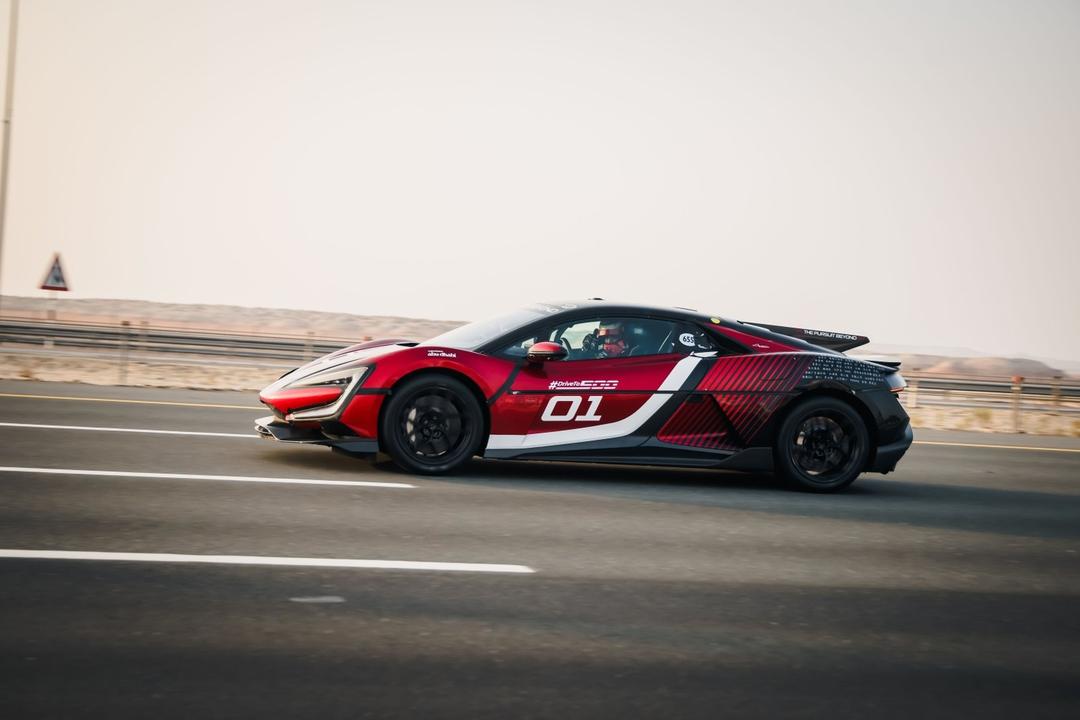
The record run took place on Sheikh Khalifa Bin Zayed International Road (E11) in Abu Dhabi's Al Dhafra Region. Local authorities closed 10 km (6.2 miles) of the highway, leaving a 7 km (4.3-mile) straight for top-speed runs. The driver was Marc Basseng, the German sports car and endurance racer who set the U9 Xtreme's previous record in Germany last year.

The attempt took four runs over two days, according to BYD:

  1. October 31: two runs, topping out at 490 km/h (304 mph).
  2. Overnight: engineers increased the rear-wing angle for more rear downforce, raised rebound damping to deal with small dips in the road, adjusted tire pressures and changed how the battery and motors were brought to temperature before each run.
  3. November 1: two more runs. The second reached 503.17 km/h.

Because the E11 normally carries everyday traffic near the desert, crews swept the road before the runs. BYD says they then checked the route again for loose wire bristles left by the cleaning brushes, which could have damaged the tires at that speed.

"Breaking a world record once is extraordinary but doing it again in such a different environment is truly special."

Marc Basseng, record driver, in BYD's announcement

Is It an Official Record? The One-Way Asterisk

Yes, with a qualifier. The two Guinness titles are for the highest speed by a production car and the highest speed by an electric production car, both "in a single-direction run." BYD also says the FIA recognized the speed, and InsideEVs reports the run was measured with a Racelogic data logger.

The traditional standard for a top-speed record is the average of two runs in opposite directions within an hour, which cancels out wind and slope. The U9 Xtreme's figure is a one-way peak, so it is not directly comparable with a two-way average. BYD's post on X claimed four Guinness records, while the FIA listing shows two, Electrek noted. None of that changes the basic fact: no production car has gone faster in any direction.

Advertisement

U9 Xtreme vs. Bugatti, Koenigsegg and Rimac

CarTop speedYearMethod
Yangwang U9 Xtreme (EV)503.17 km/h (312.66 mph)2026One-way, E11 highway, Abu Dhabi
Yangwang U9 Xtreme (EV)496.22 km/h (308.3 mph)2025One-way, ATP Papenburg, Germany
Bugatti Chiron Super Sport 300+ (gas)490.48 km/h (304.77 mph)2019One-way, pre-production car
Koenigsegg Agera RS (gas)447.19 km/h (277.87 mph)2017Two-way average, Nevada
Rimac Nevera R (EV)431.45 km/h (268.1 mph)2025Top speed, verified by Dewesoft

The comparison most people will make is with Bugatti. The Chiron Super Sport 300+ became the first car to pass 300 mph in 2019, but that was a single run in a pre-production car, and Bugatti itself did not call it an official record. The U9 Xtreme first passed it in September 2025 with 496.22 km/h and has now extended the gap to about 8 mph.

Koenigsegg's Agera RS still holds the best two-way average for a production car, set on a closed Nevada highway in 2017. Koenigsegg says its Jesko Absolut could theoretically exceed 500 km/h, but it has never tried. Among EVs, the Rimac Nevera R's 431.45 km/h is the closest rival, and it is more than 70 km/h behind.

BYD Yangwang U9 Xtreme electric hypercar driven by Marc Basseng on Abu Dhabi E11 road during 503 km/h speed record
Marc Basseng at the wheel of the U9 Xtreme on the closed E11 highway in Abu Dhabi's Al Dhafra Region. Photo: Yangwang / BYD

Days After a 280 MPH Test Crash

The record follows a scary setback. Earlier this month BYD released footage of a U9 Xtreme that went off line during a run meant to pass 450 km/h (about 280 mph), hit the guardrail and spun several times. The front and rear of the car were torn apart, but the carbon-fiber passenger cell held, and BYD said the driver had no serious injuries. BYD later returned to the track with another car and reached 457.89 km/h. BYD has not said where that crash happened. Read our full report: BYD Yangwang U9 Xtreme crashes on 280 mph test run; driver unharmed.

Advertisement

Yangwang U9 Xtreme Specs and Price

Yangwang U9 Xtreme at a glance
  • Four electric motors, 555 kW (755 PS) each, spinning to 30,000 rpm
  • 3,019 PS total (about 2,977 hp), 1,217 PS per tonne
  • 1,200-volt platform, up from 800 volts in the regular U9
  • LFP Blade Battery rated for 30C discharge; 1,800 kW still available at 20% charge
  • DiSus-X active suspension; Giti semi-slick tires developed for the car
  • Nürburgring Nordschleife lap: 6:59.157, the production EV record
  • Price: more than 20 million yuan (roughly $2.8 million) for a car sold in April 2026

BYD will build no more than 30 U9 Xtremes. The price figure comes from a car sold at the Beijing Auto Show in April, as reported by CarNewsChina; the dollar figure is an approximate conversion. BYD does not sell passenger cars in the United States, so American buyers cannot order one.

Three Years From 309 km/h to 503 km/h

  • January 2024: the regular U9 reaches 309 km/h at Wuhan Hannan Airport, China.
  • October 2024: the U9 hits 391.94 km/h at ATP Papenburg, Germany.
  • August 2025: the U9 Xtreme debuts at Papenburg with 472.41 km/h.
  • September 2025: 496.22 km/h, passing the Bugatti.
  • November 1, 2026: 503.17 km/h in Abu Dhabi.

BYD executive vice president Stella Li credited the engineering team: "I always tell people that our engineers are young, bold and maybe a little crazy – but in a good way!"

Why it matters beyond bragging rights: The U9 Xtreme runs on lithium iron phosphate cells, the same low-cost chemistry BYD uses in its mainstream cars. LFP was long seen as too weak for high-performance use. Sustaining roughly 3,000 PS and 30C discharge from LFP cells shows how far that chemistry has come.

The bottom line: The BYD Yangwang U9 Xtreme reached 503.17 km/h (312.66 mph) on November 1, 2026, the first production car past 500 km/h, recognized by Guinness and the FIA. It was a one-way run, not a two-way average, so purists will add an asterisk. But coming days after a high-speed crash, it is a clear signal that the fastest production car in the world is now electric and Chinese.

Related: Yangwang U9 Xtreme 280 mph test crash · Tesla Roadster unveiled with 0.81-second 0-60 claim · BYD October 2026 sales