Tesla Robotaxi Laser Windshield: Lars Moravy Hints at Lasers to Keep Cameras Clear in Rain
Tesla engineering VP Lars Moravy says focused lasers could clear water from the glass in front of a Robotaxi's cameras. Here's what he said, the Tesla patent behind it, and how Tesla and Waymo clean sensors today.
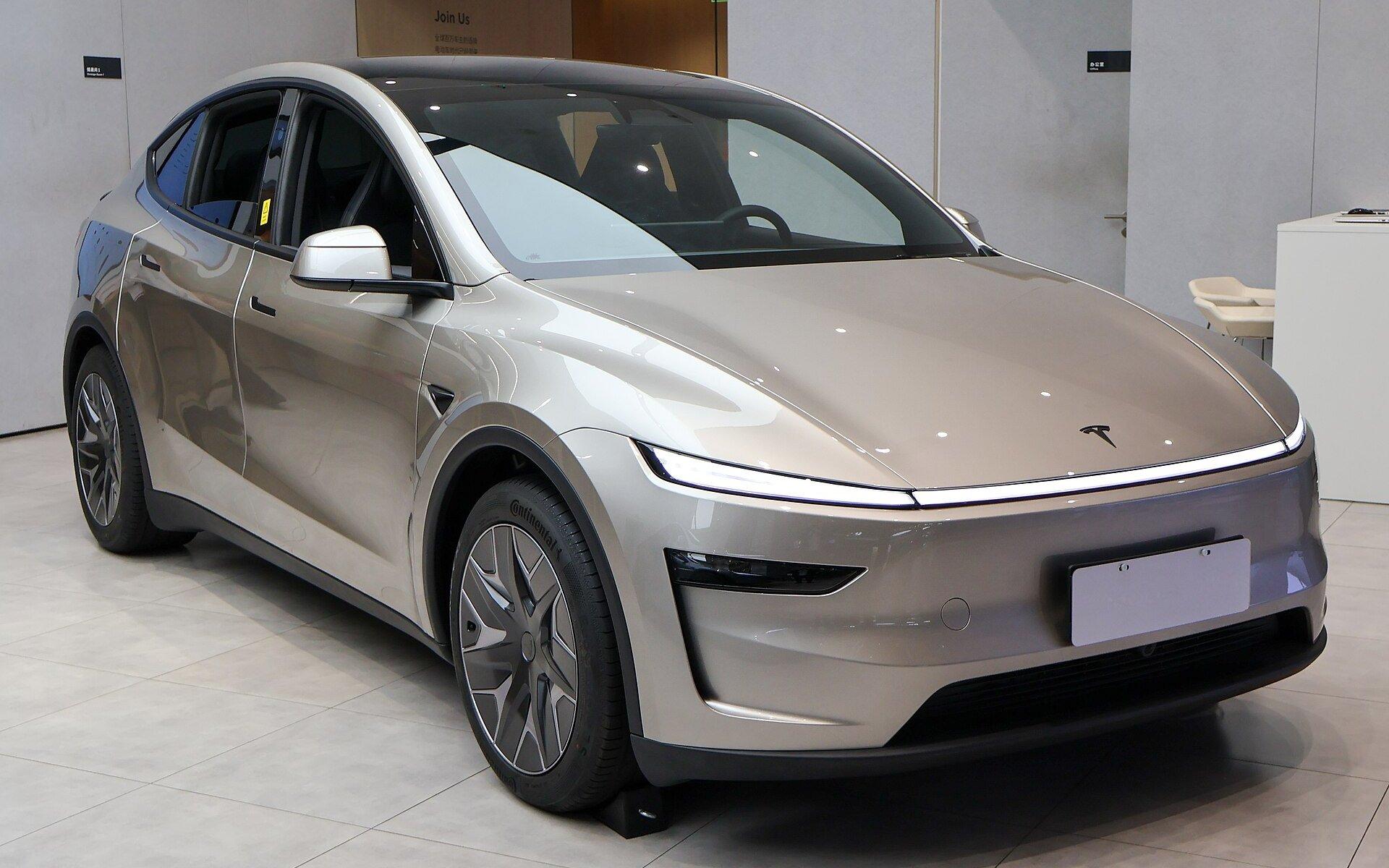
Photo: Jonathan Schilling / Wikimedia Commons (CC BY-SA 4.0)
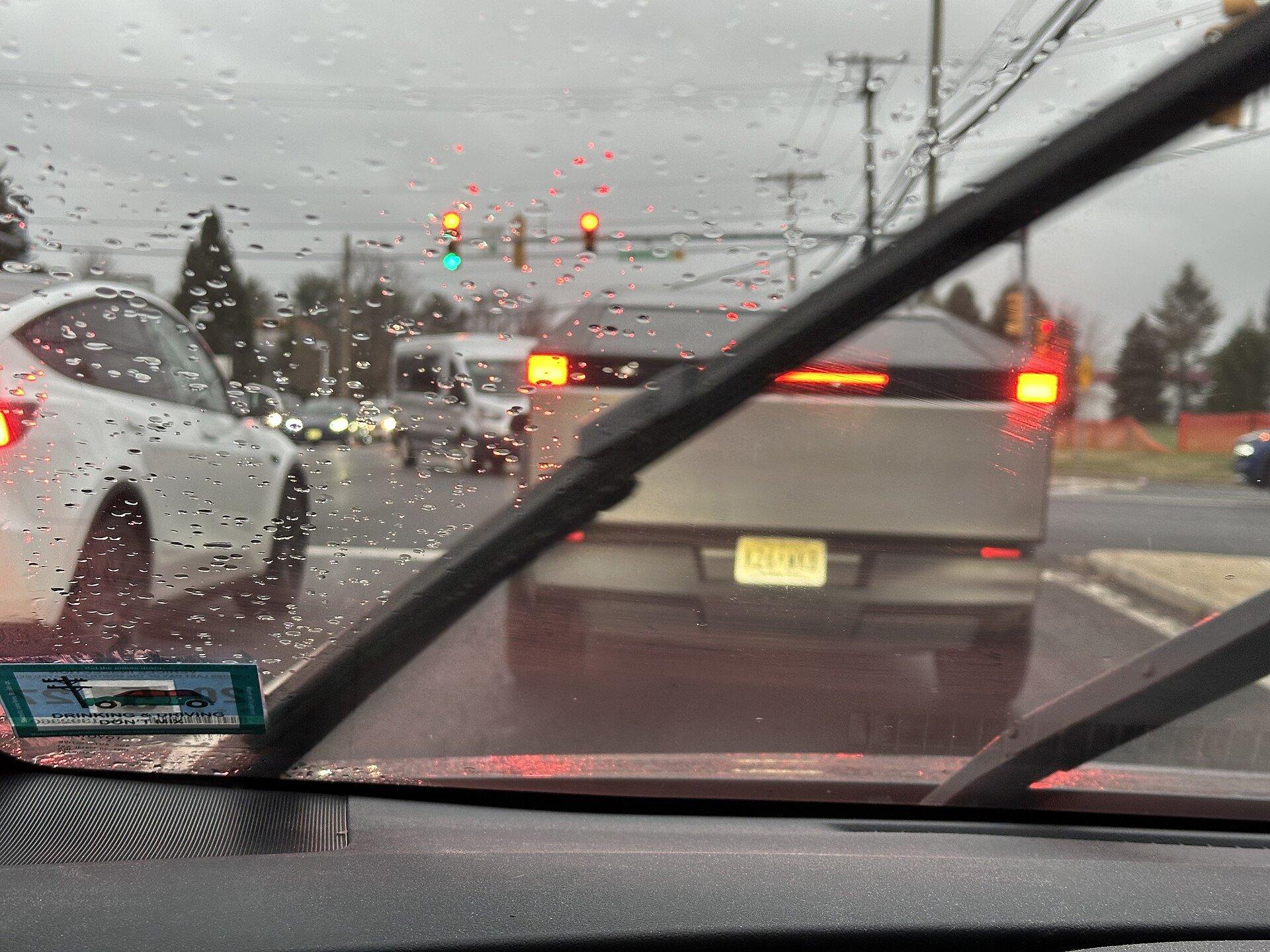
Every driver knows the moment: the rain comes down harder than the wipers can handle, and for a second or two you are driving half blind. A human leans forward, slows down and gets through it. A car with no driver has no such instinct. If its cameras cannot see, it has to stop.
That is the problem Tesla vice president of vehicle engineering Lars Moravy was talking about this week when he floated an idea that sounds like science fiction but has been sitting in Tesla's patent file for seven years: using lasers to clear water off the glass in front of a Robotaxi's cameras. He did not announce a product. But he did say, on camera, that Tesla is thinking about it, and the company's patents show it has been thinking about it for a long time.
2018
Priority date of Tesla's laser-cleaning patent family
11,110,896
Original US patent number, granted Sept. 7, 2021
12,589,715
Divisional patent, granted March 31, 2026
0
Timelines or production commitments from Tesla
What Lars Moravy Actually Said
Moravy made the comments in an episode of Jay Leno's Garage released Monday, November 9, in which he and Tesla design chief Franz von Holzhausen walked Leno through the Model Y L. According to Teslarati's account of the episode, Moravy described firing lasers at a small patch of glass rather than the whole windshield:
"If you fire them in a focused area, you can clean the sheet of water and create a barrier."
"When you think about autonomy, it might be a good solution to only clean the area where the camera is."
He also said that clearing an entire windshield would take too many lasers to make sense. Not a Tesla App, which pointed readers to the segment at about the 14:14 mark of the video, summarized it the same way: a full-windshield laser system is impractical, but a small one aimed only at the camera zone could make sense for a self-driving car.
That distinction matters. A person needs the whole glass clear. A Robotaxi needs only the few inches in front of its forward cameras.
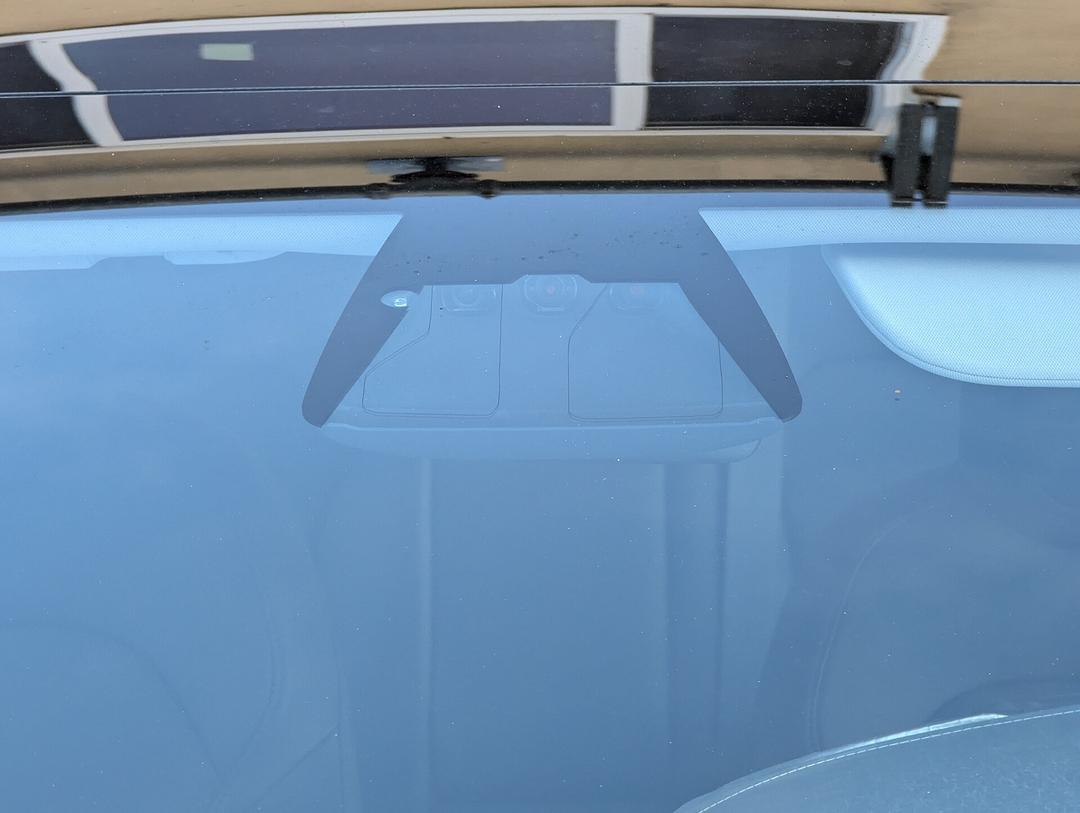
Tesla's forward cameras sit in a small housing at the top of the windshield. That patch of glass is the area Moravy suggested a laser could keep clear. Photo: Mliu92 / Wikimedia Commons (CC BY-SA 4.0)
The Patent Behind the Idea
Tesla filed the original application, titled "Pulsed laser cleaning of debris accumulated on glass articles in vehicles and photovoltaic assemblies," on May 10, 2019, claiming a provisional filing from May 16, 2018. The U.S. Patent and Trademark Office granted it on September 7, 2021, as US 11,110,896 B2. The listed inventor is Phiroze Dalal.
A divisional application, filed September 2, 2021, was granted on March 31, 2026, as US 12,589,715 B2. In plain terms, the patent describes three parts working together:
A beam optics assembly that aims a laser at a region of glass.
Debris detection circuitry that senses what has built up on that region. The newer patent lists a dash camera, rear-view camera or surround-view camera among the possible sensors.
Control circuitry that tunes the laser for the debris it finds and pulses it at a calibrated rate, so the beam penetrates less deeply than the thickness of the glass. The goal is to remove the grime without damaging the windshield.
The filings name windshields, side windows, camera lenses and solar panels as possible targets. The documents also warn that a laser could damage a camera's image sensor. A patent is a legal claim on an idea, not proof that a working, road-ready product exists.
Advertisement
How Tesla Keeps Its Cameras Clean Today
Tesla's consumer cars rely on conventional windshield wipers to keep the forward camera area clear, and the vehicles warn the driver when a camera view is blocked. With supervised Full Self-Driving, that warning is enough, because a person can pull over and wipe the glass. A car with no one inside cannot.
That is why Tesla has quietly added hardware to its driverless fleet:
Vehicle
Camera cleaning reported
Consumer Model Y
Windshield wipers for the forward cameras; no washers on the outside cameras reported as standard
Model Y Robotaxi (spotted January 2026, Austin)
Washer jets for the rear camera and the side repeater cameras
Cybercab
Active cleaners reported for all exterior cameras, including the front cameras under the windshield
Not a Tesla App reported in January that the Cybercab has an active cleaner on every camera except the cabin camera. Carscoops reported the rear and repeater washers on newly built Austin Robotaxis around the same time. Teslarati also notes a Tesla lens-cleaning patent granted in May 2026 that describes a fluid-and-wiper assembly for vehicle cameras.
Advertisement
Why Weather Is Robotaxi's Biggest Test
Tesla's self-driving system runs on cameras alone, with no lidar or radar to fall back on. That keeps hardware costs down, but it means anything that blocks a lens, whether a sheet of rain, road spray, ice or a splattered bug, blocks the car's view of the road.
The problem is not theoretical. Federal regulators opened an investigation in October 2024 into roughly 2.4 million Tesla vehicles after four crashes in "reduced roadway visibility" conditions such as sun glare, fog and airborne dust, one of which killed a pedestrian. In May 2025, before the Austin launch, NHTSA asked Tesla how its Robotaxis would handle poor visibility and whether they would pull over or cancel rides mid-trip. Early riders reported trips ending as storms rolled in, and Electrek reported in February 2026 that the Austin service shut down when it rained.
The weather problem also grows as the map grows. Tesla's newest launch and its larger Austin map, covered in our San Antonio Robotaxi report, put more driverless cars on Texas roads that see sudden, heavy downpours, and Tesla also operates in rain-prone Houston, Miami and Tampa. If a Robotaxi has to stop every time the camera glass fogs or floods, wait times stretch, a tradeoff riders can already see in the Robotaxi app's fare and wait-time estimates.
How Waymo Handles the Same Problem
Waymo, Tesla's main driverless rival, uses lidar and radar alongside cameras, but its sensors get dirty too. In its own engineering blog, Waymo says it built a "robust sensor cleaning system" that uses hydrophobic films and shaped airflow around the sensors, plus "a pulsed air-puffer and wiper system" to clear fog droplets, rain, dust and road grime. A 2023 Waymo post says larger particles "require more active sensor cleaning mitigations, such as wipers and air puffers."
Extra sensors have not made Waymo weatherproof, either. In May 2026, it paused service in Atlanta, Dallas and Houston after one of its robotaxis drove into a flooded road during heavy rain, and San Antonio service had already been paused since late April. That was about judging road conditions, not dirty lenses, but weather is clearly an industry-wide test.
What we know
Moravy discussed laser cleaning of the camera area on Jay Leno's Garage, released November 9, 2026.
He said cleaning the full windshield would require too many lasers to be practical.
Tesla holds two granted US patents (11,110,896 and 12,589,715) on pulsed laser cleaning of vehicle glass.
Model Y Robotaxis and the Cybercab already use camera washers that consumer cars lack.
What we don't know
Whether Tesla has built or tested a working laser cleaner on any vehicle.
Which vehicle would get it first. The Cybercab is a logical candidate, but Tesla has not said so.
Cost, power draw, eye-safety approval, or how a laser would handle ice and mud versus water.
Any timeline. Moravy described the idea as something Tesla is considering, not a feature.
The bottom line: Lasers are not coming to your Model Y's windshield anytime soon, and Tesla has not promised them for the Cybercab either. What Moravy's comments do confirm is that Tesla knows a camera-only Robotaxi lives or dies by a few square inches of clean glass, and that it is weighing every option, from washer jets to a seven-year-old laser patent, to keep that glass clear when the weather turns.