QuantumScape Osprey Solid-State Battery Hits 1,000 Cycles at 1 Atmosphere: What's New and When It Reaches EVs
QuantumScape's new Osprey all-solid-state battery platform pairs a sulfide cathode with its ceramic separator and ran 1,000 cycles at just 1 atm. Here's what's new, the fine print, and when it could reach cars.
Photo: QuantumScape
For more than a decade, the battery industry has chased the same idea: an all-solid-state cell built with sulfide electrolytes. And for more than a decade, the idea has run into the same wall. The cells only work well when they are squeezed hard in a press. On Wednesday, QuantumScape said it has found a way around that wall.
The San Jose company unveiled Osprey, an all-solid-state battery platform that pairs its ceramic separator with a solid sulfide cathode. QuantumScape says an Osprey test cell completed 1,000 full charge cycles while keeping about 80% of its capacity, under just 1 atmosphere of pressure. That is ordinary air pressure. The company calls it the first public data showing a sulfide-based cathode reaching that mark at that pressure.
It is a real lab result. It is also a long way from a car. Here is what Osprey is, what the numbers say, and when it could matter to EV buyers.
1,000
Full cycles to ~80% capacity in testing
1 atm
Pressure applied to the test cell
~1,100
Wh/L projected energy density (not yet measured)
No date
Commercial timeline for Osprey
What Is the QuantumScape Osprey Battery?
Every QuantumScape cell is built around the same core part: a thin ceramic separator made with what the company calls its Cobra process, a continuous-flow manufacturing method. The cells are also "anode-free." They are built with no lithium on the negative side. Lithium metal plates against the separator on the first charge.
Osprey keeps all of that. What changes is the cathode, the positive side of the cell.
QSE platform (today): ceramic separator, a fairly conventional high-nickel NMC cathode, and a liquid catholyte soaked into that cathode. This is the basis of the QSE-5 cell now shipping as samples. Strictly speaking, it is not all-solid-state.
Osprey (new): the same separator and anode-free design, but the liquid is replaced by a solid sulfide catholyte. Nothing in the cell is liquid.
So Osprey does not replace Cobra. It is a new cathode recipe paired with the separator QuantumScape already makes. The company describes it as an "open platform": customers can use QuantumScape's own sulfide cathode, made with a proprietary dry process, or bring their own. QuantumScape says it has already tested Osprey with solid cathodes developed by its automotive customers.
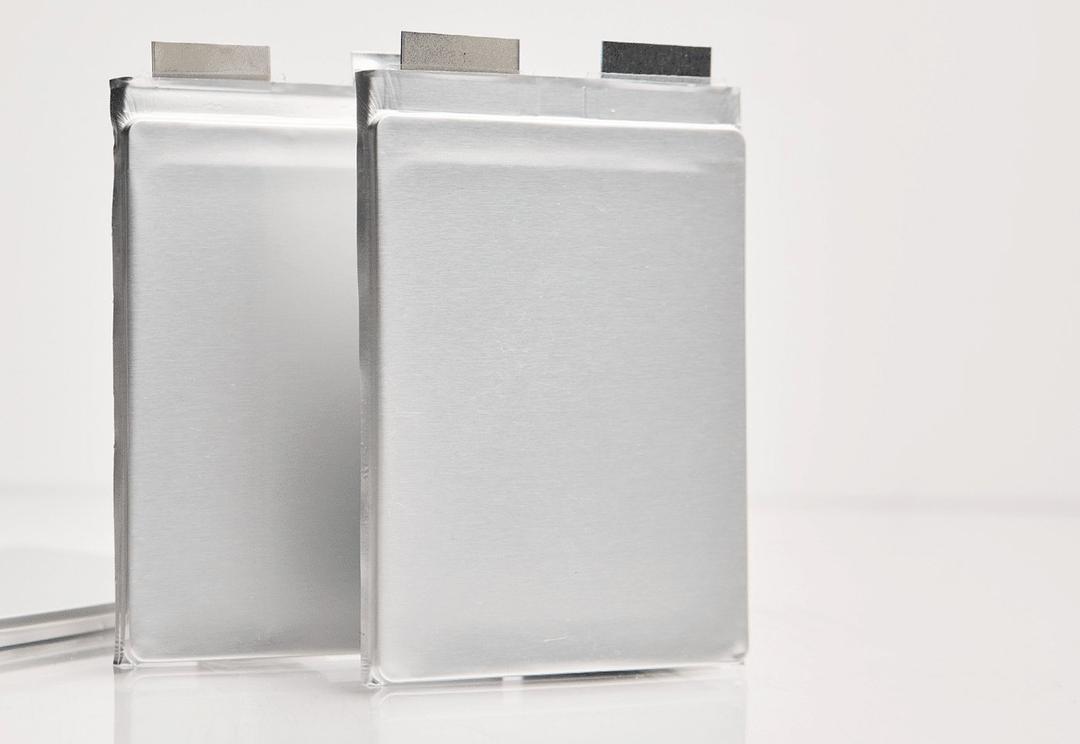
QSE-5 B-sample cells. Osprey keeps this cell's ceramic separator and swaps its liquid catholyte for a solid sulfide one. Photo: QuantumScape
Why 1 Atmosphere of Pressure Matters
Sulfide electrolytes are popular because they move lithium ions well and are relatively easy to process. Their weakness is contact. As a sulfide cell charges and discharges, the solid layers tend to pull apart. To keep them touching, lab cells are clamped under heavy pressure. Electrek notes that many published sulfide cells run at roughly 30 to 100-plus atmospheres.
That works on a lab bench. In a car, it means heavy pack structures, added cost and lost energy density. QuantumScape's white paper illustrates the problem: by Electrek's reading, holding just 20 atmospheres on a single 10 x 24.2 cm cell takes about 5,000 kg of force, the weight of roughly three midsize cars. The company's conclusion is blunt: "an automotive solid-state battery cannot require such extreme pressures."
Osprey's argument is that the ceramic separator solves the parts sulfides cannot. QuantumScape says sulfides react with lithium metal, need high pressure, struggle at room temperature and below, and cannot fast-charge against lithium metal without forming dendrites. It calls these "fundamental properties" of the material. Osprey uses sulfide only in the cathode and lets the ceramic layer handle the lithium metal.
Advertisement
Osprey Specs: Energy Density, Cycle Life and Charging Speed
Metric
QSE-5 (shipping as samples)
Osprey (early testing)
Cathode electrolyte
Liquid catholyte
Solid sulfide catholyte
Energy density
844 Wh/L, 301 Wh/kg (measured)
Up to ~1,100 Wh/L (projected)
Cycle life
QuantumScape cites 1,000 cycles under its test standard
1,000 cycles to ~80% capacity
Fast charging
Under 15 minutes
10% to 80% in about 5 minutes
Operating pressure
Under 3.4 atm
About 1 atm
Cold weather
Good low-temperature performance (company claim)
Operational to -20 C (-4 F)
Test cell
Full commercial-format cell (21.6 Wh)
2-layer unit cell, same area as QSE-5
The cycling test was run under what QuantumScape calls "gold-standard" conditions: full 0-to-100% cycles, a one-hour charge and one-hour discharge (1C/1C), cathode loading above 5 mAh/cm2, near room temperature and 1 atm. Those are demanding conditions, on a cathode the size of a real cell's.
Energy density is the long-term prize. Because sulfide moves ions without the "traffic jam" a liquid creates, QuantumScape says Osprey cathodes can be made about twice as thick, reaching 10 mAh/cm2 versus 3 to 5 in a typical lithium-ion cell. Thicker cathodes mean fewer layers, fewer separators and current collectors, and more energy in the same box. That is where the ~1,100 Wh/L projection comes from, roughly 30% above QSE-5.
Read the fine print
Small cells: the 1,000-cycle result comes from a 2-layer unit cell. Electrek estimates its capacity at about 0.3 to 0.4 Ah, versus about 5 Ah for a QSE-5 cell.
Hot fast-charging: according to Electrek's review of the white paper, the 5-minute charge was shown at 80 C. No room-temperature figure was published.
Projected, not measured: the ~1,100 Wh/L figure is a projection for large cells. Electrek reports the supporting data came from a coin cell.
Tiny cold-weather cell: Electrek says the -20 C result used a 21 x 21 mm single-layer cell that kept 68% of its capacity.
Advertisement
Who Is QuantumScape Working With?
QuantumScape did not name any Osprey customers. Its release says only that it is "already working with partners across the automotive industry on development using the Osprey platform."
Its wider partner list is public. Volkswagen's battery company, PowerCo, signed a 2024 deal that licenses it to build QuantumScape cells at up to 40 GWh a year, with an option for 40 GWh more. In its third-quarter letter, QuantumScape said it is aligning its statement of work with PowerCo toward a common long-term platform beyond QSE-5. Honda signed a joint development agreement in June 2026, and a third, unnamed "leading global player in mobility manufacturing" has also signed on.
The company reported $9.8 million in customer billings and an $84.5 million net loss for the third quarter, with about $820 million in cash and marketable securities.
"The industry has invested heavily in sulfide-based batteries but keeps hitting the same fundamental limits. As the data shows, Osprey can address these limitations."
Dr. Siva Sivaram, president and CEO, QuantumScape
When Could Osprey Batteries Be in Cars?
QuantumScape gave no date. Its white paper says the Osprey process has been demonstrated "at laboratory scale," that higher-throughput processes are "in the development stage," and that "significant work remains in process engineering." Automakers also want larger cells than anything tested so far.
For context, QuantumScape's own first product is still on the way. The QSE-5 pilot Eagle Line in San Jose opened in February 2026. A 100 MWh line is targeted to start production in 2028. That is enough cells for roughly 1,000 EVs a year with 100 kWh packs, a starting point rather than mass production. Osprey sits behind QSE-5 on that roadmap.
Rivals are moving too. Per Electrek, Samsung SDI targets sulfide mass production in late 2027 and Toyota points to 2027 to 2028, while CATL says mass-market solid-state is likely around 2030. Osprey is a bet that some of them will license QuantumScape's separator instead.
What it means for EV buyers
Nothing changes for 2027 or 2028 shoppers. No car on sale or announced uses Osprey cells.
The earliest realistic window is the 2030s, and only if a partner licenses Osprey and it scales. That is our estimate, not a company date.
If it works, the payoff is big: about 30% more energy per liter than QSE-5, much faster charging, and smaller, lighter packs without heavy clamping.
Do not wait for it. Today's lithium-ion keeps improving.
The bottom line: Osprey is the most credible answer yet to sulfide solid-state batteries' pressure problem, with 1,000 cycles at 1 atm under tough test conditions. But the 5-minute charge needed high heat, the energy density is projected, and the cells are small lab units with no production date. It is meaningful progress for the battery industry, not a reason to change your next car purchase.