August 9, 2026·6 min read·By Learn My EV

Should You Charge Your EV to 80% or 100%? Here's What Tesla, Ford, and Others Actually Say

The "80% rule" gets repeated everywhere, but it's not universal — it depends entirely on what kind of battery is in your car. Here's what Tesla, Ford, Rivian, and other automakers officially recommend, and why the right answer isn't the same for every EV.

Should You Charge Your EV to 80% or 100%? Here's What Tesla, Ford, and Others Actually Say

Cover photo: "PRNDL" by Jordan Golson, via YouTube

It's one of the most common questions new EV owners ask, and one of the most inconsistently answered: should you charge to 80%, or is it fine to go all the way to 100% every night? The honest answer is that it depends on what's actually inside your car. The "80% rule" you've probably seen repeated across forums and YouTube videos is real, well-supported advice — but only for certain battery chemistries. For others, it's outdated or simply wrong.

2
Main battery chemistries in EVs today, with opposite charging advice
~20-30%
Faster degradation for NMC batteries kept routinely at 100%
80%
Where DC fast-charging speed naturally starts to taper hard

It All Comes Down to Battery Chemistry

Nearly every modern EV uses one of two lithium-ion battery families, and they behave very differently at high states of charge. Nickel-based batteries — usually labeled NMC (nickel manganese cobalt) or NCA (nickel cobalt aluminum) — are the higher-energy-density chemistry found in most Long Range and Performance EV trims. LFP (lithium iron phosphate) batteries are cheaper, more thermally stable, and increasingly common in standard-range and entry-level trims, as well as most EVs built in China.

Why chemistry changes the advice
  • NMC/NCA cells experience real chemical stress from sitting at a full charge — the cathode structure degrades faster at high voltage, especially combined with heat
  • LFP's cathode is far more stable chemically and doesn't suffer the same degradation from sitting at 100%
  • LFP batteries actually need periodic full charges — their flat voltage curve makes the car's percentage readout drift over time without one

What Tesla Actually Recommends

Tesla's guidance splits cleanly along that chemistry line, and it's built directly into the car's own software. For NMC/NCA vehicles (most Long Range and Performance Model 3, Y, S, and X trims), Tesla recommends capping daily charging around 80%, reserving 100% for long trips where you need the extra range. For Standard Range vehicles using LFP packs, Tesla's owner documentation says the opposite: set the charge limit to 100% for daily use, and make a point of fully charging to 100% at least once a week — not because the battery needs it chemically, but because a full charge lets the car's battery management system recalibrate an accurate percentage readout.

If you own an LFP Tesla and never charge past 90%, don't be surprised if the range estimate starts drifting. That's the calibration issue Tesla's weekly-full-charge advice is meant to prevent.

How Other Automakers Compare

Every brand phrases it a little differently, but the split tracks the same underlying chemistry logic.

AutomakerDaily charging guidance
Tesla80% (NMC/NCA) or 100% (LFP) — chemistry-dependent
FordUp to 90% for NCM packs; up to 100% for LFP packs; 80% suggested to save charging time
Rivian~70% recommended for everyday charging
Kia80% recommended for daily use
GM (Chevrolet)Software-limited to 90% on some models — originally a safety measure following the Bolt battery recall

Worth noting: GM's 90% cap on certain Bolt-era vehicles wasn't primarily a longevity recommendation — it came out of the 2021 Bolt battery fire recall as a risk-mitigation measure, which is a different situation than a manufacturer simply optimizing for battery lifespan. Always check your specific model and model year, since guidance has shifted over time as chemistries and software have changed.

Why Charging Slows Down Near 80% Anyway

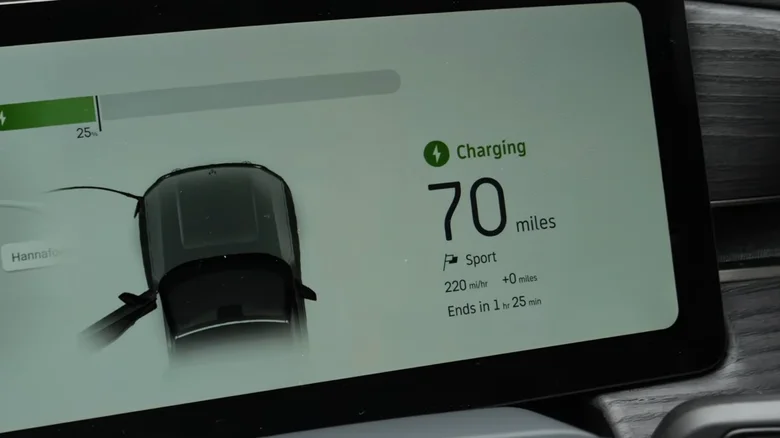
Even if you ignore all of the health advice, there's a practical reason 80% shows up so often: it's roughly where DC fast-charging speed drops off a cliff. Fast chargers can typically push a battery from around 10% to 80% in well under 30 minutes, but the last 20% can take nearly as long as the first 80% combined, because the charging curve tapers sharply to protect the cells as they approach full. On a road trip, charging to 80% and moving on is usually faster overall than waiting for a full 100%.

Habits that hurt battery health more than the 80-vs-100 debate
  • Letting the battery sit near 0% for extended periods, especially in extreme heat or cold
  • Leaving the car parked at 100% for days at a time, particularly in hot climates
  • Relying heavily on DC fast charging for routine daily charging instead of slower Level 1/2 home charging
  • Skipping battery preconditioning before a fast-charging stop in cold weather, which slows charging speed and adds stress

The Real Answer

There's no single correct percentage that applies to every EV. The single most useful thing you can do is find out what battery chemistry your specific car uses — check the owner's manual, the manufacturer's app, or the window sticker — and follow that automaker's guidance for that chemistry rather than a rule you saw applied to a different car. If you're not sure, the safest default for most nickel-based EVs remains capping daily charging around 80% and saving 100% for trips; if you own an LFP vehicle, don't be afraid to charge to 100%, and make sure you actually do it at least weekly.

The bottom line: The 80% rule isn't wrong, but it isn't universal either. It's the right call for the nickel-based batteries in most Long Range and Performance EVs, and the wrong call for LFP-equipped vehicles, which actually benefit from regular full charges. Check what's under your own car before adopting anyone else's charging habit.