Rivian Factory Robots Will Handle 20% of Plant Tasks at First, With a Goal of 80%, Says CEO RJ Scaringe
Rivian's factory robots from spinoff Mind Robotics will start with 20% of plant tasks, beginning with pick-and-place jobs in Normal, Illinois, and aim for 80%, CEO RJ Scaringe says. Here's the timeline and what it means for workers.
Photo: Rivian
Rivian CEO RJ Scaringe has put numbers on how far he wants robots to go inside his car plants. The AI-driven robots being built by Mind Robotics, the industrial robotics company he spun out of Rivian last year, will start by handling about 20% of the tasks in a Rivian factory. The long-term goal is 80%.
"In the beginning, we're going to be able to do 20% of the tasks on the plant, but over time, we want to grow that to 80%," Scaringe said, as reported by InsideEVs. He made the comments in a video interview with venture firm Kleiner Perkins, published November 9, alongside Vidya Rajagopalan, Rivian's senior vice president of electrical hardware.
Here is what the robots will do first, where they are headed, when they could arrive, and what it could mean for the people who build Rivians today.
20%
Plant tasks robots handle at first
80%
Long-term goal, on the same hardware
50%
Labor in pick-and-place, in some plant sections
$1B+
Raised by Mind Robotics since late 2025
What Will Rivian's Factory Robots Do First?
The first target is pick-and-place work: a worker reaches into a bin or rack, grabs a part and sets it on a fixture so the next step can happen. It is simple for a person and surprisingly hard for a traditional robot, because parts never sit in exactly the same spot.
"These are the immediate opportunities we see," Scaringe said. "And these tend to be the ones that often are the least interesting jobs." He added that "depending on the section of the plant, up to 50% of the labor is in pick-and-place."
Today's factory robots, like the big yellow arms on Rivian's R2 body line, are fixed in place and programmed by hand for one motion. Mind is building robots that run on AI models trained to see small differences in where a part lies and adjust. To train them, Scaringe said Mind filmed and studied a wide range of plant work: "In the case of manufacturing, what we've done within Mind, we've taken videos of a whole broad spectrum of tasks."
The jump from 20% to 80% is meant to come mostly from software. "The model gets smarter over time," Scaringe said, crediting the decision to design the hardware "with headroom." He also stressed that factory robots need a sense of touch, and said many Rivian and Mind engineers came from consumer electronics.
"In the beginning, we're going to be able to do 20% of the tasks on the plant, but over time, we want to grow that to 80%."
RJ Scaringe, Rivian founder and CEO
Which Robots, and Which Rivian Plant?
Mind Robotics has said little about its robot's design. What is known:
Not a humanoid copy. TechCrunch reports Scaringe has said Mind will not try to mimic all of human biomechanics. The company describes "purpose-built robots" running on foundation models.
Rivian silicon inside. RivianTrackr reports Scaringe said in the same interview that Rivian's in-house RAP1 chip, the one behind R2's newest autonomy hardware, is also going into Mind's robots.
First stop: Normal, Illinois. Rivian is Mind's first customer, and RivianTrackr identifies the Normal plant, where Rivian builds the R1T, R1S, R2 and its commercial vans, as the first site.
Seasoned leadership. In October, Mind hired Doug Field as president. Field led EV and technology strategy at Ford, ran Apple's car project, and oversaw the Model 3 as Tesla's senior vice president of engineering.
Rivian is already using some AI on the line. In February, the company said its R2 line includes "an AI-powered robot system that scans and places parts on the line without any manual handling." Mind's job is to take that idea from a handful of stations to a large share of the plant.
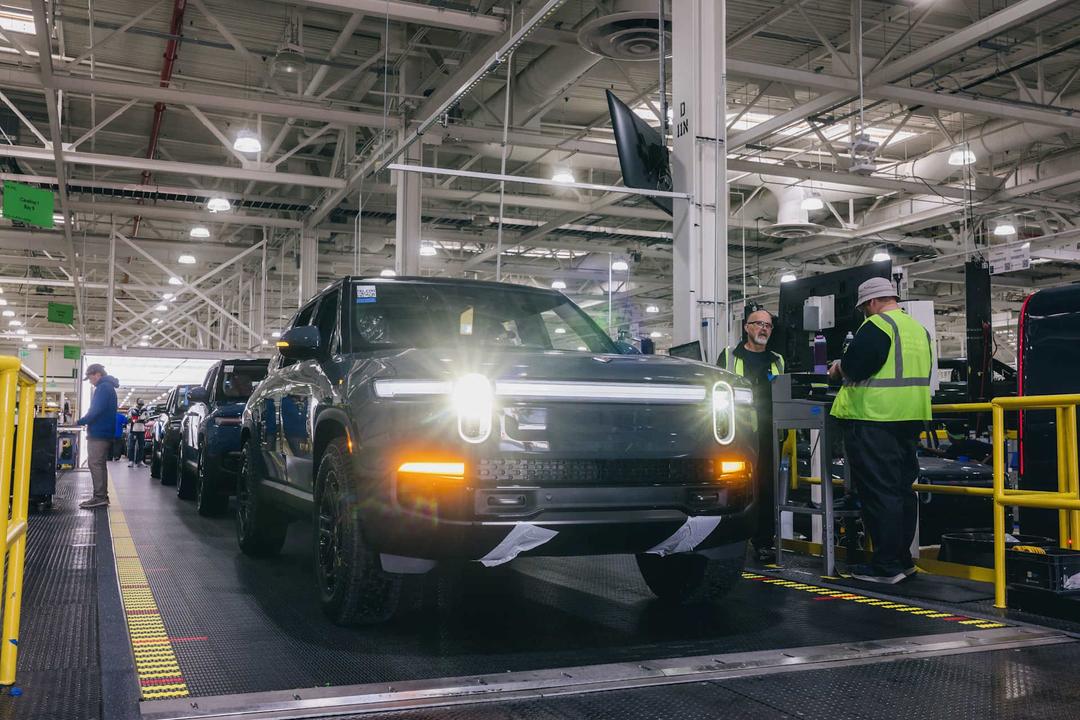
Team members check an R1S on the line in Normal, Illinois. Rivian says thousands of people work at the plant. Photo: Rivian
Advertisement
When Will Mind Robots Reach Rivian's Factory Floor?
Rivian has not announced a date. According to RivianTrackr, Scaringe said this summer that the first robots would arrive in "the early part of 2027." In the new interview, he described the timing as the "middle of next year," which points to mid-2027. InsideEVs, for its part, says it does not know when the robots will reach the floor.
The money is in place. Mind raised a $115 million seed round in late 2025, a $500 million Series A in March 2026 and another $400 million in May led by Kleiner Perkins, for more than $1 billion in total. Rivian now owns about a third of the company. RivianTrackr puts the stake at 31%, down from 53.5% at launch.
Advertisement
What Does This Mean for Rivian Workers?
Scaringe framed the first wave as taking over repetitive, low-interest jobs. Neither he nor Rivian has announced job cuts tied to the robots, and nothing in the interview put a headcount on the plan.
Still, the math is hard to ignore. If pick-and-place makes up as much as half the labor in some areas, an 80% task goal would reshape what plant work looks like. Rivian's operations chief, Javier Varela, said last year that "everything starts with our team members" and that technology "only multiplies the impact of our workforce's creativity and expertise." The key questions are how many jobs shift to new roles, how many disappear, and how fast. Rivian has not answered them yet.
Keep in mind
The 20% and 80% figures are Scaringe's targets, not results. No Mind robot is working on a Rivian line yet.
"Tasks" is not the same as "jobs." A worker's shift often mixes several tasks, so 20% of tasks does not mean 20% fewer people.
The mid-2027 timing comes from RivianTrackr's account of the interview, not from a Rivian announcement.
How Rivian's Plan Compares to Tesla Optimus, Figure and Hyundai
Program
Robot type
Where
Status
Rivian / Mind Robotics
Purpose-built, not humanoid
Normal, Illinois
First robots reported for mid-2027
Tesla Optimus
Humanoid
Tesla factories
Tesla says production has begun
Figure AI / BMW
Humanoid (Figure 02)
Spartanburg, South Carolina
Pilot helped build 30,000 BMW X3s, per Figure
Hyundai / Boston Dynamics
Humanoid (Atlas)
Metaplant, Georgia
Deployment planned from 2028
The big difference is philosophy. Tesla, Figure and Hyundai are betting on human-shaped robots that can walk into any workstation. Rivian is betting that a robot built for the job, trained on its own plant data and running its own chip, gets there sooner. Scaringe also expects a shakeout: "I think in robotics, there's probably too many companies across the stack today, and we're gonna see consolidation," he said in the Kleiner Perkins interview.
The bottom line: Rivian plans to let Mind Robotics' AI robots take over about 20% of factory tasks at first, starting with pick-and-place jobs in Normal, Illinois, with a goal of 80% as the software improves. The first robots could arrive around mid-2027. It is one of the boldest automation targets any automaker has stated publicly, and Rivian has yet to say what it means for the people on its lines.