Ford Sold Only 9,746 EVs in Q2 — Down 41% — as Lightning Dies and Mach-E Fades
Ford's Q2 2026 US electric vehicle sales collapsed 40.7% year over year to just 9,746 units. The F-150 Lightning is discontinued. The Mach-E is on borrowed time. And the next chapter doesn't start until 2027.
Ford sold 9,746 electric vehicles in the United States in the second quarter of 2026 — a 40.7% collapse from the 16,438 it sold in Q2 2025. The F-150 Lightning is discontinued. The Mustang Mach-E, which accounted for 72% of those sales, is widely expected to follow. And the EV strategy Ford bet billions on is now, effectively, on life support until a new generation of vehicles arrives in 2027.
-40.7%
Ford US EV sales decline, Q2 2026 vs. Q2 2025
-57.4%
Year-to-date EV sales decline through H1 2026
$4.8B
Ford Model e division losses in 2025 alone
The Q2 2026 EV Numbers, Model by Model
Ford Motor Company Q2 2026 U.S. Sales — official release, July 2, 2026
Model
Q2 2026
Q2 2025
Change
Mustang Mach-E
7,032
10,178
-30.9%
F-150 Lightning
2,421
5,842
-58.6%
E-Transit
293
418
-29.9%
Total EVs
9,746
16,438
-40.7%
The Mach-E is the only model still in active production — and even it is down nearly a third from a year ago. The F-150 Lightning's 2,421 units represent inventory clearance on a truck that Ford has already confirmed will not return as a pure EV. The E-Transit's 293 deliveries are barely a rounding error in Ford's commercial vehicle lineup.
The year-to-date picture is even bleaker. Ford has sold just 16,606 EVs through the first half of 2026, against 38,988 in the same period of 2025. That's a 57.4% drop — more than half of Ford's EV business, by volume, has evaporated in twelve months.
The Lightning Is Done — and Ford Admitted It
The F-150 Lightning's story is effectively over. Ford CEO Jim Farley confirmed the discontinuation during a December 2025 CNBC interview, saying bluntly that "very high-end EVs, the $50K, $70K, $80,000 vehicles, they just weren't selling." The Lightning peaked at a starting price well above $55,000 after years of cost increases from its original $39,974 announcement. Demand never materialized at those prices in volume.
The Lightning will be replaced — eventually — by an extended-range electric vehicle (EREV) version of the F-Series, expected around 2027. But that's a fundamentally different product with a fundamentally different cost structure. The all-electric Lightning era, which began with enormous fanfare in 2022, lasted less than four years.
"The very high-end EVs, the $50K, $70K, $80,000 vehicles — they just weren't selling."
— Jim Farley, Ford CEO
Advertisement
The Mach-E Is Next
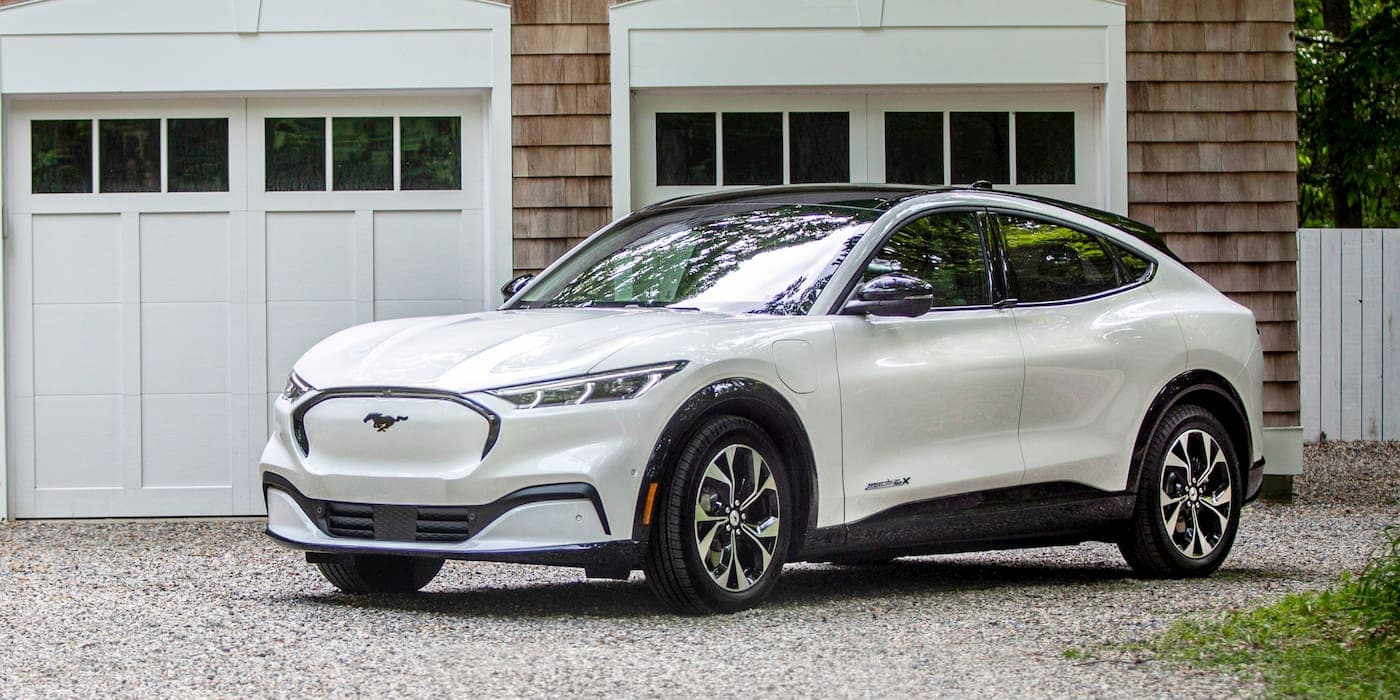
The Mustang Mach-E remains Ford's only active EV in the US, but its runway is shortening. Ford has confirmed that the Mach-E will not migrate to the company's new Universal EV (UEV) platform, the next-generation architecture designed from scratch to maximize efficiency and profitability. That means the current Mach-E is a dead-end product with no direct successor — at least not under the Mustang name.
The Mach-E will continue selling until at least 2027, when Ford's $30,000 midsize electric pickup — the first UEV-based vehicle — is expected to arrive. After that, Ford's EV lineup effectively resets. What comes next on the UEV platform beyond the pickup isn't confirmed, though Ford has said the architecture supports "everything from small cars to vans."
There's also a tariff problem. The Mach-E is built in Mexico, making it subject to Trump's import tariffs in a way that domestically produced vehicles are not. That cost headwind has pushed Ford toward employee-pricing deals and free home charger offers to sustain sales — moves that erode any remaining margin on a product that was already losing money.
Ford's current EV lineup status
F-150 Lightning: Discontinued — final units being cleared from inventory
Mustang Mach-E: On sale through at least 2027, but confirmed not to continue on new UEV platform
E-Transit: Commercial van, remains on sale in limited volume
Next EV: UEV-based midsize electric pickup, ~$30,000, expected 2027
Advertisement
The Broader Ford Picture
It's not just EVs. Ford's overall US sales fell 10.3% in Q2 2026 — 549,200 vehicles against 612,095 a year earlier. The F-Series, Ford's most important product by far, dropped 11% to 197,900 trucks. The Escape, once a high-volume crossover, fell 74% to 11,715 units as Ford winds it down. The Edge posted zero sales — it's been discontinued entirely.
The bright spots are narrow. The Bronco was up 15.9%, the Explorer gained 13.8%, and Transit vans rose 7.7%. But these are bright spots within a broader decline. Ford's Model e EV division lost $4.8 billion in 2025 and expects to lose another $4 billion to $4.5 billion in 2026. The company is bleeding cash on a strategy it can't abandon and can't execute profitably at the same time.
Toyota, notably, outsold Ford in US EVs in Q1 2026 with a single electric SUV. That context underscores how far Ford has fallen from its 2021 moment when the Lightning reveal and the Mach-E launch made it look like the most credible Detroit EV challenger. The gap between the announcement and the execution has been costly in every sense.
The bottom line: Ford's Q2 2026 EV sales — 9,746 units, down 40.7% — tell the story of a first-generation EV strategy that didn't work. The Lightning is gone. The Mach-E is winding down. Ford is now in the gap between the products it couldn't make profitable and the UEV-based lineup it hasn't launched yet. 2027 is when the real second act begins. Until then, the numbers will continue to look like this.