VW ID. AURA L5 Electric Sedan: Pre-Orders Open Nov. 16 in China, and Its New Software Is the Real Story
The VW ID. AURA L5 is a Camry-size electric sedan for China with up to two 155 kW motors and VW's new VEGA tech stack. Here are its specs, expected price, the CEA software VW may bring to Europe, and whether it comes to the US.
Photo: Volkswagen Group China
Volkswagen's newest electric sedan is about the size of a Toyota Camry, rides on a platform engineered in China, and runs software that VW co-developed with Chinese EV maker Xpeng. It is called the ID. AURA L5. It is being shown at the China International Import Expo in Shanghai through November 10, and pre-orders are reported to open on November 16.
The car is built for Chinese families and is not coming to the United States. But it matters well beyond China. It is one of the first two cars to carry VW's full new "VEGA" technology package, and the software inside it, called CEA, is the same architecture VW is now weighing for up to three-quarters of its core models in Europe. Here is what the ID. AURA L5 is, what we know about specs and price, and why its software is the bigger story.
4,883 mm
Length (192.2 in), close to a Toyota Camry
155 kW
Per motor (208 hp); single or dual motor
Nov 16
Reported pre-order date in China
3 months
VW's target gap between major software updates
What Is the VW ID. AURA L5?
The ID. AURA L5 is a battery-electric family sedan with a fastback roofline and a rear hatch, built by the FAW-Volkswagen joint venture for the Chinese market. It is the production version of the ID. AURA concept shown at the 2025 Shanghai Auto Show, designed by Chinese and German teams together. It is the second model in the ID. AURA line, after the ID. AURA T6 SUV that went on sale in September.
Spec
ID. AURA L5
Body
Five-door fastback sedan, frameless doors, semi-hidden door handles
Length / width / height
4,883 / 1,881 / 1,506 mm (192.2 / 74.1 / 59.3 in)
Wheelbase
2,820 mm (111.0 in)
Motors
Single motor, 155 kW (208 hp); dual motor with 155 kW front and rear
Top speed
175 km/h (109 mph), single motor
Battery
LFP from CATL and Gotion; capacity not announced
Platform / electronics
CMP platform with CEA zonal architecture
Driver assistance
Carizon Hyper Sense 8; roof lidar on some versions
Range, charging, price
Not announced yet
Specs come from VW Group China's November 3 release, China's regulatory filing as reported by CnEVPost, and Gasgoo. VW says 84.4% of the car's footprint is usable cabin space, and the power tailgate opens past 70 degrees with an opening more than 1,000 mm (39 in) wide. The November 16 pre-order date comes from Chinese site Autohome via CnEVPost. FAW-Volkswagen had not confirmed it officially as of this writing.
ID. AURA L5 Price and Range: What to Expect
VW has not announced a price, range or charging speed for the L5. Two reference points give a sense of where it is likely to land.
The ID. AURA T6 SUV, its sibling, sells for 129,900 to 166,900 yuan (about $19,300 to $24,800). It offers 59.9 kWh and 77.5 kWh CATL batteries, with up to 660 km (410 miles) of range on China's CLTC test cycle.
The CMP platform itself, according to VW, supports more than 600 km of CLTC range, about 11 kWh per 100 km in its most efficient version, and charging from 30% to 80% in 25 minutes. Those are platform figures, not confirmed L5 numbers.
A note on Chinese range figures
CLTC ratings run well above US EPA ratings. A 600 km (373-mile) CLTC figure would translate to a noticeably lower EPA number if the car were ever tested in the US.
Dollar figures are approximate conversions at current exchange rates. Chinese prices include local taxes and incentives and do not reflect what a US version would cost.
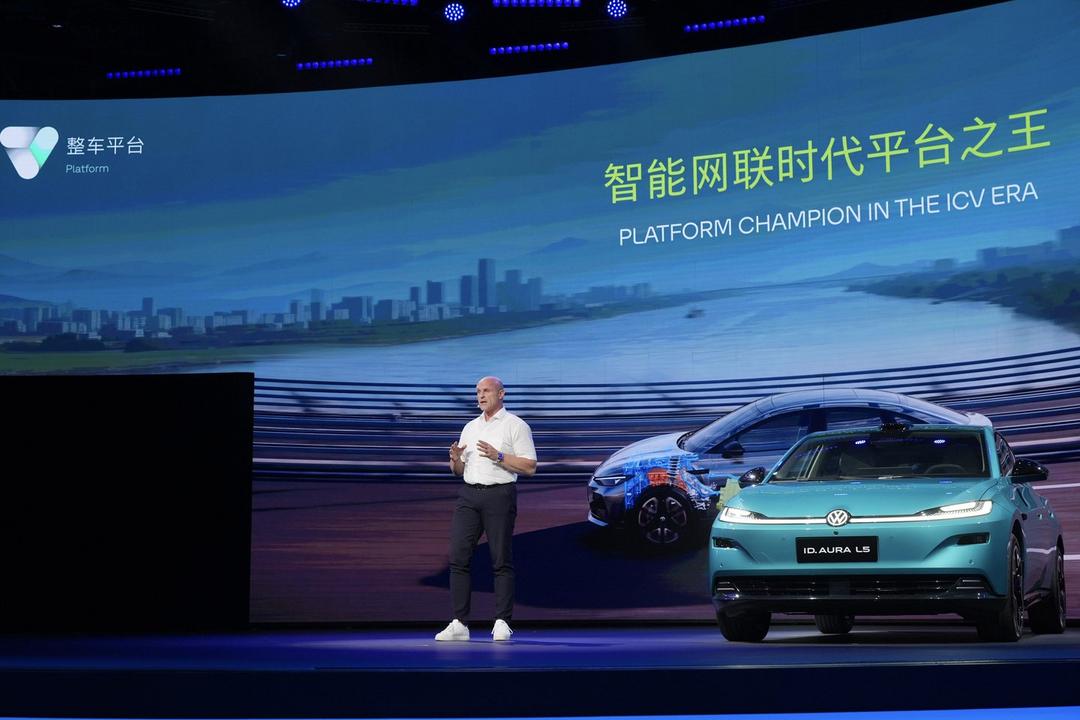
VW China CTO Thomas Ulbrich presents the CMP platform next to the ID. AURA L5 at the company's first Tech Day in Hefei on October 28. Photo: Volkswagen Group China
Advertisement
Why the ID. AURA L5's Software Is the Real Story
On October 28, Volkswagen Group China held its first Tech Day and introduced VEGA, a package that bundles three things developed in China: the CMP vehicle platform, the CEA electrical and software architecture, and Carizon driver assistance. The ID. AURA L5 and SAIC-Volkswagen's ID. ERA 5X SUV are the first two cars to carry all three.
CEA (China Electronic Architecture) is the core. It consolidates many separate control units into high-performance central computing and zone controllers, an approach pioneered by Tesla and now widely used by Chinese brands. VW co-developed it with Xpeng. VW's stated goals for CEA are more ambitious than anything it has delivered in Europe so far:
Major feature updates every three months over the air, and a full architecture upgrade every two years.
Five VW-brand EVs on CEA in 2026, including both ID. AURA models and the ID. ERA 5X.
CEA in China-built plug-in hybrids and gas cars in 2027, along with merging cockpit and driver-assistance computing onto one central computer, which VW says is the groundwork for Level 3 automated driving.
CEA 3.0 by 2029, aimed at supporting Level 4 development.
AI-assisted development. VW says its C-Brain AI toolchain has cut some software function tests from two to three days to two to three hours.
The driver-assistance system, Hyper Sense 8, comes from Carizon, VW's joint venture with Horizon Robotics. VW calls it its first self-developed one-stage end-to-end system. It offers navigation-guided assistance on city streets and highways plus automated parking, and VW says it will be on seven new electrified models from its three Chinese joint ventures in 2026.
"China is a key source of innovation for the Volkswagen Group, and it is increasingly becoming an important product and technology hub for our global markets."
Oliver Blume, CEO, Volkswagen Group, at VW China Tech Day (translated from Chinese)
Advertisement
Could Europe Get This Software?
This is where the L5 stops being only a China story. Autocar reported on November 6 that VW Group is studying whether to use CEA in up to 75% of its core models in Europe across the Volkswagen, Skoda and Cupra brands, citing internal discussions confirmed by VW brand CEO Thomas Schäfer. No decision has been made. Asked whether CEA would be chosen, Schäfer told Autocar: "I believe it will be, but we're not finished yet."
That would put two software stacks inside VW Group. The other is the architecture VW is developing with Rivian for the Western markets, which Autocar says will debut on the production ID. Every1 small car. That Rivian-based system, not CEA, is the one most relevant to future VW EVs in North America, including the ID. Tiguan that replaces the ID.4.
Is the ID. AURA L5 Coming to the US?
No. Volkswagen has announced no plans to sell the ID. AURA L5 outside China. VW's stated export plans for China-built cars point to the Middle East, Central Asia, Africa, Mexico, Egypt and Vietnam, and it says South America will be the first region to use China-developed technology in its local lineup before 2030.
US rules would also stand in the way. A Commerce Department rule finalized in January 2025 bars connected-vehicle software tied to China from cars sold in the US starting with the 2027 model year, with hardware limits following for 2030. A China-built sedan running software co-developed with Xpeng would face that rule head-on.
Key facts
The ID. AURA L5 is a Camry-sized electric sedan for China, built by FAW-Volkswagen.
Pre-orders are reported for November 16; price, range and battery size are still unannounced.
It is one of the first two cars with VW's complete VEGA package: CMP platform, CEA software and Carizon driver assistance.
VW is considering CEA for up to 75% of core European models; no decision yet.
It is not planned for the US, where rules on China-linked vehicle software take effect for model year 2027.
The bottom line: The ID. AURA L5 is a sensible, roomy electric sedan aimed squarely at China's price-war market, and the T6's sub-$25,000 pricing suggests it will be aggressively priced too. Americans won't be able to buy one. Its real significance is the software: a China-developed, frequently updated architecture that VW may soon bring to millions of European cars. We'll update this story with price and range when FAW-Volkswagen announces them.