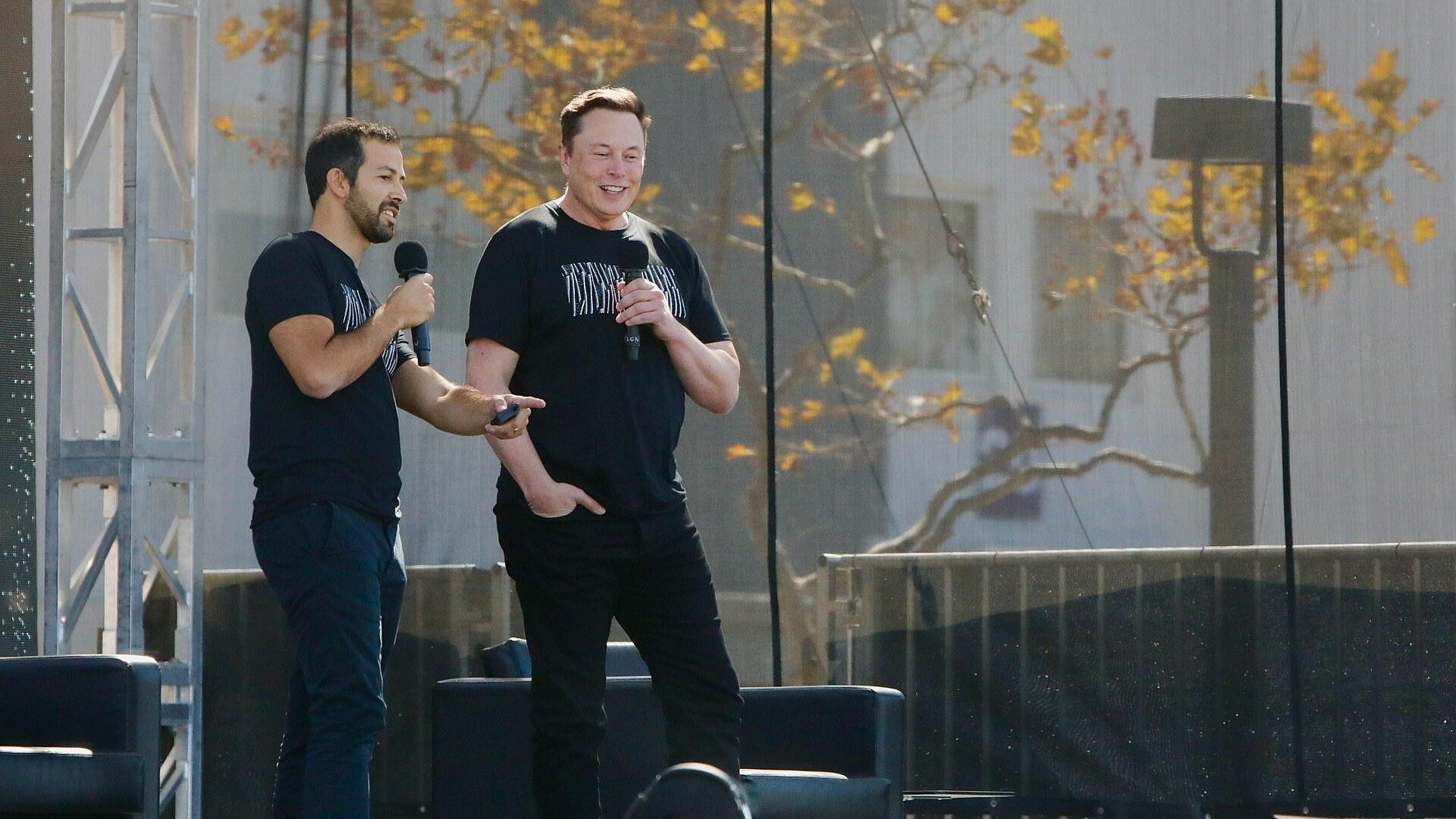
Photo: Steve Jurvetson / Wikimedia Commons (CC BY 2.0). Drew Baglino (left), who left Tesla in April 2024, with Elon Musk at Battery Day 2020.
For years, Tesla's answer to doubters was that it had the best engineers in the business and plenty of them. Over the weekend, Elon Musk said something different. Explaining why Tesla is ending the Cybertruck, he wrote on X that "there are a very limited number of smart, dedicated people," and that Tesla can't spare the ones running the pickup if it wants to scale the Cybercab robotaxi.
Coming after a long run of senior departures, the comment amounts to an admission of a Tesla talent shortage. It also helps explain how Tesla went from five consumer models at the start of 2026 to one platform, the Model 3 and Model Y, by the middle of 2027. Here is exactly what Musk said, who has left, and what it means for the Roadster, the Cybercab and cheaper Teslas.
7 of 14
2023 Investor Day executive presenters who have left
4
Cybercab program leaders who quit in 2026
3 of 5
Consumer models on Tesla's 2024 lineup slide now ended or ending
June/July 2027
When Musk says the Cybertruck line comes out
What Musk Said About Tesla's Talent Shortage
Musk gave three different reasons for ending the Cybertruck in four days, all on X.
- Friday, November 6: Tesla will wind down Cybertruck production at Giga Texas around the middle of next year "to make room for increased Cybercab production."
- Saturday, November 7, replying to a user: "The biggest thing most people fail to understand is that there are a very limited number of smart, dedicated people! They can only do so many things." He added that keeping the truck means Tesla must "maintain a complex production line, supply chain and allocate engineering for Cybertruck," and that "we can't use those people or factory space and machinery for scaling Cybercab," according to Electrek and Not a Tesla App.
- Monday, November 9: the Cybertruck is not unprofitable, he said, "but rather that the opportunity cost of the complexity of Cybertruck is vastly outweighed by the value of incremental Cybercab production."
"The biggest thing most people fail to understand is that there are a very limited number of smart, dedicated people! They can only do so many things."
— Elon Musk, on X, November 7, 2026
The Saturday post is the one that matters. It says Tesla's limit is not factory space or money. It is people.
Who Has Left Tesla? The 2023–2026 Departures
At Tesla's Investor Day at Giga Texas on March 1, 2023, Musk let a line of executives present the company's plans. "We've obviously got significant bench strength here," he said. Electrek counted 14 executives named as presenters that day. Seven are gone. Seven are still at Tesla, according to their LinkedIn profiles: Tom Zhu, Lars Moravy, Franz von Holzhausen, Ashok Elluswamy, Karn Budhiraj, Laurie Shelby and Brandon Ehrhart.
| Executive | Role | Left |
|---|
| Zach Kirkhorn | Chief financial officer | Aug. 2023 |
| Drew Baglino | SVP, powertrain and energy engineering (18 years) | Apr. 2024 |
| Rebecca Tinucci | Head of Supercharging (fired with most of her team) | Apr. 2024 |
| Colin Campbell | VP, powertrain engineering (now CTO at Redwood Materials) | 2024 |
| David Lau | VP, software engineering (12 years) | Apr. 2025 |
| Pete Bannon | VP, hardware engineering, as Tesla shut down Dojo | Aug. 2025 |
| Mike Snyder | VP, energy and charging (per the Wall Street Journal; not confirmed by Tesla) | Oct. 2026 |
Martin Viecha, who ran investor relations at that event, also left in April 2024. In March 2026 Tesla lost Sendil Palani, its vice president of finance for 17 years, and Thomas Dmytryk, the director who built its over-the-air update system and Robotaxi infrastructure.