October 15, 2026·8 min read·By Learn My EV

Tesla Roadster History: The Car That Nearly Killed Tesla, and Why Tonight's Second-Gen Demo Matters

The original Tesla Roadster nearly bankrupted Tesla in 2008. Here's the full story, from a Lotus kit car to tonight's second-gen Roadster demo.

Tesla Roadster History: The Car That Nearly Killed Tesla, and Why Tonight's Second-Gen Demo Matters

In December 2008, Tesla was running out of money. The global economy was in freefall, a quarter of the company had just been laid off, and its only product, a $100,000 electric sports car built on a Lotus chassis, was late, over budget, and breaking down. By Elon Musk's own account, the funding that saved the company closed on Christmas Eve, just hours before Tesla would have missed payroll.

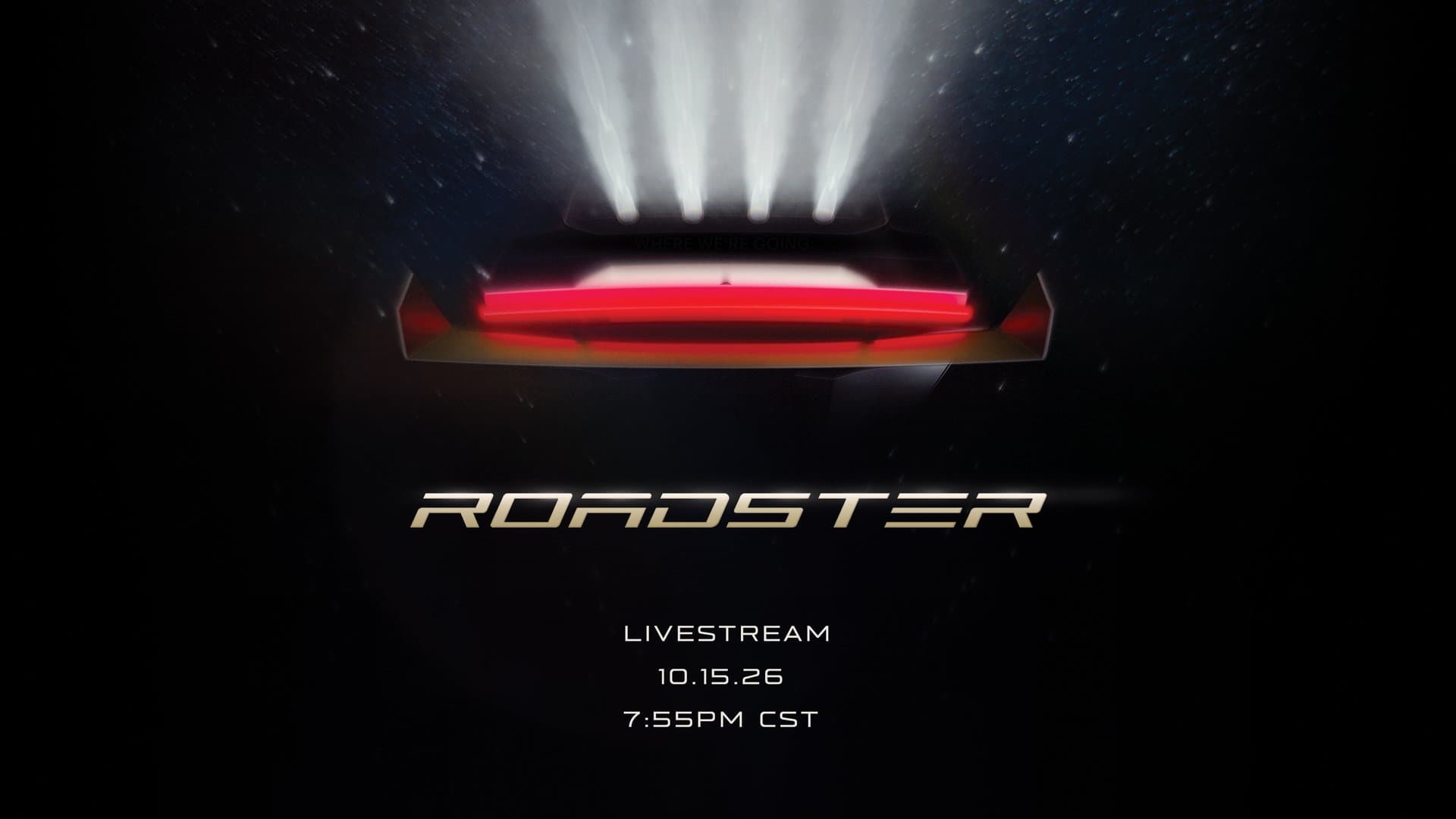
That car was the Tesla Roadster. Tonight at 7:55 PM Central, nearly 18 years later, Tesla is set to demo the second-generation Roadster live on X from SpaceX's McGregor test site outside Waco, Texas. It's been almost nine years since Musk first showed it off in 2017. To understand why tonight matters, you have to start with the car that almost ended Tesla before it began.

Tesla Roadster at a glance
  • First generation: built 2008–2012 on a modified Lotus Elise chassis, about 2,450 made
  • It was Tesla's first car and the first highway-legal production EV to use lithium-ion battery cells
  • Second generation: unveiled November 16, 2017, priced from $200,000, originally promised for 2020
  • Second-gen demo: October 15, 2026, 7:55 PM CT, livestreamed on X
  • Production guidance: 12 to 18 months after the reveal, so 2027 or 2028
2008
First production Roadster delivered, to Elon Musk
~2,450
First-gen Roadsters built before production ended in January 2012
3,255
Days between the 2017 unveil and tonight's demo

It Started With a Converted Kit Car

Tesla Motors was founded on July 1, 2003, by Martin Eberhard and Marc Tarpenning. Their big idea was simple: lithium-ion laptop batteries had gotten good enough to power a real car. That same year, Eberhard paid to have AC Propulsion convert its tzero electric sports car prototype from lead-acid batteries to lithium-ion. It worked well enough that it became the basis for the Roadster concept.

In February 2004, Elon Musk put in $6.5 million and became Tesla's largest shareholder and chairman. A year later, in 2005, Tesla signed with Lotus. Tesla couldn't build a car platform of its own, so the plan was to start with the aluminum Lotus Elise chassis and electrify it.

That plan turned out to be much harder than it sounded. The chassis rails had to be reinforced, the wheelbase stretched about two inches, and custom mounts built to hold a battery pack weighing roughly 900 pounds. The pack itself held 6,831 small 18650 cells, the same kind used in laptops of that era. By the time Tesla was done, only about 6% of the Roadster's parts were shared with the Elise. Lotus built "glider" bodies in Hethel, England, and shipped them to Menlo Park, California, where Tesla added the batteries and motor.

The Reveal, and Then the Problems

Tesla showed the Roadster to the public on July 19, 2006, in Santa Monica. It drew hundreds of preorders, and later that year it won a Popular Mechanics Breakthrough Award and a spot on Time's Best Inventions list. Getting it built was another matter.

The engineering kept breaking. A two-speed transmission couldn't handle the electric motor's torque, and Tesla eventually dropped it for a single-speed BorgWarner gearbox in 2008. The motor overheated and needed redesigns. Early validation prototypes came in short of the range target. Supply problems added more delays. Musk has said plainly in the years since that the early cars "broke down all the time" and "didn't really work."

What went wrong on the first Roadster
  • The two-speed transmission failed under the motor's torque and was replaced with a single-speed unit in 2008
  • Motor overheating and thermal management required redesigns
  • Early prototypes fell short of the original range target
  • Turning a Lotus Elise into an EV added roughly 850 pounds and left only about 6% of parts in common
  • Supply chain constraints pushed the start of production back repeatedly

2008: The Year Tesla Almost Died

As the delays piled up, the company went through a lot of upheaval at the top. In August 2007, the board asked Eberhard to step down as CEO, and Michael Marks came in as interim chief. Ze'ev Drori took over in December 2007. Tesla cut about 10% of its staff in January 2008 to slow its cash burn.

The first production Roadster went to Musk himself in February 2008, and regular production started in March. Just as the car was finally in production, the global financial crisis hit. In October 2008, Musk took over as CEO and laid off about a quarter of Tesla's workforce. Tesla was running out of money, and in early 2009 it raised Roadster prices, including for some buyers who had already reserved, which angered loyal early customers.

At that point, Musk was putting nearly all of his own money into keeping both Tesla and SpaceX alive. In December 2008, a funding round that was in trouble was restructured into about $40 million in convertible debt, and that kept Tesla out of bankruptcy. Musk has described the deal as closing on Christmas Eve, hours before Tesla would have missed payroll. Over the next year, things turned around. Daimler bought a stake for a reported $50 million in May 2009. In June 2009, the US Department of Energy approved $465 million in loans, which helped pay for the Model S.

Musk has never sugarcoated it. Looking back years later, he admitted the early Roadsters broke down all the time and didn't really work. Tesla got through it anyway. Its customers stuck around, the car got better, and the money it raised in 2009 went into the Model S, which was the car that made Tesla a real automaker.

Advertisement

What the First Roadster Actually Proved

For all its problems, the Roadster showed that an electric car could be fast, desirable, and practical to drive. It had an EPA range of 244 miles at a time when most people assumed EVs were golf carts. The Sport version could reach 60 mph in a claimed 3.7 seconds. In October 2009, a Roadster drove 313 miles on a single charge during the Global Green Challenge in Australia.

The car also had its share of trouble. Tesla issued recalls in 2009 and 2010. In December 2008, a Top Gear episode showed the car apparently running out of charge on a test track, and Tesla's libel suit against the BBC was struck out in 2012. Production ended in January 2012 with roughly 2,450 cars built, as Tesla put its resources into the Model S. Owners later got a Roadster 3.0 retrofit offering more range.

First-gen RoadsterSpec
Battery53 kWh, 6,831 cells, ~900 lb
EPA range244 miles
0-60 mph3.7 s (Sport, claimed) / 4.1 s (base)
Top speed125 mph (limited)
Curb weight2,723 lb
Production2008–2012, ~2,450 units

One of those cars took a much stranger trip. On February 6, 2018, Musk's own 2008 Roadster was launched on the first Falcon Heavy, with a mannequin called "Starman" in the driver's seat. It's still orbiting the sun, on a path that goes past the orbit of Mars.

The Second Generation: A Surprise in 2017

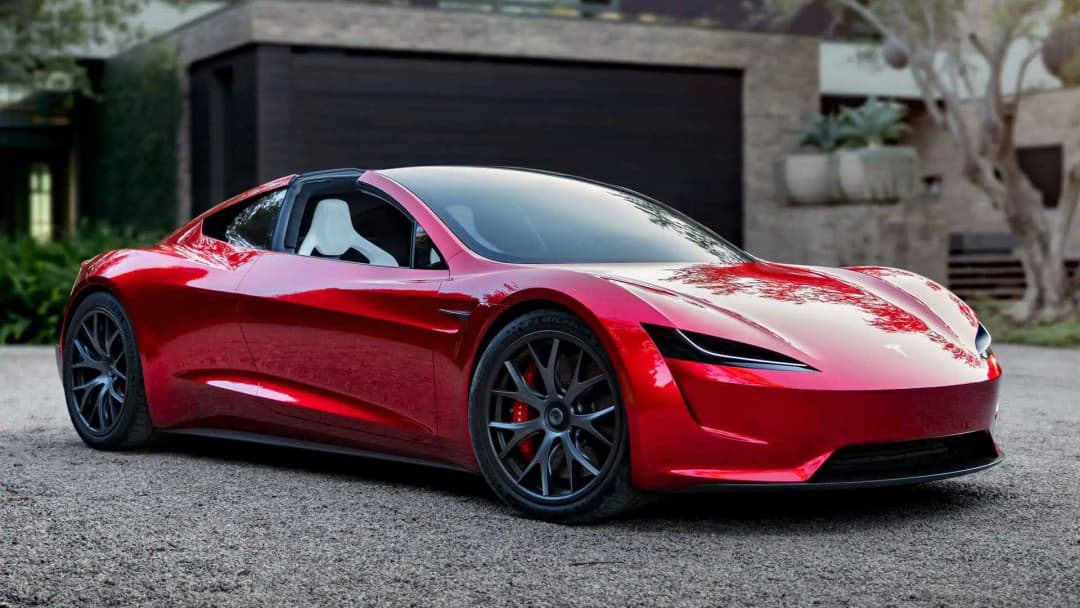
Red second-generation Tesla Roadster prototype parked in a driveway, front three-quarter view
The second-generation Tesla Roadster, first unveiled in November 2017 with a promised 1.9-second 0-60 mph time and a $200,000 starting price.

By then, the next Roadster had already been revealed. On November 16, 2017, at the end of the Tesla Semi event in Hawthorne, California, a red Roadster rolled out of the back of a Semi trailer. Musk made enormous claims for it: 0-60 mph in 1.9 seconds, a quarter mile in 8.8 seconds, a top speed above 250 mph, and 620 miles of range from a 200 kWh battery driving three motors.

The base price was $200,000, with a $50,000 deposit to reserve one. A 1,000-car Founders Series at $250,000, paid up front, sold out within days. In 2018, Musk added a "SpaceX package": cold-gas thrusters he said could get the car to 60 mph in about a second.

Second-gen Roadster as promised in 2017
  • 0-60 mph: 1.9 seconds (under 1 second claimed with the SpaceX thruster package)
  • Quarter mile: 8.8 seconds
  • Top speed: over 250 mph
  • Range: 620 miles from a 200 kWh pack
  • Price: $200,000 base; 1,000-unit Founders Series at $250,000
  • Original production target: 2020
Advertisement

Nine Years of "Next Year"

The 2020 production date came and went. In September 2021, Musk moved it to 2023, citing Cybertruck, FSD, and battery and supply constraints. In 2023 it slipped again. On the October 2024 earnings call, Musk said production would start in 2025 and apologized to "long-suffering deposit holders." That didn't happen either.

At the November 2025 shareholder meeting, Musk set April 1, 2026, as the reveal date and said production would follow 12 to 18 months later. The demo then moved to late April, then to "maybe in a month or so," then to a reported August hover demo at McGregor. On September 12, Tesla posted "Go for launch" with an October 1 date in Waco. Tesla reopened $50,000 reservations around September 20. On September 28, it pushed the event back two weeks to today, saying severe weather in the forecast would affect an event that "can only be held outdoors."

WhenWhat Tesla said
Nov 2017Unveil; production in 2020
Sept 2021Production pushed to 2023
Oct 2024Production "in 2025"; apology to deposit holders
Nov 2025Demo on April 1, 2026
Spring–summer 2026Late April, then "a month or so," then August
Sept 12, 2026"Go for launch": October 1 in Waco
Sept 28, 2026Moved to October 15, citing weather

What to Watch for Tonight

Tesla hasn't said exactly what it will show. Reports going into the event say the centerpiece is the SpaceX cold-gas thruster system, with the car remotely operated, nobody inside, and spectators kept several hundred yards away. An FAA airspace closure over the area this week has been read as a rehearsal. On October 14, Musk posted only "Timing is everything." Fans have pointed out that 7:55 could be a Back to the Future reference, in keeping with Tesla's earlier "Where we're going" teaser.

Keep expectations grounded
  • A demo isn't production: Tesla's own guidance puts production 12 to 18 months after a successful reveal, meaning 2027 or 2028 at the earliest
  • The 2017 specs are claims, not verified numbers, and rivals like the Rimac Nevera R have since raised the bar
  • A car with rocket thrusters faces serious regulatory hurdles before it can be sold for public roads
  • Founders Series buyers have now been waiting almost nine years, and some depositors have reported trouble getting refunds

Tesla Roadster FAQ

When is the Tesla Roadster demo?
Thursday, October 15, 2026, at 7:55 PM Central (8:55 PM Eastern, 5:55 PM Pacific). It's being livestreamed on X from near SpaceX's McGregor test site outside Waco, Texas.

How much does the new Tesla Roadster cost?
Tesla announced a $200,000 base price in 2017, with a 1,000-unit Founders Series at $250,000. Reservations cost $50,000 and reopened in September 2026. Final pricing hasn't been confirmed.

When will the new Roadster be delivered?
Tesla says production should start 12 to 18 months after a successful reveal. That points to 2027 or 2028 for the first customer cars.

How many original Tesla Roadsters were made?
About 2,450, built from 2008 until production ended in January 2012.

What was the original Tesla Roadster's range?
244 miles on the EPA cycle. In 2009, one Roadster drove 313 miles on a single charge in Australia's Global Green Challenge.

Is there really a Tesla Roadster in space?
Yes. Elon Musk's own 2008 Roadster was launched on the first Falcon Heavy on February 6, 2018, with a mannequin named Starman at the wheel. It's still orbiting the sun.

The bottom line: The first Roadster nearly killed Tesla. It ran over budget, ran late, and broke constantly, and it survived only on a last-minute funding deal in December 2008. It also proved that people would want electric cars, and everything Tesla built afterward came out of it. Tonight, the second-generation car finally has to show it can live up to nine years of promises. If it does, it's a fitting way to close the loop. If it doesn't, it will be the latest slip in the longest-running delay in Tesla's history. The livestream starts at 7:55 PM Central (8:55 PM Eastern, 5:55 PM Pacific) on X.