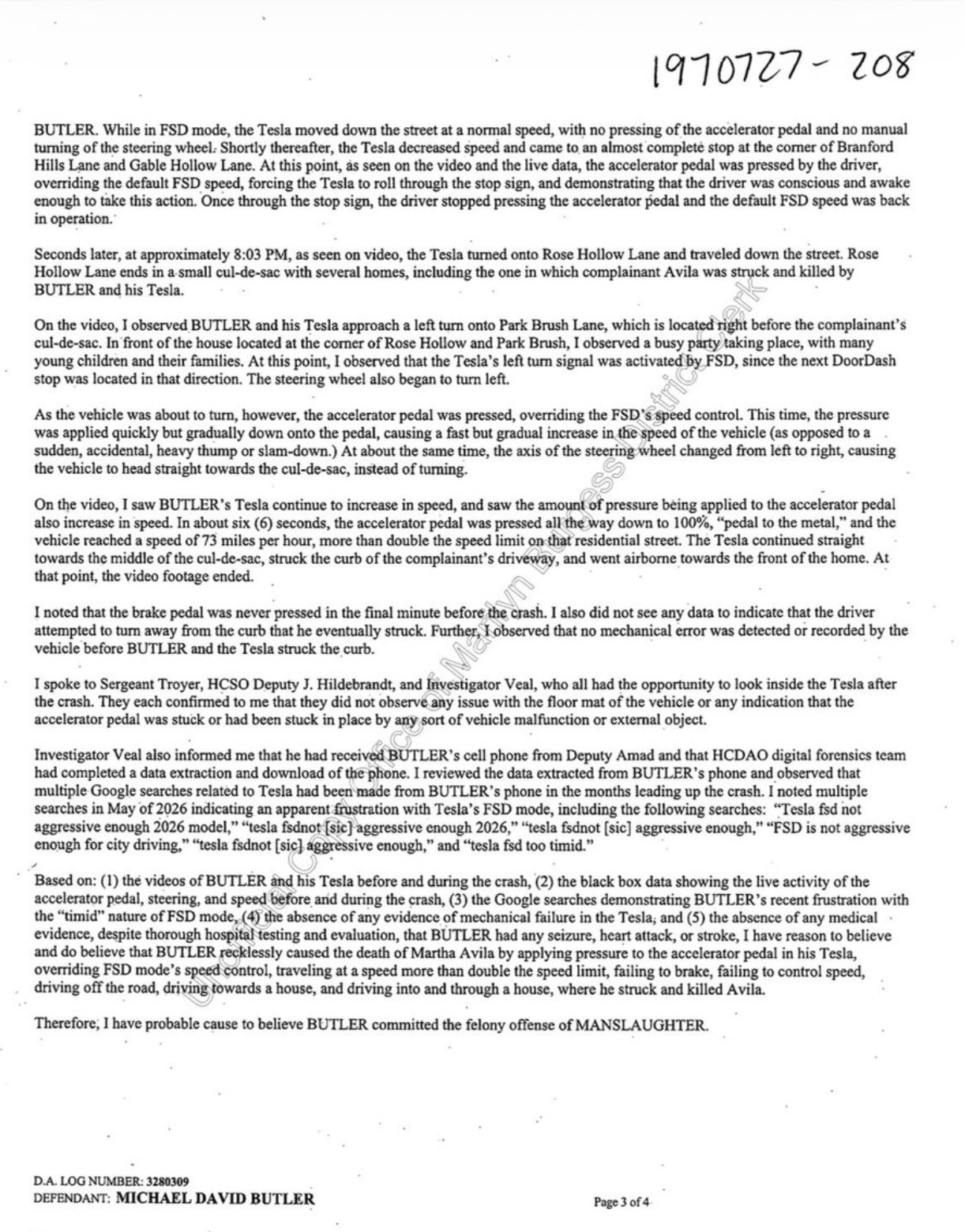
⚡ UPDATE — July 2, 2026: Driver Michael Butler has been charged with Felony Manslaughter. Court documents and phone forensics are now public. New sections added below.
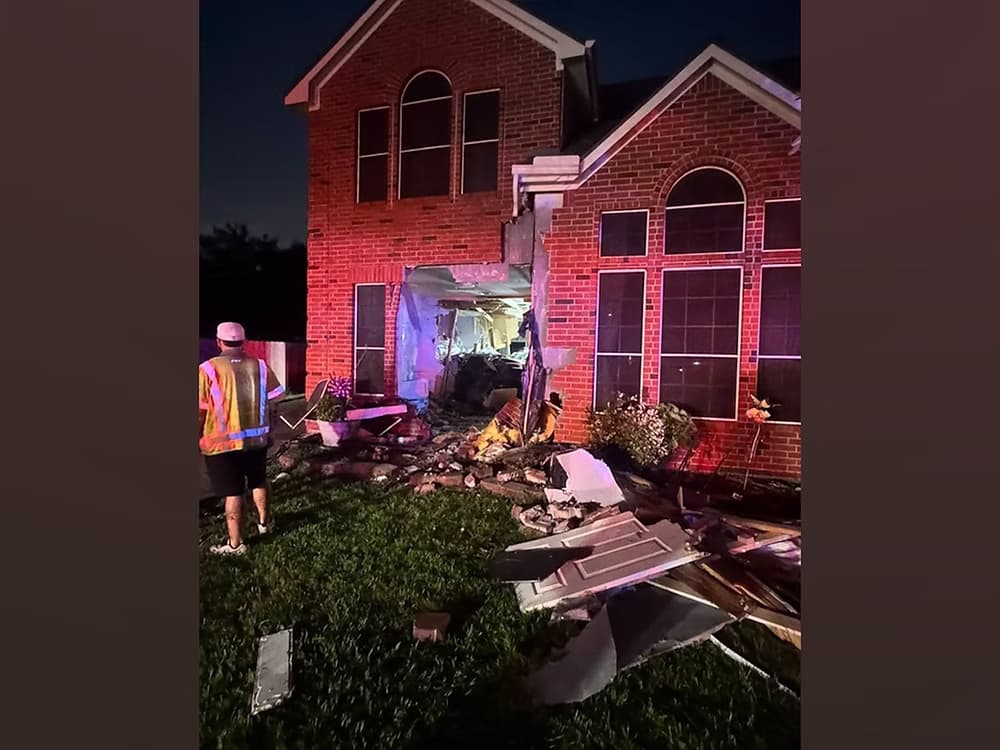
On the evening of June 19, 2026, a Tesla Model 3 traveling at high speed through a residential neighborhood in Katy, Texas failed to make a right turn and drove straight through the brick wall of a home, striking 76-year-old Martha Avila. She was airlifted to Memorial Hermann hospital, where she was later pronounced dead.
In the four days since, the story of what happened inside that Tesla has become one of the most contested technology narratives in recent memory. Headlines have blamed Tesla's self-driving software. Tesla's own executives have gone on social media to dispute that account using internal data. And the federal government has launched its own independent investigation, saying it intends to reach its own conclusions.
This piece separates what is verified from what is still disputed, so you can form an accurate picture of a tragic, genuinely complex event.
What happened: the confirmed facts
Confirmed and uncontested
- Driver Michael Butler, 44, was traveling east on Rose Hollow Lane in Katy, TX around 8 p.m. on June 19, 2026
- The Tesla Model 3 failed to make a right turn at an intersection and struck the home of Martha Avila at high speed
- Martha Avila, 76, was standing in the front room of her home when the car came through the wall
- She was airlifted to Memorial Hermann hospital and pronounced dead
- Butler was also injured and taken to hospital by ambulance
- Harris County Sheriff's investigators confirmed Butler showed no signs of intoxication and was cooperating with the investigation
- Butler told investigators that the vehicle was operating with an automated driving assistance system at the time of the crash
- NHTSA has opened a Special Crash Investigation into the incident as of June 23, 2026
What Tesla's VP of AI said — and why it matters
By Monday, two of Tesla's most senior executives had weighed in publicly on X, formerly Twitter. Ashok Elluswamy, Tesla's Vice President of AI and the executive responsible for the FSD and Autopilot software programs, posted what he described as findings from the car's own telemetry data.
"In this case, the driver manually overrode self-driving by pressing the accelerator all the way to 100% of the accel pedal in this residential area. They reached a speed of 73 mph during the crash, and had the accelerator pressed even after the crash."
— Ashok Elluswamy, VP of AI, Tesla (@aelluswamy on X, June 23, 2026)CEO Elon Musk separately posted: "FSD drives slowly through neighborhood streets and this was a high speed crash!"
These statements are significant for several reasons. Tesla vehicles record detailed telemetry continuously, including pedal inputs, system engagement status, steering inputs, speed, and driver monitoring data. Elluswamy, as head of the AI division, would have direct access to that data. His claim that the accelerator was pressed to 100% — and remained pressed even after impact — is a specific, falsifiable technical assertion, not a general denial.
If accurate, it would mean the driver physically overrode any driver-assistance system that may have been active. FSD and Autopilot both disengage or reduce control authority when a driver applies significant accelerator input. Pressing the pedal to the floor is not consistent with passive engagement of an automated system.
What FSD and Autopilot actually do — and what they cannot do
Full Self-Driving (Supervised)
Handles route navigation, steering, lane changes, and speed modulation. Still requires the driver to actively supervise at all times and be ready to take over. It is not an autonomous system. Costs $99 per month.
Autopilot (discontinued Jan 2026)
Tesla's basic driver-assistance system, discontinued for new vehicles in January 2026 after California regulators found the name misleading. Millions of existing vehicles still carry the software.
What it does in neighborhoods
FSD navigates residential streets at low speeds, typically 25–35 mph, following posted limits. It does not drive at 73 mph through residential streets under normal operation.
Driver override
Any significant accelerator input from the driver can override or disengage automated systems. Pressing the accelerator to 100% is the clearest possible driver override signal.
This is the crux of the technical dispute. The driver says the car was on autopilot. Tesla says its data shows the driver floored the accelerator to 73 mph. Both things could theoretically coexist if a driver panicked during a system malfunction and slammed the pedal — or they could be contradictory if the car was never in an automated mode at all. That is precisely what NHTSA is investigating.
Why NHTSA opened an investigation anyway
Despite Tesla executives' public statements, the National Highway Traffic Safety Administration launched a Special Crash Investigation on June 23, 2026. This is not a routine review. It means federal regulators are not taking anyone's word for it — not the driver's, and not Tesla's.
The investigation carries additional context that explains federal interest even if Tesla's telemetry account is correct:
NHTSA already had an active Engineering Analysis — the last procedural step before a potential recall — covering an estimated 3.2 million Tesla vehicles for a specific FSD camera failure mode. A separate probe covers roughly 2.88 million Teslas for FSD executing traffic violations including running red lights and crossing into oncoming lanes. This Katy crash lands squarely inside both probe populations.
The agency has also found that Tesla may have under-reported crashes involving its driver-assistance systems due to internal data and labeling limitations. That history of under-reporting is itself a factor in why NHTSA does not simply accept Tesla's account and move on.