Lucid Motors announced Monday that it is cutting approximately 18 percent of its U.S. workforce — roughly 1,500 people — and eliminating its Chief Operating Officer role as new CEO Silvio Napoli begins his first major restructuring of the struggling electric vehicle maker. It is the second mass layoff Lucid has carried out in less than five months.
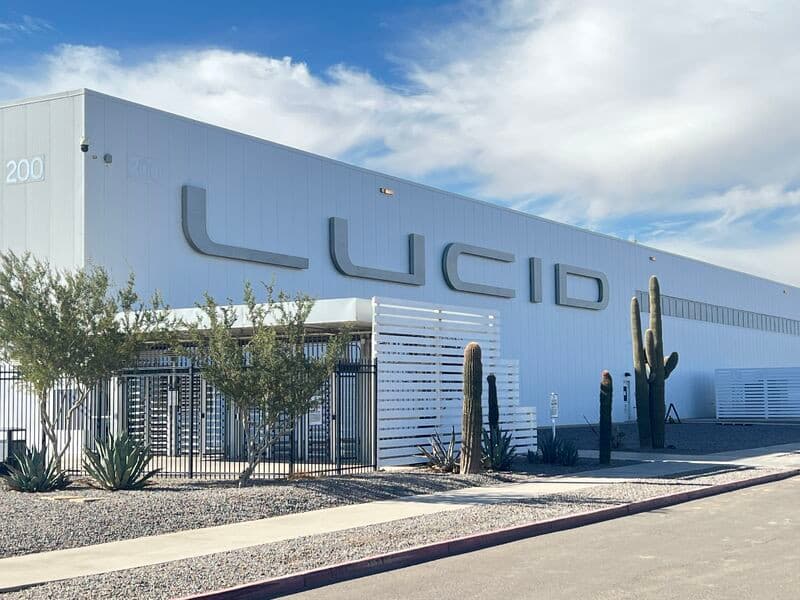
The cuts affect full-time employees, contractors, and hourly production workers in manufacturing. The company is also shutting down the second shift of production at its AMP-1 factory in Casa Grande, Arizona, and has suspended its full-year production guidance while Napoli evaluates the business.
~1,500
jobs eliminated, including contractors and hourly workers
$158M
in annualized cost savings expected from the plan
$32M
in severance and employee transition costs to be paid
What Lucid said
"These are difficult decisions taken to align production with demand, reduce inventory, and adapt to declining market conditions. They are part of a broader effort to simplify the company, sharpen execution, and position Lucid to become more competitive over time."
— Lucid Motors spokesperson, June 22, 2026
The plan was filed with the U.S. Securities and Exchange Commission on June 22 and is expected to be substantially complete by the end of the third quarter of 2026. Lucid said the restructuring is designed to advance the company's path toward profitability by streamlining its organizational structure and aligning production with anticipated demand.
The executive changes
Silvio Napoli
CEO — In role since June 1, 2026
Formally assumed the CEO position on June 1. These layoffs are his first major strategic move. Previously announced he would be evaluating all business operations.
Marc Winterhoff
COO — Departed effective immediately
Served as Lucid's interim CEO for over a year before Napoli took over. Moved to COO when Napoli arrived. The COO role has now been permanently eliminated. He will receive severance, security support, and keeps his company vehicle.
The elimination of the COO role is significant. Winterhoff was the executive who steered Lucid through a turbulent stretch that included a supplier disruption that hammered Gravity SUV deliveries in February, a suspended production outlook, and the company's first major layoff round earlier this year. His departure removes the last executive continuity from the previous leadership era.

The second layoff in five months
This is not the first time Lucid has cut staff in 2026. In February, the company laid off approximately 12 percent of its workforce as part of an earlier push toward profitability. Monday's announcement brings the total to around 30 percent of the workforce reduced in a single year.
February 2026
Lucid cuts 12% of its workforce in its first major layoff of the year. A seat supplier issue disrupts Gravity SUV deliveries the same month.
April 14, 2026
Lucid announces Silvio Napoli as incoming CEO. Marc Winterhoff moves from interim CEO to COO. Lucid also expands its robotaxi partnership with Uber to at least 35,000 vehicles.
May 2026
Lucid suspends its 2026 production guidance, citing elevated inventory. CEO Napoli announces he will review all business operations.
June 1, 2026
Silvio Napoli officially assumes the CEO role.
June 22, 2026
Lucid files an 8-K with the SEC announcing 18% workforce reduction, elimination of the COO role, shutdown of the AMP-1 second production shift, and $158 million in annualized savings.
The financial picture behind the cuts
The restructuring reflects a company under serious financial pressure. Lucid lost $2.7 billion on revenue of $1.35 billion in 2025 — spending roughly two dollars for every dollar it brought in. Its negative free cash flow last year was $3.8 billion, approximately 31 percent larger than the year before.
Lucid's financial headwinds
- Lost $2.7 billion in 2025 on $1.35 billion in revenue
- Negative free cash flow of $3.8 billion in 2025 — 31% worse than the prior year
- Elevated vehicle inventory requiring production alignment
- Supplier disruption in February 2026 hurt Gravity SUV deliveries
- Production guidance suspended pending full business review
- This is the second major workforce reduction in under five months
Lucid does have financial backing: the company ended Q1 2026 with approximately $3.2 billion in liquidity, and on a pro forma basis including a capital raise and expanded delayed draw term loan from its primary backer, the Saudi Arabia Public Investment Fund, total liquidity stood at approximately $4.7 billion. That backstop has kept Lucid alive through multiple loss cycles, but it has not resolved the fundamental challenge of selling enough vehicles at a high enough margin to become self-sustaining.
What Lucid is betting on next
What Lucid says is coming
- A midsize vehicle platform expected to be the company's highest-volume product to date
- An Uber robotaxi partnership covering at least 35,000 vehicles, including Gravity and Midsize models
- A target of cash-flow positive operations by later this decade, stated at its investor day in March 2026
- Restructuring expected to complete by end of Q3 2026
Lucid has staked much of its recovery narrative on the Gravity SUV and the upcoming midsize platform. The Gravity is the company's first attempt at a higher-volume product after years of selling only the Air sedan at a price point that limited its addressable market. But Gravity deliveries were disrupted by a supplier problem in February, and elevated inventory of both models is one of the stated reasons for cutting the Arizona factory's second production shift.
What it means for the EV market
Lucid's troubles are not happening in a vacuum. The broader U.S. electric vehicle market has cooled significantly from its peak growth years. Several major automakers have delayed or scaled back their EV product plans in response to slower-than-expected consumer adoption. Lucid, which competes at the premium end of the market against Tesla's Model S and Plaid, is particularly exposed when luxury EV demand softens — its vehicles start at prices that put them beyond most mainstream buyers even in a strong market.
The elimination of 30 percent of the workforce in a single year — even if spread across two rounds — is the kind of structural reset that tends to precede either a successful turnaround or a deeper crisis. Napoli, who came from the industrial sector and has no prior automotive CEO experience in the U.S. EV space, is now working against a compressed timeline to demonstrate that the company's remaining assets — its technology, its Saudi backing, and its Uber partnership — can form the basis of a viable business.
Lucid enters the second half of 2026 smaller, leaner, and without a production forecast. The company's path forward depends on whether Napoli can stabilize inventory, ramp the Gravity to meaningful volumes, and begin generating enough revenue to reduce its dependence on outside capital. The $158 million in annualized savings is a real number — but against $2.7 billion in annual losses, it is a starting point, not a solution.