July 26, 2026·5 min read·By Learn My EV

GM Is Bringing Smart Grid Transformer Tech to Its Michigan Plant

General Motors is teaming up with UK deeptech firm IONATE to install its Hybrid Intelligent Transformer at GM's Romulus, Michigan transmission plant — IONATE's first U.S. deployment, aimed at giving the automaker real-time control over power quality as manufacturing energy demand keeps climbing.

GM Is Bringing Smart Grid Transformer Tech to Its Michigan Plant

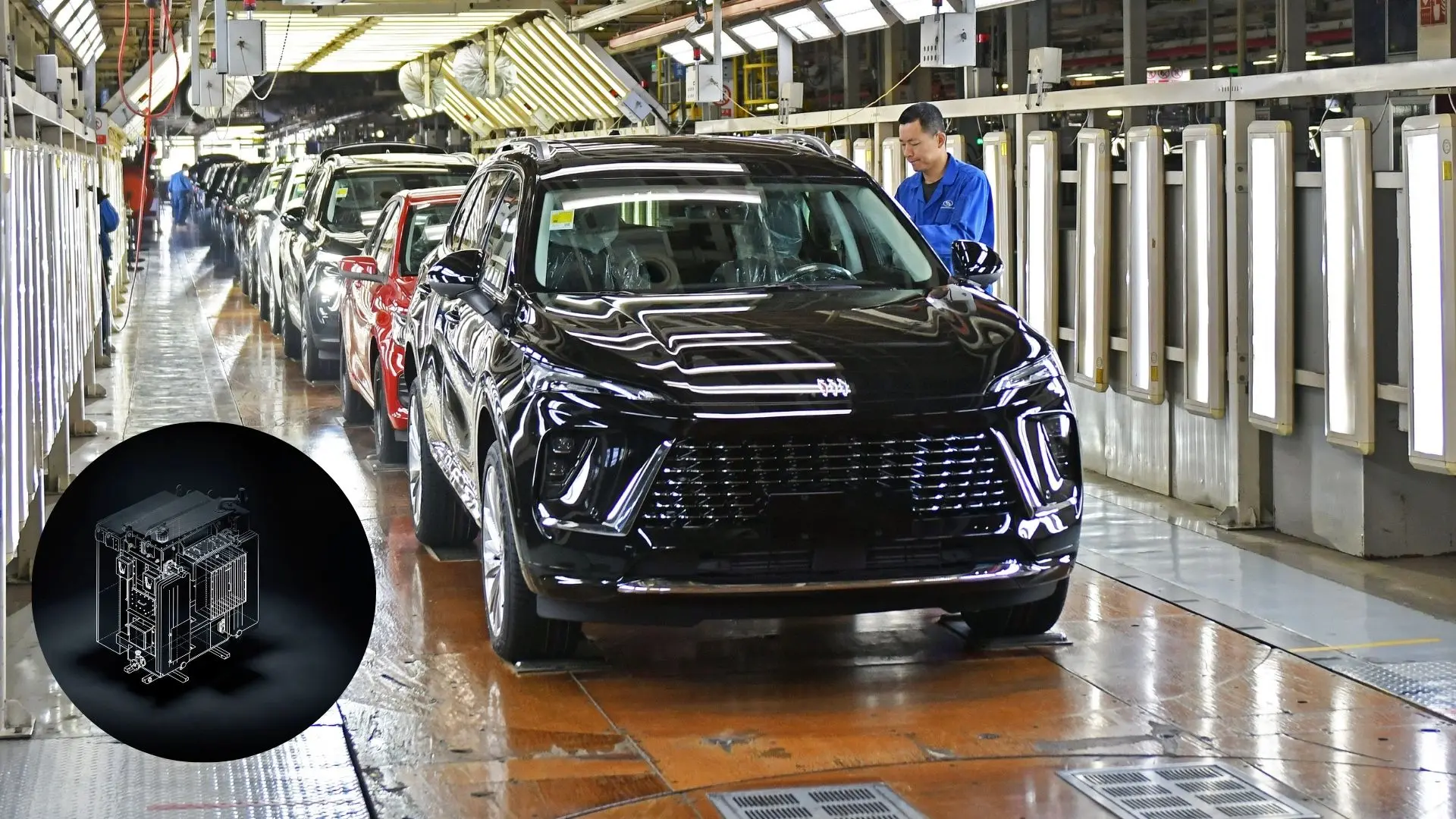
General Motors is getting an upgrade to the electrical infrastructure behind one of its manufacturing plants, and the technology is coming from an unexpected place: a UK-based startup making its first move into the U.S. market. GM has partnered with IONATE to deploy its Hybrid Intelligent Transformer (HIT) at the automaker's Romulus, Michigan facility — a project both companies are framing as a template for how heavy manufacturers can modernize power infrastructure without waiting years for utility-scale grid upgrades.

99%+
Claimed operating efficiency of the HIT transformer
33%
More distributed energy resources a grid can accommodate, per IONATE's modeling
900K sq ft
Size of the Romulus plant getting the upgrade

What's Actually Being Installed

IONATE's Hybrid Intelligent Transformer is, as the name suggests, a transformer — but one built with solid-state intelligence layered in rather than the passive equipment that's sat at grid connection points for over a century. The company says HIT can sense and resolve power flow issues in real time, giving sub-millisecond visibility into power conditions while operating at more than 99% efficiency. Positioned at the connection point between the grid and a facility's internal power system, it's designed to catch and correct disturbances before they cause downtime or ripple out to the surrounding grid.

The first units — U.S.-standard 3MVA IEEE-spec transformers — are currently finishing build and testing, with installation at the Romulus plant expected in the coming months. GM and IONATE say they'll evaluate expanding the technology to other GM manufacturing sites depending on how the initial rollout goes.

Why Romulus, specifically
  • The plant is roughly 900,000 square feet and currently produces 10-speed transmissions for GM's full-size trucks and SUVs
  • GM has invested a combined $600 million across two funding rounds since November 2025 to expand transmission capacity there
  • That expansion means rising power demand at the site — exactly the kind of situation IONATE is pitching its technology for

The Pitch: Squeeze More Out of the Grid You Already Have

IONATE's broader argument is that a lot of the power capacity utilities and manufacturers need already exists — it's just poorly monitored and inefficiently used. Based on the company's own modeling of average deployment scenarios, IONATE says grids running its technology can accommodate 33% more distributed energy resources, carry 25% more power without physically upgrading poles and wires, and cut wasted power by about 6%. Each installed unit also acts as a real-time control node, coordinated through IONATE's Aurora software platform, so individual deployments can theoretically contribute to grid-wide resilience as more of them come online.

"Deploying the Hybrid Intelligent Transformer with General Motors marks a significant step in reinforcing industrial power infrastructure with solid-state intelligence. GM's manufacturing operations demand the highest standards of reliability, efficiency, and power quality — and that is what we build for."

— Matthew Williams, Founder and CEO, IONATE

On GM's side, the framing is more about operational reliability than marketing. "Maximizing efficiency and resiliency is crucial in GM's manufacturing system, and it's why we're implementing innovative technology to enhance our energy management and the overall grid," said Luis Cervantes, GM's executive director of manufacturing excellence, in the companies' joint announcement.

Part of a Bigger Grid Squeeze

This deal lands against a backdrop of growing strain on U.S. electrical infrastructure, as industrial electrification, EV manufacturing, and AI-driven data center demand all compete for capacity on a grid that, in many places, hasn't been meaningfully modernized in decades. IONATE previously proved out its technology on grids in Portugal and Spain (with utility EDP/E-REDES) and in Austria (with Wien Group/Smartworks) before bringing it to the U.S. with GM as its first American industrial customer.

Worth keeping in perspective
  • The Romulus plant itself builds 10-speed transmissions for gas-powered full-size trucks and SUVs, not EVs — this is a grid-infrastructure story more than a direct EV manufacturing story
  • The efficiency and capacity figures (33%, 25%, 6%) come from IONATE's own modeling of "average deployment scenarios," not independently verified results from the GM site specifically
  • This is IONATE's first U.S. deployment — real-world performance data from Romulus isn't available yet since installation hasn't happened

The bottom line: This isn't a flashy new EV or battery announcement, but it points at a real bottleneck facing the entire auto industry's electrification push: aging grid infrastructure that wasn't built for today's power demands. Whether or not IONATE's specific numbers hold up at scale, GM's willingness to test smart-transformer technology at a major manufacturing site is worth watching, especially if it expands to plants that build EVs and batteries directly.

Advertisement