Alpitronic Picks South Carolina for $34 Million EV Charger Plant: 400-kW and 1-MW Hyperchargers, 70 Jobs, 2027 Start
Alpitronic, maker of the 400 kW chargers used by Ionna and Walmart, will build HYC400 and 1 MW HYC1000 fast chargers at a $33.94 million Fort Mill, South Carolina plant opening in February 2027.
An alpitronic hypercharger at an ESWE fast-charging site in Wiesbaden, Germany. Photo: Matti Blume / Wikimedia Commons (CC BY-SA 4.0)
The company that builds the chargers at Ionna Rechargeries and many Walmart lots is about to start making them in South Carolina. Alpitronic Americas, the US arm of Italian fast-charger maker alpitronic, will invest $33.94 million in a factory in Fort Mill, York County, and create 70 jobs, the South Carolina Department of Commerce announced on November 18.
The plant will build alpitronic's Hypercharger line, including the 400 kW HYC400 and the 1-megawatt HYC1000. Operations are set to begin in February 2027. For US drivers, it means more of the same high-power hardware already on the road, built closer to where it gets installed.
$33.94M
Investment in the Fort Mill plant
70
New jobs
173,315
Square feet of factory, lab and warehouse space
Feb 2027
Expected start of operations
Where Is the New Alpitronic Plant?
The factory will sit at 3560 Stateview Blvd. in Fort Mill, just south of the North Carolina line. That is a short drive from Charlotte, where alpitronic already runs its North American headquarters. The company's global headquarters is in Bolzano, Italy.
The building is part of the redevelopment of the former Wells Fargo Home Mortgage campus near Interstate 77 and Carowinds. Alpitronic Americas bought it in September for more than $28 million, according to Charlotte public radio station WFAE, which cited The Herald of Rock Hill. WFAE also reported that the 70 jobs are expected over five years.
The site is more than an assembly line. According to the state, it will also house warehousing, a testing lab, repair operations, logistics and offices. South Carolina's Coordinating Council for Economic Development approved job development credits for the project and gave York County a $200,000 Set-Aside grant to help pay for building improvements.
"Our Fort Mill facility will put U.S. production under our direct control." — Patrik Herrnegger, CEO, Alpitronic Americas
That line matters. Alpitronic has built chargers in the US since 2024, when it began producing Hypercharger 400 units in Wisconsin for Mercedes-Benz High-Power Charging. The company has not said whether Fort Mill will replace or add to that work. What it has said is that a plant it owns outright will bring it closer to customers.
What Chargers Will Be Built in South Carolina?
The state named two products. Here is how they compare, based on alpitronic's US product pages and reporting by InsideEVs, Electrek and electrive.
Spec
HYC400
HYC1000
Total power
Up to 400 kW
Up to 1,000 kW (1 MW) per power cabinet
Layout
All-in-one charger
Central cabinet feeding separate dispensers
Vehicles at once
Up to 3 (US spec)
Up to 8 (four dual-plug dispensers)
Max to one car
Up to 400 kW
Up to 600 kW on a standard dispenser
Connectors
CCS1, NACS, CHAdeMO
CCS or NACS for cars; MCS for heavy trucks
US status
On sale and widely installed
US and Canada launch planned for 2027
Sources: alpitronic, SC Department of Commerce, InsideEVs, EVChargingStations.com, electrive
The HYC400 is the workhorse. It is the charger of choice for Ionna and Walmart, according to InsideEVs. The HYC1000 is the newer, bigger system. Its cabinet holds eight 125 kW power stacks and shifts power between stalls in 62.5 kW steps, so a car that is nearly full gives up power to one that just plugged in.
The HYC1000 also has a truck dispenser with the Megawatt Charging System (MCS) plug, rated up to 1,500 amps. That makes it relevant for electric semis and fleet depots, not just passenger cars.
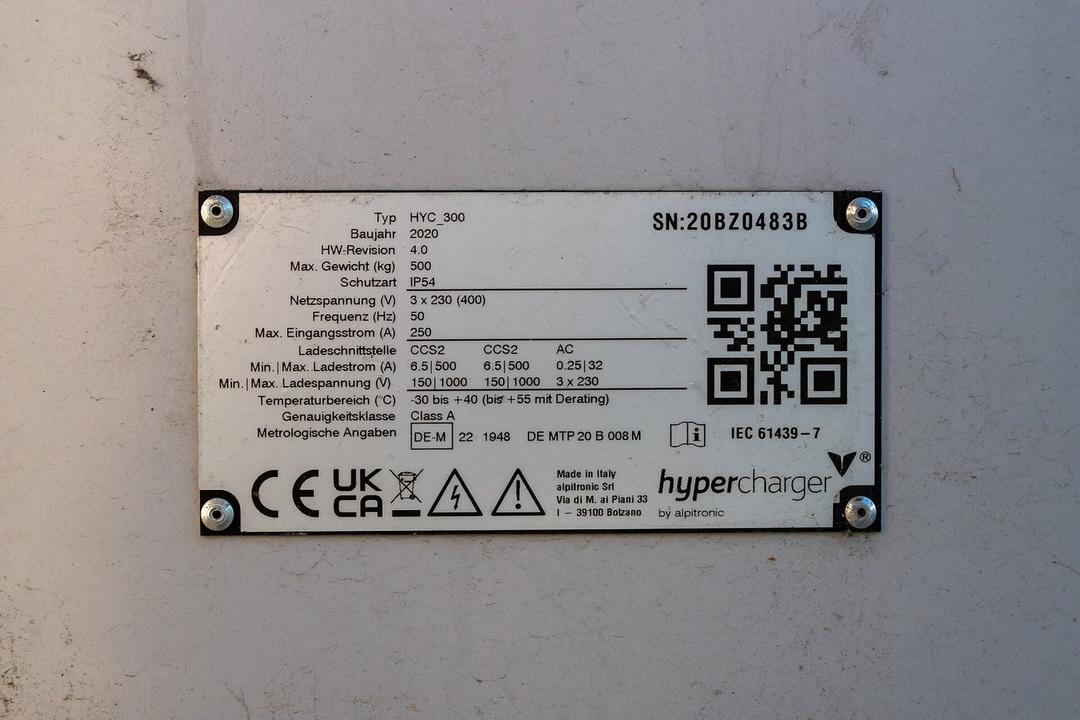
Today, alpitronic hyperchargers like this HYC300 in Germany carry a "Made in Italy" plate from its Bolzano headquarters. The Fort Mill plant will add US-built units starting in 2027. Photo: Matti Blume / Wikimedia Commons (CC BY-SA 4.0)
Advertisement
Which US Charging Networks Use Alpitronic Chargers?
If you have fast-charged at one of these networks, there is a good chance you used alpitronic hardware:
Ionna, the automaker-backed network, runs alpitronic HYC400 units at its Rechargeries.
Walmart picked alpitronic and ABB as suppliers for its first charging sites.
Mercedes-Benz High-Power Charging has deployed US-built Hypercharger 400 units since 2024.
Electrify America and BP Pulse have also been named as alpitronic partners. InsideEVs did not confirm how many units each has installed.
Alpitronic's hardware has also been used for a high-power demo. In October, BMW, Ionna and alpitronic showed a BMW iX5 charging at up to 460 kW in Laguna Hills, California. That was a technology demonstration, not a speed you can get at a public station today.
Buy America angle
Chargers paid for with federal highway money, including the NEVI program, must meet Buy America rules. Under the current Federal Highway Administration waiver, chargers made on or after July 1, 2024, need US final assembly and at least 55% US-made components by cost. In February 2026, FHWA asked for comment on raising that threshold to as much as 100%. Alpitronic did not tie the Fort Mill plant to these rules, but owning a US factory gives it more control over how much of each charger is American-made.
Advertisement
What It Means for US EV Drivers
The short version: more fast chargers that can keep up with the quickest-charging EVs on sale.
Few cars can use the full 400 kW today, but more are getting close. The 2026 Lucid Gravity can accept up to 400 kW, according to InsideEVs. The Tesla Cybertruck peaks at about 325 kW, and the 2025 Porsche Taycan is rated at up to 320 kW. Ionna CEO Seth Cutler told InsideEVs that the network's new flagship site has enough power that "you could have 10 Lucid Gravitys and they can all pull 400 kilowatts."
Most EVs charge more slowly than that. But a 400 kW charger still helps those cars. Because the power is shared, a high-output unit is less likely to slow you down when the stall next to you is busy.
Local production could also help with uptime. The Fort Mill site will include a repair operation and testing lab, which should make it easier to get parts and fixed units back to US stations. Alpitronic has made reliability its pitch. "We have a clear strategy, charging must always work," Alpitronic Americas president Mike Doucleff told InsideEVs in 2025.
Don't expect 1 MW for your car
The HYC1000's 1-megawatt figure is the total for the whole cabinet, shared across up to eight stalls. A passenger car on a standard dispenser tops out at 600 kW, and your EV will only take what its battery allows. The full megawatt matters most for heavy trucks using MCS.
When Will Fort Mill Chargers Show Up?
Operations are expected to start in February 2027. Herrnegger said the company is preparing "to begin production in early 2027." Alpitronic has not said how many chargers the plant can build per year or which customers will get the first units.
Demand is there. Ionna is still adding sites, Walmart is expanding its network, and Ionna has said 500 kW chargers could arrive around 2028. Ionna has not said who will build those 500 kW units.
Gov. Henry McMaster called the deal proof that "South Carolina continues to attract innovative companies that are shaping the future of advanced manufacturing." The plant joins a growing EV supply base in the state, which already includes BMW, Volvo and Scout Motors.
The bottom line: Alpitronic, the Italian company whose chargers power Ionna and many Walmart stations, is spending $33.94 million on a 70-job plant in Fort Mill, South Carolina. Starting in February 2027, it will build 400 kW HYC400 and 1 MW HYC1000 Hyperchargers there, with on-site testing and repair. For drivers, that should mean more high-power stalls at networks like Ionna and Walmart, and faster fixes when something breaks.