Tesla's autonomy team had a busy 24 hours. On July 20, 2026, Tesla and SpaceX's Starlink jointly announced that Starlink V5 satellite connectivity is now "directly integrated" into the Cybercab. Then, on July 21, two more posts landed back to back: the invite-only Bay Area "robotaxi" rideshare service can now pick up and drop off at San Francisco International Airport, and the separate, unsupervised Robotaxi network — the one already running in Austin, Dallas, Houston, and Miami — switched on in Tampa and Orlando. Three announcements, three different parts of Tesla's autonomy stack. Here's what's actually true in each one.
2
New Florida metros: Tampa & Orlando join Miami
SFO
Busiest of 3 Bay Area airports to get robotaxi pickup
V5
Starlink generation built into the Cybercab's roof
Starlink V5, Built Into the Cybercab's Roof
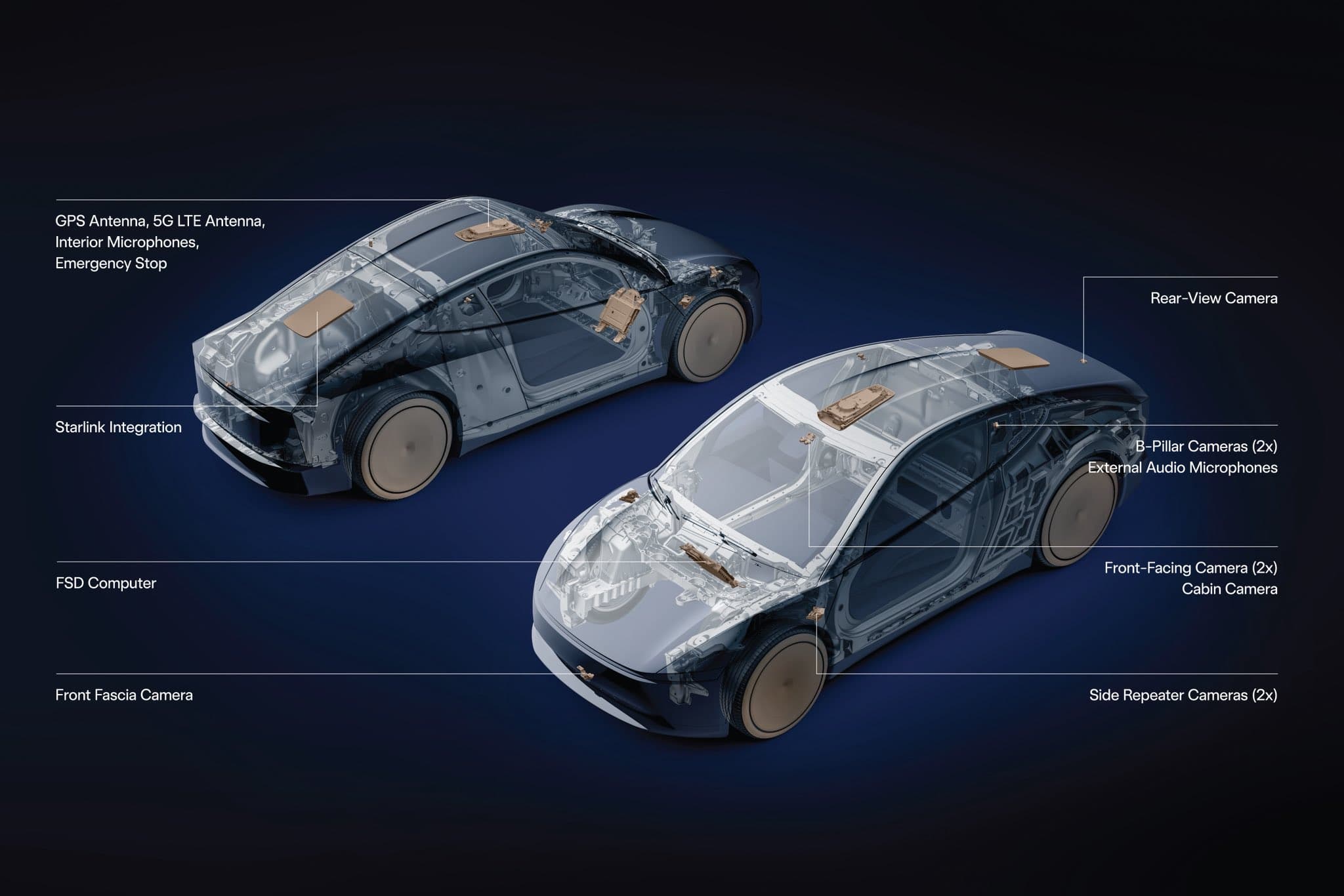
The reveal came through a pair of posts on X: Starlink shared a cutaway diagram with the line "High-speed internet from space for the future of autonomous vehicles," while Tesla's own post was three words — "Starlink V5 directly integrated in Cybercab." The graphic (shown above) labels a "Starlink Integration" block sitting in the roof structure, positioned alongside the GPS antenna, 5G LTE antenna, interior microphones, and the FSD computer.
Neither company explained why a car that's designed to drive itself entirely on its own onboard computer needs an internet connection from space. That's not a small detail — it's the whole premise of Tesla's approach to self-driving. The Cybercab's FSD stack runs on AI4 hardware and perceives, plans, and drives without any data connection at all. Cut the signal entirely, and the car keeps driving. What connectivity actually does is different: live routing and navigation, fleet dispatch, remote support for a stuck vehicle, over-the-air updates, and in-cabin streaming for passengers. All genuinely useful. None of it is what keeps the car on the road.
What we actually know
- Announced July 20, 2026 via posts from @Tesla and Starlink on X
- Starlink terminal sits in the Cybercab's roof, alongside GPS/5G antennas and interior microphones
- No spec sheet, timeline, or production confirmation was given
- Tesla is currently building Cybercab units before it has regulatory approval to sell or drive them autonomously, so "integrated" could mean a current production feature or a forward-looking design plan
Why the Timing Raises Questions
Satellite connectivity solves a coverage problem Tesla's robotaxi fleet doesn't currently have. The unsupervised Robotaxi network operates in small geofenced zones in Austin, Houston, Dallas, and a limited mapped area of Miami — dense metro areas that already have strong existing cellular coverage. Satellite internet's real advantage is filling gaps in rural and remote areas where cellular service thins out, and Tesla's robotaxi fleet is nowhere close to operating there.
A satellite terminal in every Cybercab looks less like a driving necessity right now and more like a built-in subscription line for a Musk-owned satellite company, paid for by Tesla's own fleet purchases.
The timing fits a broader pattern of Elon Musk routing Tesla money toward his other companies — Tesla previously invested $2 billion in xAI, which SpaceX then absorbed in a separate deal, and a proposed Tesla-SpaceX tie-up has been floated as another billion-dollar arrangement tying the two companies together financially. Under that reading, the Starlink hardware is less about a driving necessity and more about creating a recurring revenue line for SpaceX, funded by Tesla's own fleet purchases.
Bay Area Rideshare Now Reaches SFO
Separately, Tesla's Bay Area ride-hailing service — the one that still requires a human safety monitor behind the wheel — crossed a real milestone on July 21: passengers can now request pickup and drop-off at San Francisco International Airport, the busiest of the three Bay Area airports Tesla has been working to clear. San Jose Mineta was the first to come online, back on October 27, 2025; SFO took roughly nine additional months of permitting to follow.
The fine print on "Bay Area rideshare"
- Still invite-only — limited to select Tesla owners, employees, and their friends and family
- Every vehicle carries a human safety monitor behind the wheel; this is not the unsupervised network
- Operates under an SFO Authorized Limousine Permit (LP-263002), valid through January 31, 2027
- Legally classified as a chauffeur operation under California's Transportation Charter Party framework — which is why the safety monitor is required by regulation, not just caution
It's worth being precise about what this service is, because it's easy to conflate with the fully driverless Robotaxi network. The Bay Area service is closer to a supervised chauffeur product: a human is always in the driver's seat, and the SFO expansion only extends where existing invited riders can go — it doesn't open new invitations.
Robotaxi Goes Live in Tampa and Orlando
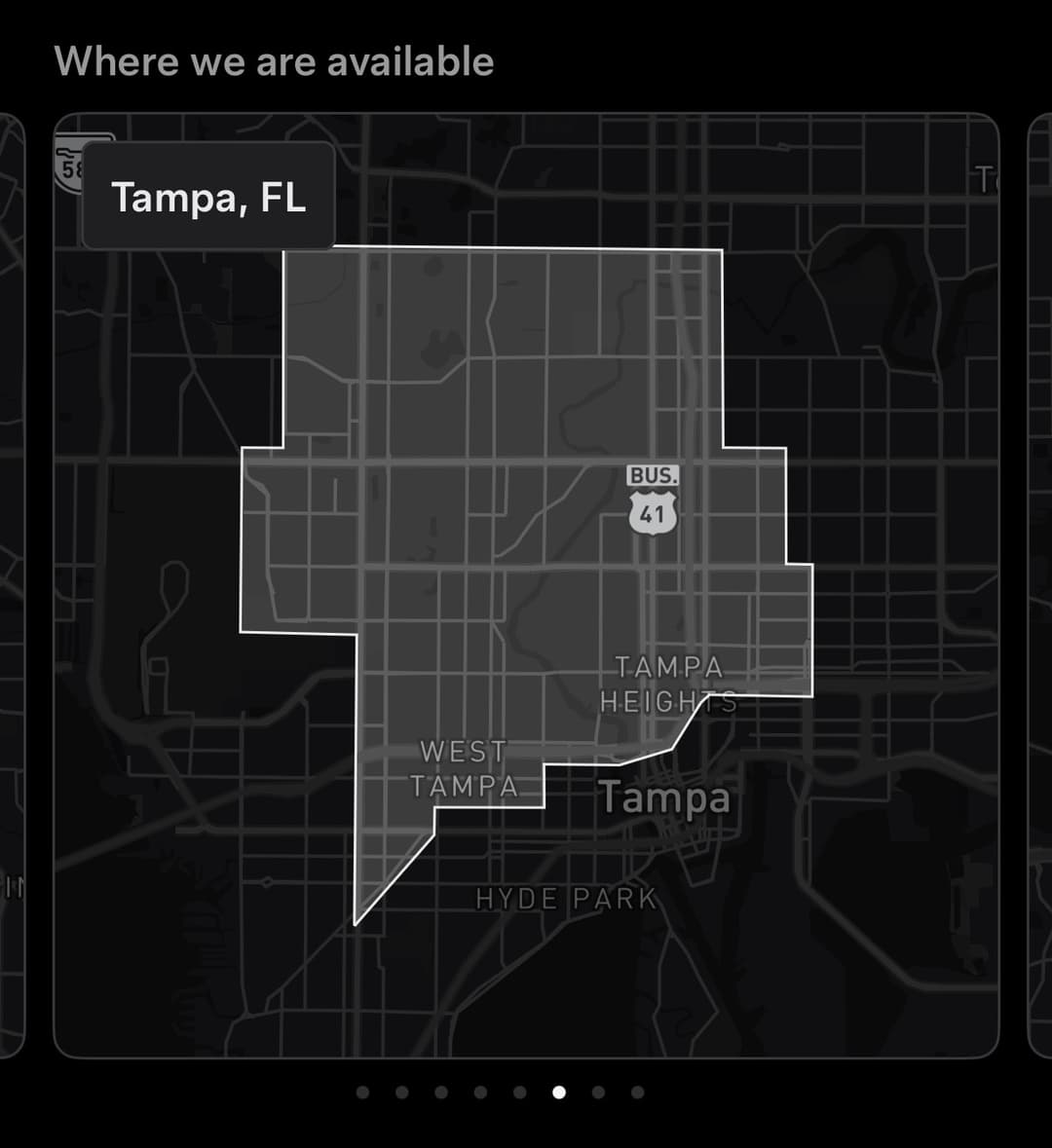
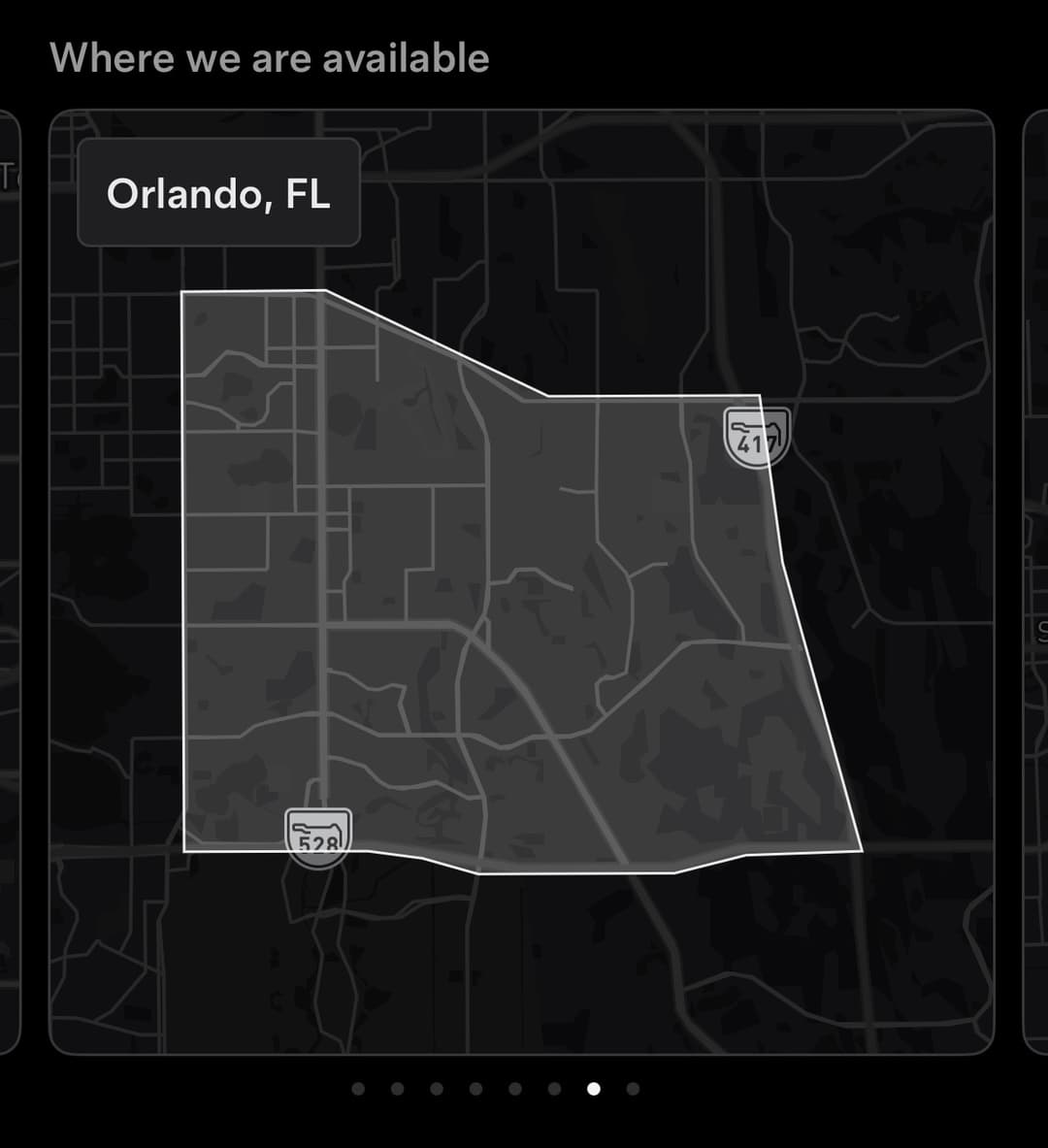
The bigger expansion for the unsupervised network: the @robotaxi account confirmed "Robotaxi now in Tampa & Orlando!" alongside service-area maps for both cities, matching the format Tesla used when Miami launched. That makes Tampa and Orlando the third and fourth Florida markets tied to Tesla's rollout, following Miami's launch on July 3, 2026 — itself the company's first robotaxi market outside Texas and California.
Tesla's initial Robotaxi service zone in Tampa. (Source: @robotaxi via X)
Tesla's initial Robotaxi service zone in Orlando. (Source: @robotaxi via X)
| City | Status | Notes |
| Austin, TX | Live | Original Robotaxi launch market |
| Dallas / Houston, TX | Live | Expanded network within Texas |
| Miami, FL | Live since July 3, 2026 | 10–14 sq. mile zone in western Miami-Dade |
| Tampa & Orlando, FL | Live as of July 21, 2026 | Newest additions; geofenced zones per Tesla's maps |
The Florida push traces back to Tesla's Q4 2025 earnings call, where the company named seven target cities for robotaxi expansion in the first half of 2026: Dallas, Houston, Phoenix, Miami, Orlando, Tampa, and Las Vegas. Orlando and Tampa were both frequently requested by riders given the region's heavy tourist traffic around Disney and other resorts, which makes today's launch a direct response to that demand — though as with Miami, expect the initial service areas to be tightly geofenced rather than city-wide.
How the Existing Cities Are Actually Doing
New maps are easy to post. The more useful question is how the cities Tesla already operates in are actually performing, and the picture there is mixed. Austin — the original launch market from June 2025 — has grown to roughly 16 to 20 active unsupervised vehicles on the road day-to-day, well short of Musk's original public target of 500 cars by the end of 2025 (a goal Tesla quietly revised down to around 60 before scaling back further). Dallas and Houston, which went unsupervised in April 2026, have stayed similarly small: around three vehicles apiece rather than the fleet growth riders were expecting after the initial launch coverage.
~16-20
Active unsupervised cars in Austin, down from a peak near 25
14-17
Crashes reported to NHTSA since the Austin launch
~4x
Tesla's own robotaxi crash rate vs. its cited average human driver benchmark
Crash data reported to NHTSA shows Tesla's Austin robotaxis logging somewhere between 14 and 17 incidents since the June 2025 launch, across an estimated 800,000-plus cumulative paid miles — a rate that, by Tesla's own published Vehicle Safety Report benchmark for the average human driver, works out to roughly four times as many minor collisions per mile. Most of these have been low-speed, no-injury incidents, and one high-profile case out of Houston on July 20, 2026 was reportedly caused by a human remote operator taking control of the vehicle rather than the onboard FSD system itself — a reminder that "unsupervised" doesn't mean nobody is ever in the loop; Tesla still runs a remote assistance layer that can intervene.
Signs of a stall, not just a slow ramp
- Musk said in April 2026 that a wider robotaxi expansion would wait for FSD version 15, effectively pausing aggressive fleet growth in existing cities
- Independent vehicle-tracking efforts have shown active fleet counts in Austin, Dallas, and Houston shrinking over multi-week stretches rather than climbing
- Waymo, by comparison, already runs roughly 300 robotaxis in the Austin area alone as part of a 577-vehicle Texas fleet, and completes over 500,000 paid rides per week nationally
Miami's first weeks have been rockier still. The market launched July 3, 2026 with as few as two to three unsupervised vehicles in service — not enough to meet demand. Spot checks found the service completely unavailable more than a quarter of the time, riders reported wait times exceeding 15 minutes when a car was available at all, and several rides were canceled outright, including at least one apparently tied to a lightning storm. Florida's climate is also a live variable for Tesla's camera-only approach to self-driving: NHTSA escalated its investigation into Tesla's FSD system to an engineering analysis in March 2026 — the step before the agency can seek a recall — after finding the system "fails to detect and/or warn the driver appropriately under degraded visibility conditions such as glare and airborne obscurants," exactly the kind of sudden tropical downpours and intense sun glare Miami, Tampa, and Orlando all see regularly.
None of this means Tampa and Orlando are destined to repeat Miami's rough start — Tesla has had more practice with Florida weather by now, and each new city benefits somewhat from lessons learned in the last one. But the pattern across every city Tesla has actually launched, rather than just announced, is the same: small fleets, availability gaps, and a safety record that's still being scrutinized, running well behind the pace of the announcements themselves.
Three Announcements, One Pattern
Taken individually, none of these is a huge leap: a hardware reveal with no timeline, an airport added to an already-limited chauffeur service, and two new geofenced zones added to a network that's still thin on the ground in the cities it already serves. Taken together, they read as a coordinated push to keep Tesla's autonomy narrative moving — expanding the visible geographic footprint (Florida, Bay Area airports) at the same time as teasing future-facing hardware (Starlink) that doesn't yet have an obvious use case in the cities where the fleet actually operates, and while the existing network is still working through fleet-size and reliability growing pains.
The bottom line: If you're in Tampa or Orlando and invited to the network, you may actually be able to hail a driverless ride soon — that's the most concrete news here, though expect the same small-fleet, limited-availability experience that defined Miami's first weeks. The SFO expansion is real but narrow: it only helps existing Bay Area invitees, and there's still a human behind the wheel. The Starlink integration is the least substantive of the three right now — no spec, no confirmed production timeline, and arguably a business arrangement benefiting SpaceX more than it solves any problem the Cybercab currently has.