Tesla reported second-quarter 2026 earnings this week, and the results split cleanly into two stories. On the financial side, profitability got noticeably worse: non-GAAP earnings per share came in at $0.33 against a $0.55 estimate, gross margin slipped to 16.8%, and free cash flow went negative for the quarter. On the product side, nearly everything Tesla has been promising for years is now visibly moving at once — Cybercab entered production, Optimus took over factory space once used for the Model S and X, FSD subscriptions grew faster than in any prior quarter, and the Robotaxi network crossed 2.4 million cumulative paid miles.
$0.33
Non-GAAP EPS, vs. $0.55 estimate
$28.2B
Revenue, vs. $27.6B estimate
-$1.1B
Free cash flow for the quarter
The Financial Picture: A Revenue Beat, a Profit Miss
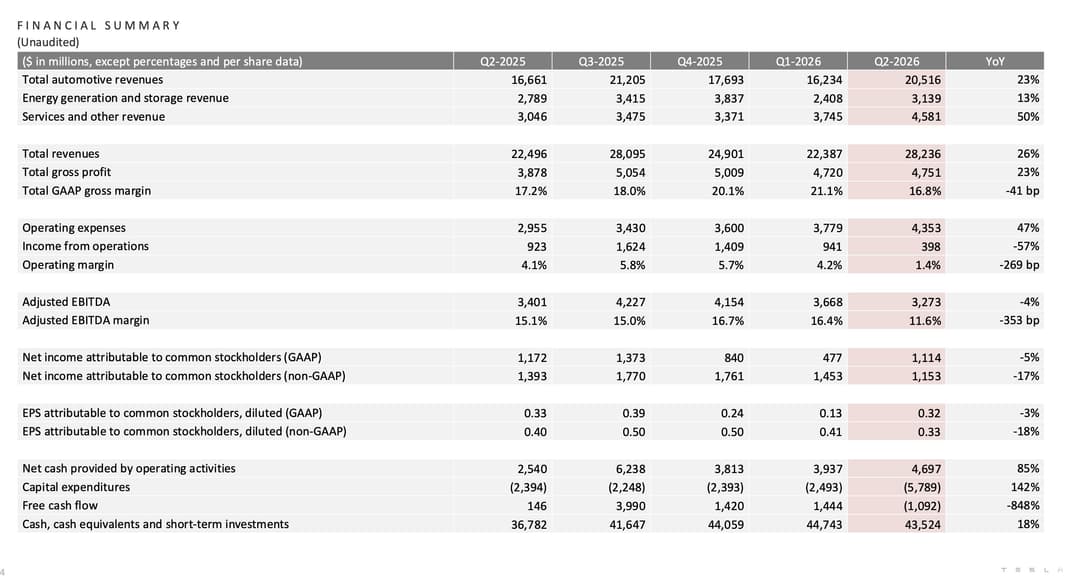
Total revenue of $28.2 billion beat Wall Street's $27.6 billion estimate and was up 26% year over year, driven partly by a 50% jump in "services and other" revenue. But nearly every profitability metric moved the wrong direction. GAAP gross margin fell to 16.8%, down from 21.1% just one quarter earlier. Operating margin collapsed to 1.4%, compared to 4.2% in Q1 and 4.1% a year ago. GAAP net income landed at $1.11 billion, and non-GAAP EPS of $0.33 missed the $0.55 analyst estimate by a wide margin.
| Metric | Q2 2026 | Q1 2026 | YoY Change |
| Total revenue | $28.24B | $22.39B | +26% |
| GAAP gross margin | 16.8% | 21.1% | -41 bp |
| Operating margin | 1.4% | 4.2% | -269 bp |
| GAAP net income | $1.11B | $477M | -5% |
| Non-GAAP diluted EPS | $0.33 | $0.41 | -18% |
| Capital expenditures | $5.79B | $2.49B | +142% |
| Free cash flow | -$1.09B | $1.44B | -848% |
Tesla's official Q2 2026 financial summary, showing the trailing five quarters. (Source: Tesla shareholder deck)
The story underneath those numbers is capital spending. Capital expenditures more than doubled quarter over quarter to $5.79 billion, up 142% year over year — and that spending is exactly why free cash flow swung negative despite operating cash flow actually rising 85% year over year. Tesla is spending aggressively on new factories, battery capacity, and compute infrastructure well ahead of the revenue those investments are expected to eventually generate.
"We've never been more optimistic about the future... Scaling will be non-linear, and we are focused on long-term value creation."
— Tesla, Q2 2026 shareholder letter
FSD Subscriptions Had Their Best Quarter Ever
The clearest bright spot in the quarter was software attach rates. Tesla added roughly 200,000 net new FSD (Supervised) subscribers in Q2, pushing the total to 1.48 million — a 56% increase year over year and the largest single-quarter gain in the program's history. Tesla said an average of 2,200 customers subscribed to FSD (Supervised) per day during the quarter, and that the subscription business now generates approximately $775 million a year in recurring revenue.
FSD subscriptions, by the numbers
- 1.48 million total FSD (Supervised) subscribers, up 56% year over year
- +200,000 net new subscribers added in Q2 alone — a company record
- ~2,200 average daily subscriptions during the quarter
- ~$775 million/year estimated run-rate revenue from FSD subscriptions
CEO Elon Musk framed the shift bluntly on the earnings call, saying that people are increasingly buying a Tesla for the FSD software rather than buying FSD as an add-on to the car — in his words, treating the purchase as "Tesla FSD with a car attached, rather than the other way around." Whether or not that's literally true for most buyers, it captures how central the software subscription business has become to Tesla's pitch to investors, especially in a quarter where hardware margins compressed sharply.
Cybercab Enters Production, Alongside a Bigger Manufacturing Buildout
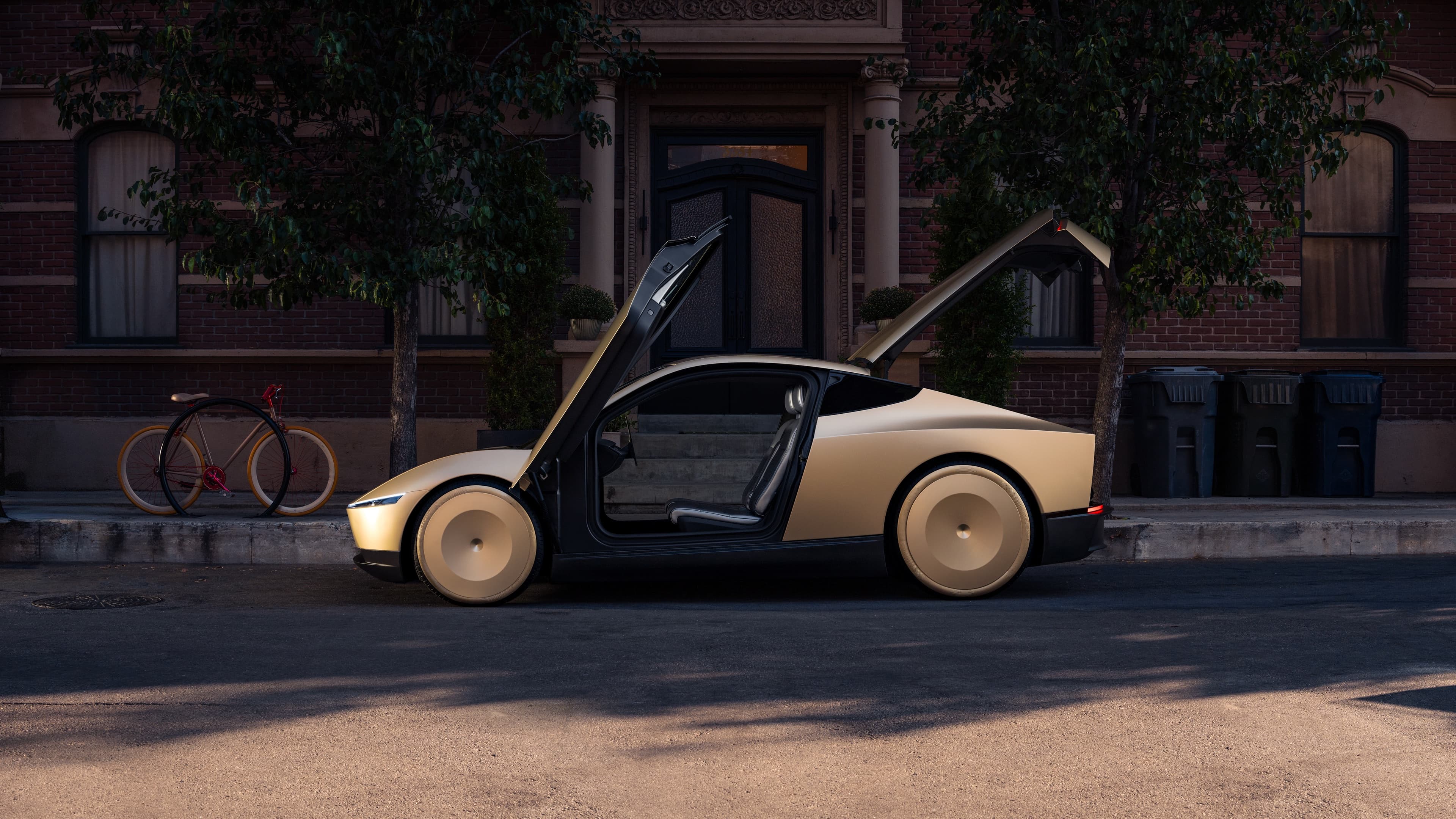
Tesla confirmed that Cybercab began production at Gigafactory Texas during the quarter, and published an updated installed annual manufacturing capacity figure of more than 125,000 units for the vehicle. Tesla Semi remains on track for production later this year at its new factory in Nevada, currently listed at the "commissioning" stage. Engineering test drives of production Cybercabs on public roads began in Q2, and this month Tesla started offering employee rides in Cybercabs on the Giga Texas campus itself — steps the company describes as "important precursors to Cybercab deployment in our Robotaxi fleets."
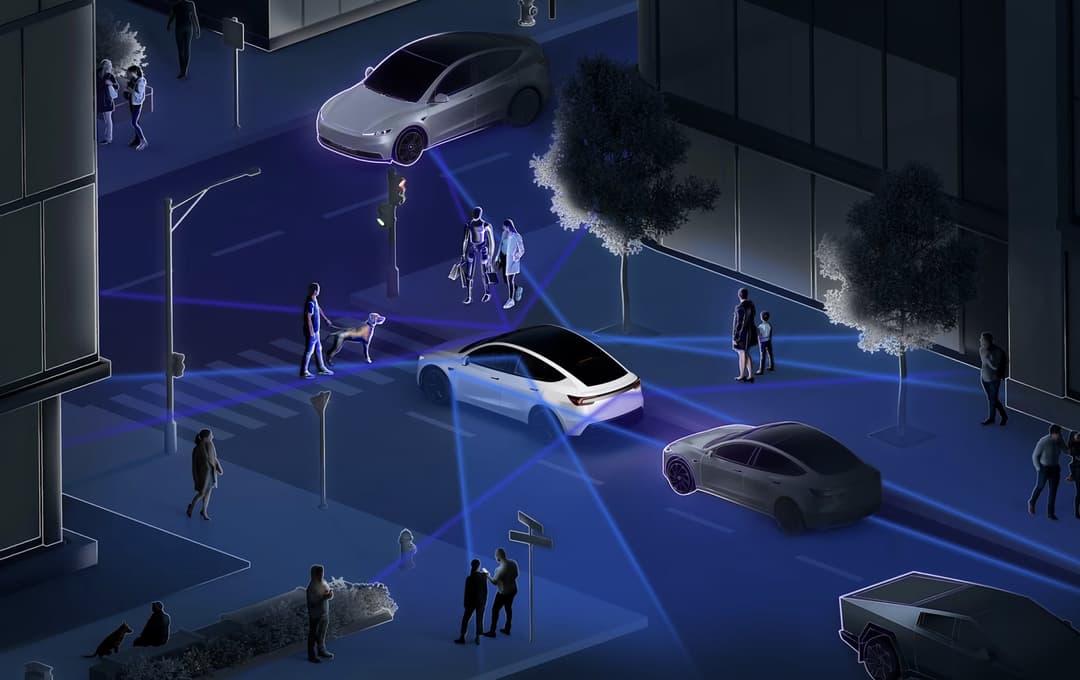
Tesla's illustration of FSD/Robotaxi perception across a mixed street scene with pedestrians, cyclists, and other vehicles. (Source: Tesla)
Behind all of this sits a manufacturing constraint Tesla has now flagged for several consecutive quarters: battery pack capacity. Tesla says pack capacity remains "the main limiting factor to near-term vehicle production volume increase," and detailed progress on multiple fronts to address it — expanding battery pack capacity in Berlin, ramping cathode material production and lithium refining in Texas, building out LFP cell production in Nevada for energy storage products, and increasing 4680 cell output specifically to support Cybercab, Semi, and Model Y production. Megafactory Texas, a separate facility, is described as nearing completion with production planned to start later this year.
Optimus Takes Over the Model S/X Line
In one of the quarter's more symbolically significant updates, Tesla confirmed it has decommissioned the Model S and Model X manufacturing lines at its Fremont factory and is installing the first-generation production lines for Optimus, the company's humanoid robot, in that same space. Tesla expects to begin Optimus production there "soon." The initial builds will reportedly be used internally, in what Tesla calls its "Optimus Academy," for training-data collection and further functionality development — meaning these early units are aimed at teaching the robot, not shipping to customers or businesses yet.
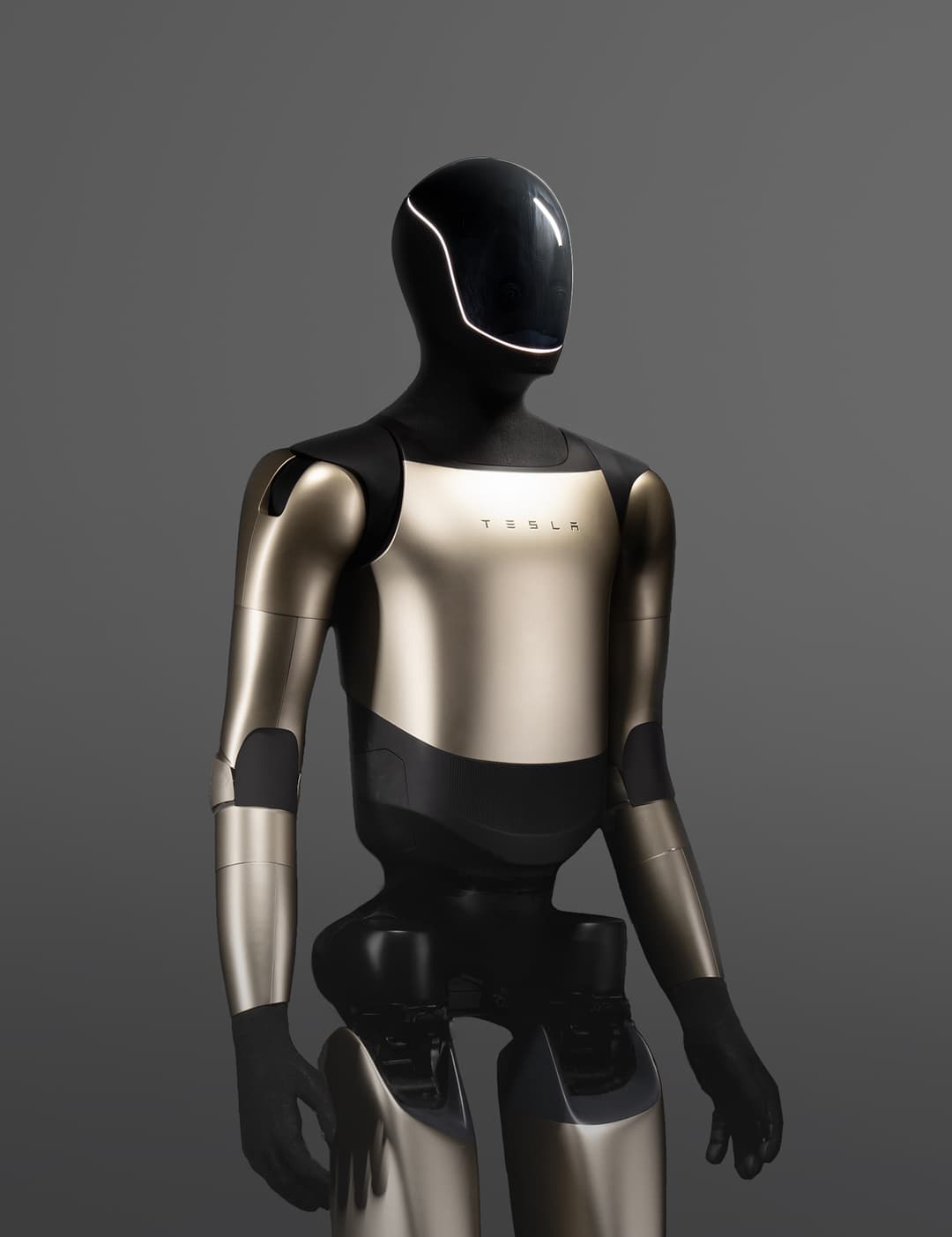
Tesla's Optimus humanoid robot. Production lines for Optimus have replaced the former Model S/X lines at the Fremont factory. (Source: Tesla)
Tesla also said it continued site development at Gigafactory Texas for Optimus, with "building construction now in full swing," and that it more than doubled its onsite compute capacity in Texas (measured in megawatts) during the first half of 2026. That compute buildout, which Tesla calls Cortex 2, is described as supporting both vehicle autonomy and humanoid robot software development simultaneously. Tesla plans to push Texas compute capacity to nearly 400 MW in the second half of 2026 — a 60% increase from June 2026 levels, and a 220% increase from the end of 2025.
Musk also previewed a new compute product called Megapod on the call, describing it as pairing an x86 computer with Tesla's AI4 chip — essentially, in his description, "digital Optimus in a giant box" — designed to be placed anywhere, including at Superchargers, to scale AI compute alongside distributed electricity production.

Robotaxi Keeps Growing, Now Running Early FSD V15
Tesla said its Robotaxi network reached 2.4 million cumulative paid miles in Q2, up from roughly 1.7 million miles at the end of Q1 — meaning the network added about 700,000 paid miles in a single quarter, more than the network's entire history up to that point took to accumulate before this year. Tesla's head of Autopilot software, Ashok Elluswamy, said the current Robotaxi fleet is already running early versions of FSD V15, with several improvement tracks planned for that version specifically.
Worth keeping in perspective
- 2.4 million cumulative Robotaxi miles is a small fraction of the 7-billion-plus miles logged across Tesla's broader FSD (Supervised) fleet
- Musk stated flatly that Tesla will not partner with ride-share platforms like Uber or Lyft for Robotaxi, saying "we will have enough demand" and that riders will book directly through Tesla's own app
- Fleet size in existing Robotaxi cities (Austin, Dallas, Houston) has been reported elsewhere as still fairly small in absolute vehicle count, even as cumulative mileage climbs
The Tension at the Center of This Quarter
Put together, Q2 2026 is a quarter where Tesla's core auto business generated weaker margins and negative free cash flow, while the company simultaneously ramped spending across four capital-intensive frontiers at once: Cybercab, Tesla Semi, Optimus, and AI compute infrastructure. Tesla's own language leans into that framing rather than away from it, describing this as "its largest and most exciting period of investment" and cautioning investors directly that "scaling will be non-linear." That's an accurate description of the financials this quarter — the spending is real and already showing up in margins, while the revenue payoff from Cybercab, Optimus, and expanded Robotaxi service remains mostly ahead of Tesla rather than behind it.
The bottom line: This was not a quarter where Tesla's core financials looked good — margins compressed sharply, EPS missed estimates, and free cash flow went negative. But it was also a quarter where Cybercab, Optimus, and Robotaxi all moved from slides and promises into physical production lines and paid miles. Whether that trade-off was worth it depends entirely on whether those programs scale the way Tesla is betting they will — and that's a question this earnings report raises far more than it answers.