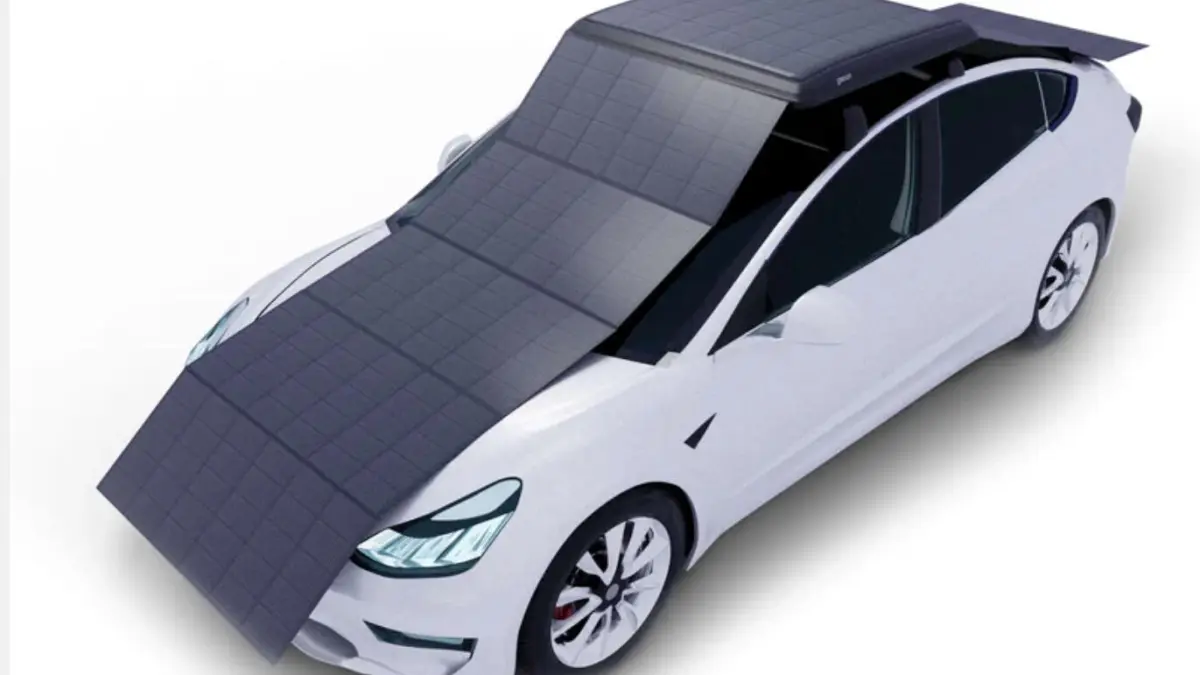
Photo: GoSun
It's one of the most common questions new EV owners ask: "Why don't they just put solar panels on the roof so it charges itself?" Some people even ask whether a solar roof could give you unlimited range. It's a great idea, and the physics doesn't allow it. A solar panel on a normal EV adds only a few miles a day, at best. Here's the math behind it, and why plugging in, especially at a Tesla Supercharger, is still the real answer.
~3–7 mi
Realistic solar miles per day from a sedan or SUV roof
~37 mi
How far the average American drives per day
85,000
Tesla Supercharger stalls worldwide
The short answer
- A car roof is only about 2 square meters, too small to collect much energy
- Even in full sun, that's only a few hundred watts, a tiny fraction of what an EV uses while driving
- On a typical sunny day, a roof panel adds roughly 1–2 kWh, or about 3–7 miles of range
- Parked in a garage, in the shade, or on a cloudy day, it adds close to zero
- Unlimited range from solar is a myth for any normal-sized car
The Math: Why the Roof Is Too Small
Sunlight at its strongest delivers about 1,000 watts per square meter at ground level. The best solar panels convert about 22% of that into electricity. A typical car roof has roughly 2 square meters of usable space:
| Step | Number |
|---|
| Usable roof area | ~2 m² |
| Peak sunlight | ~1,000 W per m² |
| Panel efficiency | ~22% |
| Peak solar power | ~440 W, best case |
| Realistic after heat, angle and dirt losses | ~300–350 W |
| "Peak sun hours" per day (varies by season and location) | ~3–5 hours |
| Energy per day | ~1–2 kWh |
| Typical EV efficiency (e.g. Model Y) | ~3.5 miles per kWh |
| Miles added per day | ~3–7 miles |
That's a best-case sunny day, with the car parked outside all day. A flat roof isn't angled toward the sun the way home panels are, car panels run hot (which lowers their output), and dust, trees and buildings cut it further. Park in a garage or a covered lot at work, and you get almost nothing.
Why It Can't Power the Car While You Drive
The gap is even bigger on the road. A midsize EV cruising at 65 mph uses roughly 15–20 kW of power. A roof panel making 400 W in perfect sun covers only about 2–3% of that. To drive on sunshine alone, you'd need a panel roughly 40 to 50 times bigger than the roof, around 1,000 square feet, about the floor area of a small apartment.
Why solar roofs aren't standard on EVs
- Cost: Curved, car-grade solar panels are expensive, and the few miles a day take years to pay back
- Weight: Extra weight and wiring partly cancel out the energy gained
- Safety and durability: Roof panels have to survive crashes, hail and car washes
- Better options: The same money spent on rooftop solar at home produces far more energy, because home panels are bigger, angled correctly and never parked in the shade
What About Cars Built Around Solar?
A few companies have designed cars from scratch around solar, and they show how extreme you have to go. Aptera, a three-wheeled, teardrop-shaped two-seater covered in solar cells, produced 4.2 to 4.75 kWh per day in independent TÜV Rheinland testing in sunny Carlsbad, California. That works out to about 40 miles a day, but only because Aptera is designed to use roughly 100 Wh per mile, about a third of what a typical EV uses. Put that same 4.5 kWh into a Model Y and you'd get around 15 miles.
Others haven't survived. The Dutch startup Lightyear and Germany's Sono Motors both spent years on solar cars before going bankrupt or canceling their vehicles. Some mainstream EVs offer small solar roofs, but those mostly run ventilation or top off the 12-volt battery rather than adding real range.