July 28, 2026·6 min read·By Learn My EV

Ford Beat Q2 2026 Earnings — But Model e Revenue Fell 58% and Losses Are Only 'Improving' Because Sales Are Shrinking

Ford topped earnings estimates and raised full-year guidance, sending the stock up. But its Model e electric vehicle division lost $919 million on roughly $1 billion of revenue — an 89.6% EBIT margin — and the company booked $4.2 billion in charges to unwind its battery joint venture and cancel EV programs. The entire EV strategy now hinges on a $30,000 truck that hasn't been revealed yet.

Ford Beat Q2 2026 Earnings — But Model e Revenue Fell 58% and Losses Are Only 'Improving' Because Sales Are Shrinking

Ford's Q2 2026 earnings looked good on the surface: adjusted EPS of $0.42 beat the $0.35 estimate, and the company raised its full-year adjusted EBIT guidance to $10–11 billion (from $8.5–10.5 billion) and its free cash flow guidance to $6–7 billion (from $5–6 billion). The stock rose after hours. But the page in Ford's earnings deck covering its Model e electric vehicle division tells a very different story than the headline numbers do.

-$919M
Model e EBIT loss, Q2 2026
-58%
Model e revenue, year over year
$4.2B
Special charges to unwind battery JV and cut EV programs
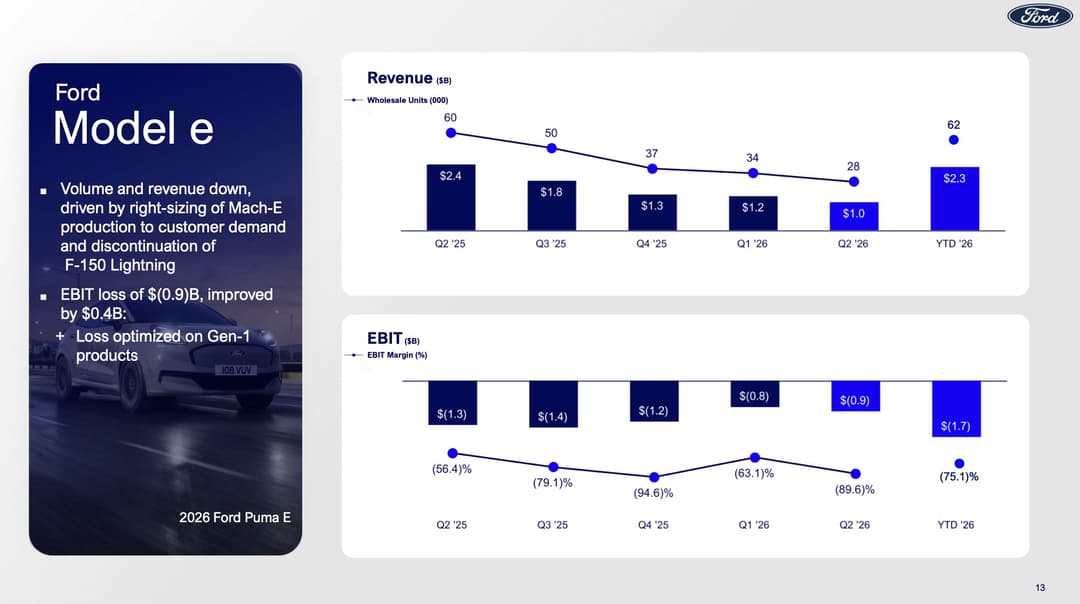
Slide from Ford's Q2 2026 earnings presentation showing Model e revenue and EBIT trends
Ford's Model e segment results from its Q2 2026 earnings presentation. (Source: Ford Motor Company)

Two Numbers That Are Actually One Number

Model e lost $919 million in the quarter, an improvement of $410 million from a year earlier. Read on its own, that sounds like real progress. But Model e's revenue was only about $1 billion in the quarter — down 58% year over year from $2.4 billion in Q2 2025. Those two facts aren't separate: Ford's EV losses shrank largely because Ford sold far fewer EVs, not because the underlying business got healthier.

Ford said as much directly, attributing the drop to "right-sizing of Mach-E production to customer demand and discontinuation of F-150 Lightning." The resulting EBIT margin for Model e was -89.6% — for every dollar of EV revenue Ford brought in last quarter, it lost about ninety cents.

QuarterModel e RevenueWholesale Units (000)EBITEBIT Margin
Q2 2025$2.4B60-$1.3B-56.4%
Q3 2025$1.8B50-$1.4B-79.1%
Q4 2025$1.3B37-$1.2B-94.6%
Q1 2026$1.2B34-$0.8B-63.1%
Q2 2026$1.0B28-$0.9B-89.6%

Both revenue and wholesale unit volume have fallen in every single quarter on this chart. Losing less money by building and selling less product is a defensible management decision, arguably even the correct one given demand — but it's a contraction, not a turnaround.

The $4.2 Billion Charge Nobody Highlighted

Beyond the quarterly numbers, Ford also booked $4.2 billion in special charges tied to its EV strategy, split into two pieces.

Where the $4.2 billion came from
  • $3.6 billion, largely non-cash, from unwinding BlueOval SK — Ford's battery manufacturing joint venture with SK On
  • Roughly $500 million from EV program cancellations that Ford announced back in December 2025

Unwinding a battery joint venture isn't just a rough-quarter write-down — it's dismantling industrial capacity Ford built for a specific strategy. Ford committed to domestic battery cell manufacturing at scale, and this charge reflects not needing that capacity on the timeline it originally planned. Put together with the discontinued Lightning, the cut Mach-E production, and the canceled programs, the picture is a company actively taking apart its first-generation EV strategy rather than just having a slow quarter.

What's Supposed to Replace It: A $30,000 Truck

Ford's next-generation EV plan centers on a compact electric pickup targeted at a starting price around $30,000, built to be profitable earlier in its life cycle rather than eventually. The truck is expected to use a native NACS port (Tesla's charging connector, now the North American standard) and an LFP battery — a cheaper, more durable, less energy-dense chemistry that avoids nickel and cobalt. A reveal is expected in the second half of 2026 or early 2027, with launch to follow after that.

Both of those technical choices point toward the same goal: cost. LFP chemistry and a shared charging standard are what an automaker specifies when the priority is hitting a price point, not maximizing range or performance — a deliberate pivot away from the strategy that produced a large, expensive, battery-electric F-150.

The Lightning isn't gone for good — it's changing form
  • Ford says the F-150 Lightning name will return, but not as a pure battery-electric truck
  • The next version is planned as an extended-range EV (EREV) — a battery drivetrain paired with an onboard gas generator
  • Ford's claimed range target is beyond 700 miles, addressing the range and charging-time complaints that dogged the original Lightning
  • This amounts to Ford conceding that customers weren't rejecting an electrified truck — they were rejecting the compromises of a pure-electric one

The Part of Ford That's Actually Strong Right Now

None of the Model e story is why Ford's stock moved, and the rest of the company earned that reaction. Company-wide adjusted EBIT came in at $2.5 billion, up $400 million year over year, at a 5.2% margin — margin expansion on lower revenue, which is the harder direction to move that number. Ford says its F-Series recovery is on track, and F-Series remains the profit engine funding the EV division's losses. Total automotive revenue of $44.89 billion did come in just under the $45.86 billion estimate, but investors largely shrugged that off given the EPS beat and raised guidance.

The bottom line: Ford's overall quarter was genuinely good, and the guidance raise reflects real strength in its gas-powered lineup. But Ford's entire electric vehicle thesis now rests on a $30,000 truck that hasn't been revealed yet, while its current EV lineup keeps shrinking. Watch three things from here: whether that reveal happens on schedule, whether the $30,000 price survives contact with tariffs and battery costs, and whether Model e's revenue line ever turns upward instead of just losing money more slowly.