Canada Budget 2026 Funds 55,000 New EV Chargers With C$587 Million ZEVIP Renewal, but No New Rebates
Canada's Budget 2026 renews the ZEVIP charger program with C$587 million (about US$415 million) over five years for 55,000+ new chargers from 2027-28. The C$5,000 EV rebate stays, with nothing new for buyers.
Canada is betting that the way to sell more electric cars is to make them easier to plug in. The federal government's Budget 2026, tabled in Ottawa on November 5 under the title "Masters of our destiny," commits C$587 million (about US$415 million) over five years to renew the Zero Emission Vehicle Infrastructure Program, the country's main source of federal money for public chargers. Ottawa says the money will support more than 55,000 additional chargers.
What the budget does not do is put more money in buyers' pockets. There is no new rebate and no change to the existing one. For Canadian drivers, the message is clear: more places to charge, same incentive to buy.
C$587M
ZEVIP renewal over five years (about US$415M)
55,000+
Additional chargers the money is meant to support
2027–28
First year the new funding flows
C$0
New money for consumer EV rebates
What the Budget Actually Funds
The charging measures total just over C$634 million (about US$450 million). Here is the breakdown, taken from Chapter 1 of the budget document:
Measure
Amount (CAD)
Approx. USD
Timeline
Zero Emission Vehicle Infrastructure Program (ZEVIP) renewal, run by Environment and Climate Change Canada
$587 million
$415 million
5 years from 2027–28
Charging research and development, Natural Resources Canada
$45 million
$32 million
5 years from 2027–28
Greening Government Operations Fleet Program (federal fleet EVs)
$2.2 million
$1.6 million
5 years from 2027–28
USD figures are approximate, at roughly US$0.71 per Canadian dollar.
ZEVIP does not build chargers itself. It reimburses part of the cost for the businesses, municipalities, utilities and building owners that do. According to Electric Autonomy, the program covers up to 50% of eligible project costs, or up to 75% for Indigenous-led projects, with a cap of up to C$2 million (about US$1.4 million) per project. The existing program was due to run out next year, so the budget keeps it going without a gap. Funding still needs Parliament's approval.
The program's priorities include rural routes, apartment and condo buildings, and workplaces. Simple division puts the average federal contribution at about C$10,700 per charger, which suggests the money will go mostly to Level 2 chargers, with DC fast chargers making up a smaller share.
Where Canada's Charging Network Stands Now
The budget says Ottawa has supported "more than 50,000 chargers to date." Its own results table is more precise:
44,539 federally supported chargers installed from 2019 to 2026.
1,077,457 EVs on Canadian roads.
A target of 58,874 chargers installed by 2028–29 under existing funding. Electric Autonomy reports that Ontario accounts for 23,802 of those, British Columbia 17,147 and Quebec 9,555.
If the new 55,000 are built on top of that, Canada would roughly double its federally funded network by the early 2030s. Separately, the Canada Infrastructure Bank has more than C$500 million committed to FLO, Parkland and JOLT that the bank says could enable up to 5,400 new public fast-charging stations.
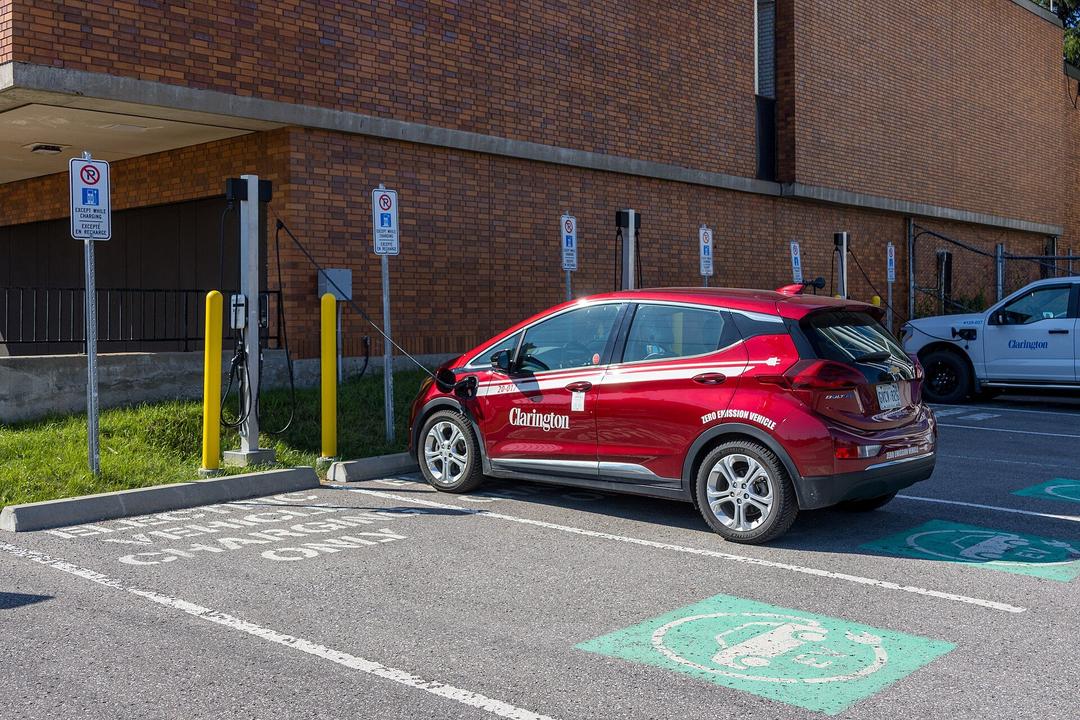
A municipal Chevrolet Bolt EV charges at a Level 2 station in Clarington, Ontario. ZEVIP has paid for much of this kind of workplace and public charging. Photo: Dillan Payne / Wikimedia Commons (CC BY-SA 4.0)
Advertisement
What the Charging Industry Says
Industry groups welcomed the multi-year commitment more than the dollar figure itself. Travis Allan, president and CEO of the Canadian Charging Infrastructure Council, told Electric Autonomy that "the charging industry is really encouraged by the multi-year investment in the budget." He said the council wants programs aimed at condo and apartment residents, fleets, and "public fast charging, which needs to cover major corridors and metropolitan areas."
"The multi-year announcement was as important as the announcement of funding."
— Daniel Breton, president and CEO, Electric Mobility Canada
Breton was also disappointed. The budget has no new money for medium- and heavy-duty electric trucks, EV education or battery recycling. The federal incentive for electric trucks and buses, iMHZEV, ended March 15, 2026, with no replacement.
Advertisement
The Rest of Canada's EV Policy in 2026
The budget mostly confirms decisions Ottawa made earlier this year, when it launched its Automotive Strategy on February 5:
Canada's EV rules at a glance
Rebate: The Electric Vehicle Affordability Program continues unchanged at up to C$5,000 (about US$3,550) for a battery-electric car and up to C$2,500 for a plug-in hybrid, stepping down to C$2,000 and C$1,000 by 2030.
Rebate limits: A final transaction price of C$50,000 or less, and the vehicle must come from a country with a Canadian free-trade agreement. Canadian-built vehicles are exempt from the price cap.
Sales mandate: The Electric Vehicle Availability Standard, which required 100% zero-emission new car sales by 2035, is being repealed and replaced by greenhouse gas standards for model years 2027 to 2032. The budget says those standards are being updated "to reflect changes in consumer demand."
Chinese EVs: Since March 1, 2026, up to 49,000 Chinese-built electrified vehicles a year can enter at a 6.1% tariff, replacing the earlier 100% surtax.
The broader budget also folds charging into a national electricity plan. Nearly C$4 billion (about US$2.8 billion) over 10 years goes to grid expansion and renewable projects, and the Clean Electricity and Clean Technology investment tax credits are extended to the end of 2040. More grid capacity matters, because large fast-charging hubs need it.
How Canada Compares With the US
The contrast with the United States is sharp. The US federal EV tax credit ended for vehicles acquired after September 30, 2025, while Canada still offers a point-of-sale rebate. On charging, the US $5 billion National Electric Vehicle Infrastructure (NEVI) program was paused in February 2025 and restarted under new federal guidance in August 2025. As of August 12, 2026, only 132 of the 1,014 NEVI-funded sites announced nationwide were open, according to Plug In America figures cited by Oregon Public Broadcasting.
What drivers should know
No new chargers come from this money right away. Funding starts in the 2027–28 fiscal year, and projects take time to permit and build.
The 55,000 figure includes slower Level 2 chargers, not just highway fast chargers.
US drivers heading north can use Canada's growing CCS and NACS networks, but check apps such as PlugShare for pricing and payment options before the trip.
The bottom line: Budget 2026 renews Canada's main charger program with C$587 million (about US$415 million) over five years, aimed at more than 55,000 new chargers starting in 2027–28. It keeps the existing C$5,000 rebate but adds nothing new for buyers, and it confirms the move away from a hard EV sales mandate. For drivers, the payoff is more places to plug in by the end of the decade, especially in rural areas and apartment buildings. The industry's main win is a five-year funding window it can plan around.