July 13, 2026·6 min read·By Learn My EV

California Signs $3,500 Instant EV Rebate — And It Favors Rivian and Lucid Over Tesla

Gov. Newsom signed SB 168 on July 13, 2026, creating "MyFirstEV" — a $3,500 point-of-sale rebate for first-time EV buyers, $1,750 for used EVs, backed by $270 million in combined state and automaker funding. A California-headquarters rule lets Rivian and Lucid buyers skip the $50,000 price cap entirely — Tesla can't.

California Signs $3,500 Instant EV Rebate — And It Favors Rivian and Lucid Over Tesla

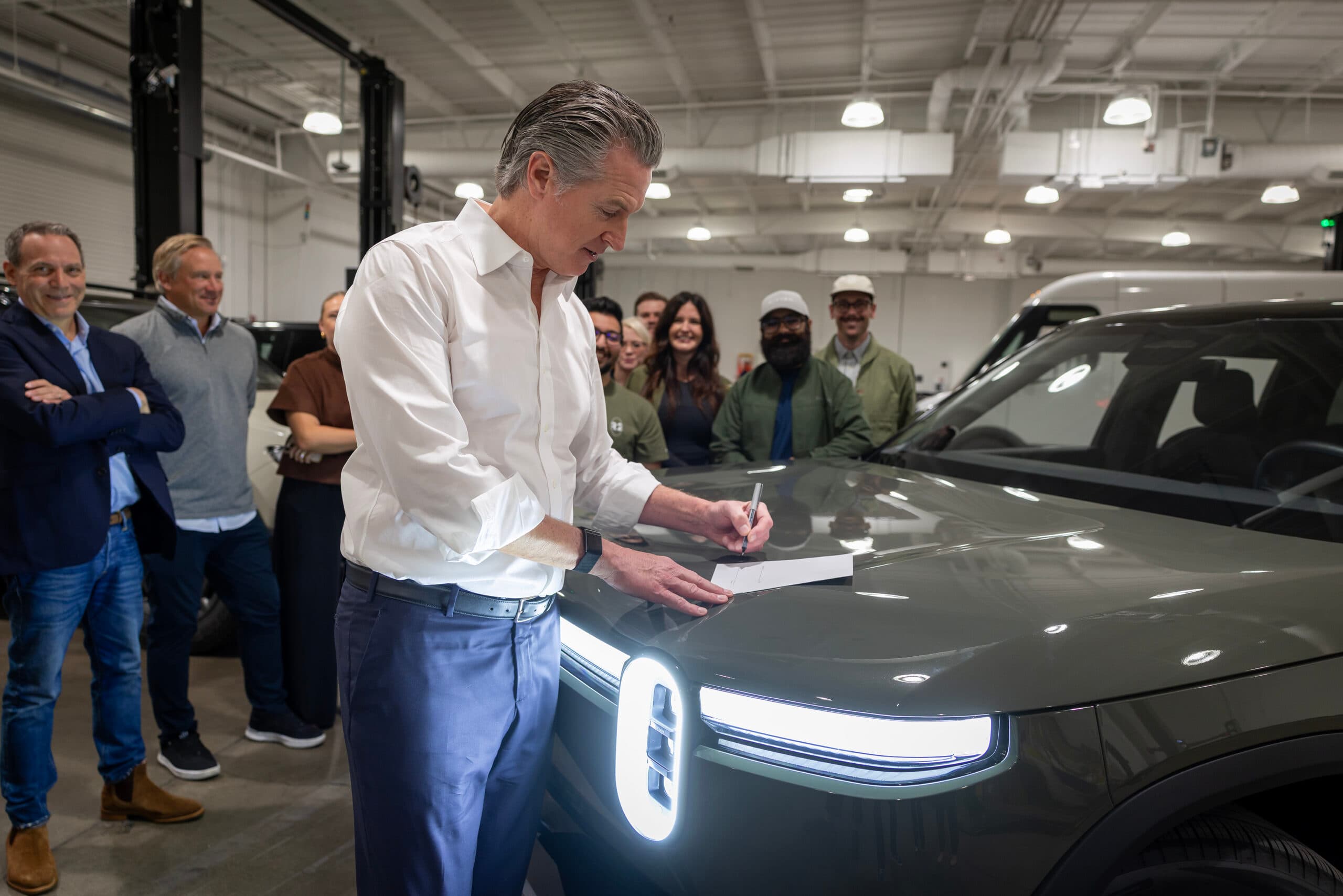
California families buying their first electric vehicle will soon get $3,500 knocked off the price right at the dealership. Governor Gavin Newsom signed SB 168 on July 13, 2026, creating "MyFirstEV," a new instant point-of-sale rebate funded by $135.5 million in state money and matched dollar-for-dollar by participating automakers. But a rule tucked into the bill — waiving the program's price cap for California-headquartered automakers — means Rivian and Lucid buyers get the rebate on cars costing $60,000-$70,000, while Tesla buyers only get it on the cheapest Model 3 and Model Y configurations.

$3,500
Instant rebate on new EVs up to $50,000 MSRP
$1,750
Rebate on used EVs sold for up to $25,000
$270M
Combined state + automaker funding pool

How the Instant Rebate Works

Unlike California's old application-based Clean Vehicle Rebate Project — which required paperwork and a wait for a check — MyFirstEV applies at checkout. Eligible buyers walk into a participating dealership and the discount is already off the price before they drive away.

MyFirstEV — Core Rules
  • $3,500 off new EVs with an MSRP up to $50,000
  • $1,750 off used EVs sold for up to $25,000
  • First-time ZEV buyers only, confirmed by buyer attestation — no income cap
  • 8,500-pound curb weight limit, restricting eligibility to light-duty passenger vehicles
  • California residents only

The $135.5 million in state funding is matched by participating automakers, who must opt in and cover half of each rebate — bringing the combined pool to roughly $270 million in point-of-sale savings. The California Air Resources Board is still finalizing agreements with automakers and dealerships, with full details expected next month and the program launching in the coming weeks.

The Catch: A California-Headquarters Loophole

The $50,000 price cap is waived entirely for EVs built by California-headquartered, EV-only automakers — defined as companies whose corporate management and staff are based in the state as of January 1, 2026. In practice, that describes exactly two companies: Rivian, whose engineering headquarters in Irvine qualifies, and Lucid, based in the Bay Area. Their cheapest models sit well above the general cap, but both still get the full $3,500.

VehicleStarting PriceRebate PathGets $3,500?
Rivian R1S / R1T~$58,000CA-HQ exemptionYes
Lucid Air~$71,000CA-HQ exemptionYes
Tesla Model 3 RWD$42,490Under $50K capYes
Tesla Model Y$44,990Under $50K capYes
Tesla Model 3 Long Range$47,490Under $50K capYes
Tesla Cybertruck$50,000+No exemption appliesNo

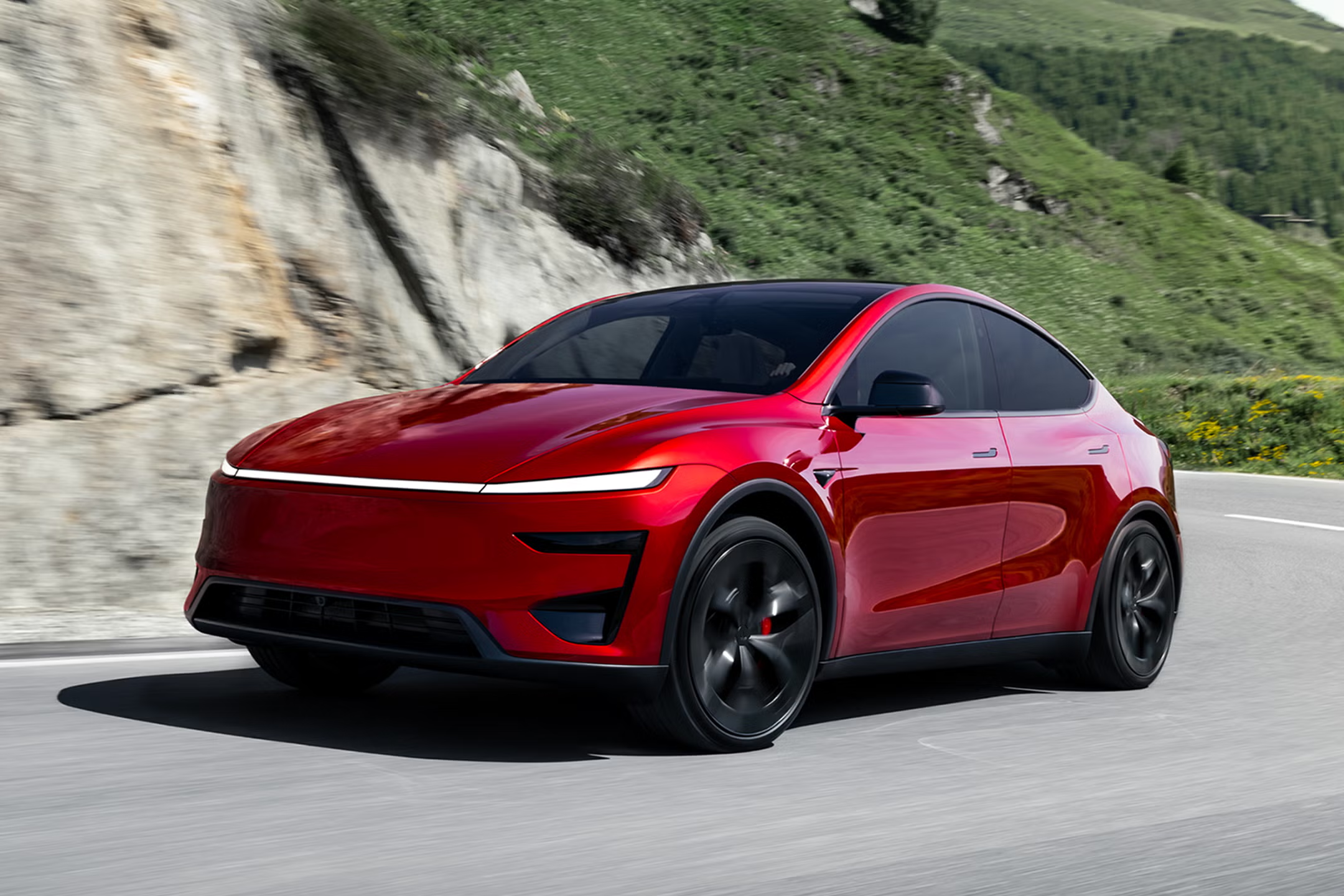
Tesla doesn't qualify for the headquarters exemption because it moved its corporate address from California to Austin, Texas, in 2021. That means only Tesla's sub-$50,000 configurations get the rebate — the Cybertruck is locked out entirely (Tesla wound down the Model S and Model X earlier this year, so they're no longer part of the equation), regardless of the fact that Tesla still builds far more vehicles in California, at its Fremont factory, than Rivian (assembled in Normal, Illinois) or Lucid (assembled in Casa Grande, Arizona) build anywhere.

The exemption rewards where a company plants its headquarters flag, not where it builds its cars.

Given the ongoing public feud between Newsom and Tesla CEO Elon Musk, the optics are hard to miss — and critics argue the carve-out is legally vulnerable, since it ties eligibility to a corporate address rather than actual in-state manufacturing or jobs.

Why California Is Moving Now

The timing traces back to Washington. Congress repealed the federal $7,500 EV tax credit (and the $4,000 used-EV credit) effective September 30, 2025, as part of the same tax package that ended other clean-energy incentives. Since then, US EV sales are down at least 20% year over year, and California's own EV share of new car sales fell from nearly a quarter a year ago to just 15.7% in the first quarter of 2026 — well short of the state's 35% target for the year.

Other EVs that qualify under the standard $50K cap
  • Chevrolet Bolt — starts under $30,000
  • Chevrolet Blazer EV and Equinox EV — both under $50,000
  • Hyundai Ioniq 5 — starts around $35,000
  • Ford Mustang Mach-E — starts around $38,000
  • Toyota bZ and C-HR — start under $40,000

MyFirstEV is the centerpiece of a broader $600 million zero-emission vehicle package in the 2026-27 state budget, funded through Cap-and-Invest revenue and smog-abatement fees. The rest includes $150 million for the Community Air Protection Program, $135.5 million for the Clean Truck and Bus Voucher Incentive Project, $130 million to replace polluting heavy-duty engines through the Carl Moyer Program, $35 million for clean off-road equipment, and $19.8 million for lower-income buyers through Clean Cars 4 All.

The bottom line: MyFirstEV is a well-designed response to the loss of the federal tax credit — instant, point-of-sale savings tend to move buyers far more than a rebate check months later, and the used-EV rebate in particular could help a lot of budget-conscious first-time buyers. But the California-headquarters carve-out is a real asterisk: it hands Rivian and Lucid an advantage on their priciest models while capping Tesla at its cheapest ones, based on a corporate mailing address rather than where the cars are actually built. Expect more detail from CARB next month, with the rebate live at dealerships in the coming weeks.