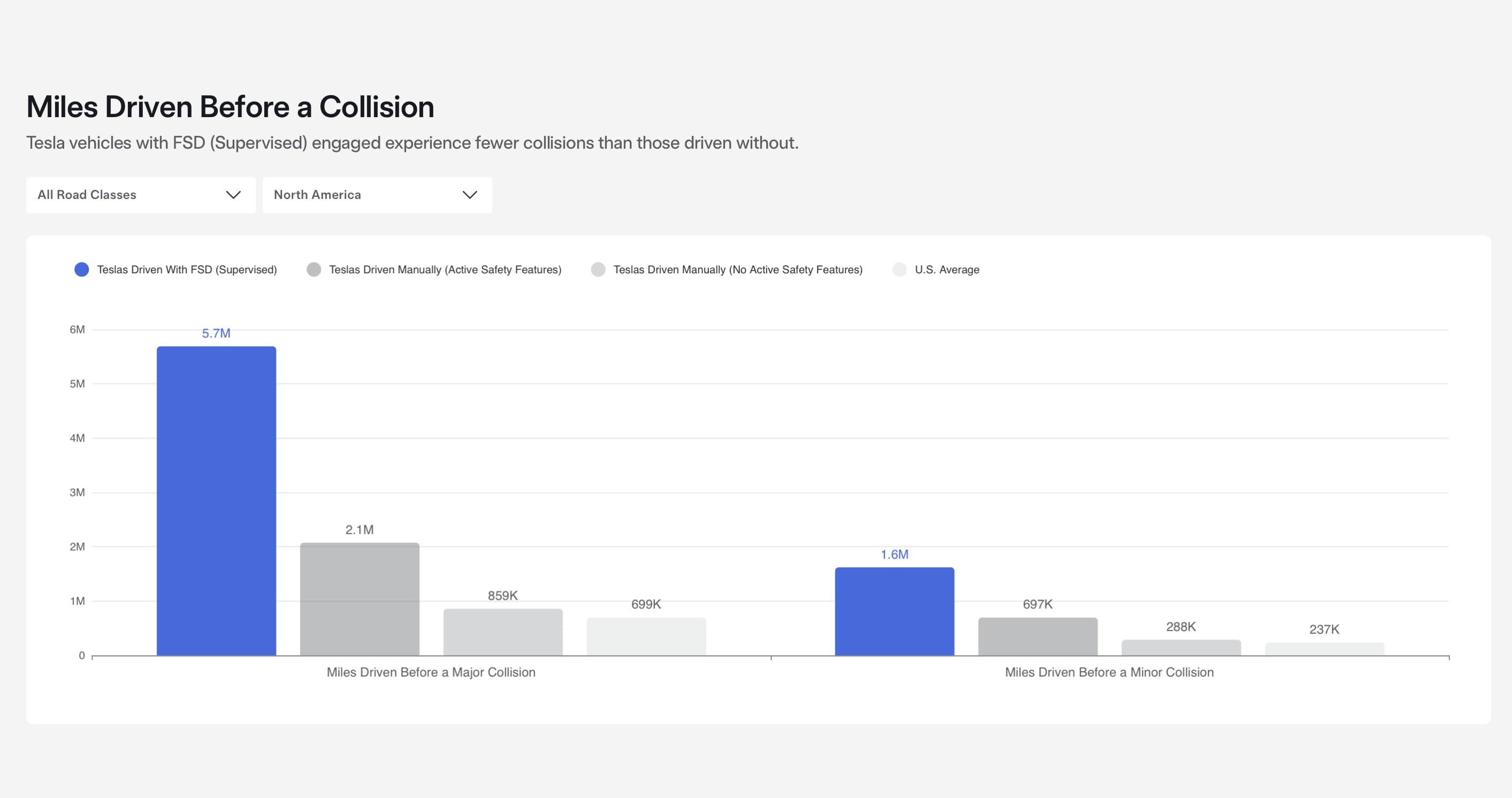
Tesla has updated its Vehicle Safety Report with new FSD (Supervised) collision data, covering a rolling twelve-month period across North America. The headline claim: Teslas driving with FSD (Supervised) engaged went an average of 5,690,675 miles between major collisions — airbag-deployment-level crashes — compared to 698,781 miles for Tesla's estimated U.S. average. Tesla frames that as roughly 7x fewer major collisions with FSD engaged. The raw numbers are real and internally consistent. Whether that comparison tells you what Tesla wants it to tell you is a separate question, and independent safety researchers have been picking that question apart for months.
5.69M
Miles per major collision with FSD (Supervised) engaged
699K
Miles per major collision, Tesla's estimated U.S. average
~7x
Tesla's own framing of the difference
The Full Numbers, As Tesla Reported Them
Tesla breaks its data into four groups: vehicles driving with FSD (Supervised) engaged, Teslas driven manually with active safety features (Automatic Emergency Braking, Forward Collision Warning, etc. — standard on every Tesla made since 2014), Teslas driven manually with no active safety features (pre-2014 Tesla vehicles, which Tesla uses as a proxy for an older, less-equipped car), and an estimated U.S. average built from federal crash and mileage data.
| Group | Miles per Major Collision | Total Major Collisions | Total Miles Logged |
|---|
| FSD (Supervised) engaged | 5,690,675 | 1,255 | 7,141,797,525 |
| Manual, with active safety | 2,076,014 | 17,380 | 36,081,121,994 |
| Manual, no active safety | 859,465 | 239 | 205,412,073 |
| U.S. average (estimated) | 698,781 | 4,646,404 | 3,246,817,000,000 |
A "major collision" in this report specifically means a crash severe enough to deploy an airbag or other non-reversible restraint — a fairly high bar. Tesla also counts a collision as an "FSD collision" if the system was active at any point in the five seconds before impact, even if the driver had already taken over. The report only covers North America; Tesla publishes separate figures for other regions and for non-highway driving specifically.
Why the Comparison Is More Complicated Than the Headline
The 7x figure comes from comparing FSD-engaged miles to the "U.S. average" column — which Tesla itself defines as pre-2014 vehicles, standing in for the average American car (roughly 12-13 years old) because that's genuinely closer to the actual U.S. fleet age than a new Tesla. That's a defensible choice for estimating national road safety broadly, but it also means the comparison is measuring a brand-new car loaded with modern collision-avoidance hardware against a car built before most of that hardware existed — a gap that has nothing to do with whether FSD itself is doing anything.
If the question is whether turning FSD on makes a Tesla safer than driving the same Tesla manually, the more relevant baseline in Tesla's own table isn't the U.S. average — it's the "manual, with active safety" row, since that's the same fleet, same hardware, same drivers, with only the FSD variable changed.
Run that comparison instead — 5,690,675 miles per collision with FSD versus 2,076,014 miles per collision for the same fleet driving manually — and the gap narrows to roughly 2.7x, not 7x. That's still a real difference, but it's a much smaller and more defensible one, and it's the comparison that Carnegie Mellon University engineering professor Phil Koopman, who has reviewed multiple versions of this report, argues is the only apples-to-apples one available in Tesla's own data.
Other issues independent researchers have flagged
- Fleet age gap: the average Tesla on the road is a few years old; the average U.S. vehicle is over 12 years old — newer cars of any brand crash less often, independent of software
- Narrower crash window: Tesla only counts a crash as FSD-related if the system was active within 5 seconds of impact, versus the 30-second window NHTSA uses for its own crash-reporting rules
- Asymmetric crash counting: Tesla's major-collision figures require airbag deployment, while some federal baseline data includes tow-truck crashes that never deployed an airbag — a mismatch that can inflate the apparent gap
- No fatality breakout: the report doesn't separate out deaths, and Tesla says its airbag-based telemetry can't reliably capture injury severity
- Not independently auditable: the underlying crash data isn't published in a form outside researchers can verify against Tesla's own numbers
A 2026 Reuters investigation into Tesla's FSD safety claims — drawing on interviews with former Tesla data labelers, a former self-driving engineer, and eleven independent traffic-safety researchers — found similar issues with earlier versions of this same report, concluding that stacking the fleet-age gap, the crash-type mismatch, and selection-and-exposure bias together could inflate Tesla's headline comparison by somewhere close to an order of magnitude versus a properly matched baseline. Ten of the eleven researchers Reuters consulted described Tesla's safety statistics as marketing material rather than a rigorous safety analysis.