Lunar Fast Charger: 25 kW Home DC EV Charger Adds 100 Miles an Hour and Can Power Your House
Lunar Energy's new 25 kW home DC fast charger plugs into its Lunar System battery, supports CCS and NACS, and lets a compatible EV back up your home. Specs, availability, what's missing and how it compares to Ford, GM, Tesla and Wallbox.
Photo: Lunar Energy
Nearly every home EV charger in America is an AC charger, and that puts a ceiling on how fast your car can fill up in the garage. Lunar Energy, the home-battery company founded by Tesla's former head of energy, Kunal Girotra, says it has found a way around that ceiling, and a way to send the car's power back into the house.
On November 11, the Mountain View, California, company announced the Lunar Fast Charger, a 25-kilowatt home DC fast charger that plugs into its next-generation Lunar System home battery. Lunar says it adds up to 100 miles of range in an hour and supports two-way charging, so a compatible EV can power the home in a blackout or, eventually, sell energy to the grid. The catch: it won't arrive until later in 2027, and Lunar hasn't announced a price or which cars will work with it.
25 kW
Continuous DC charging power
100 mi
Range added per hour, per Lunar
CCS + NACS
Connector support listed in Lunar's specs
2027
Rollout begins; price not yet announced
Why DC at Home Is a Big Deal
A normal Level 2 wall charger sends AC power to the car, and the car's onboard charger converts it to DC for the battery. That onboard charger is the bottleneck. As Heatmap noted in its coverage, most U.S. EVs can accept only about 11 kW of AC power at home, no matter how big the wall unit is. (For the basics, see our guide to Level 1, Level 2 and DC fast charging.)
A DC charger skips the onboard charger and feeds the battery directly, the way a public fast charger does. Lunar can do this cheaply because its home system already runs on a DC bus: solar panels, batteries and now the car all share it. Lunar's spec sheet lists a DC input of 380 to 460 volts from the Lunar System and an output to the car of 0 to 60 amps, within a 200 to 500 volt range under the ISO 15118 standard.
Twenty-five kilowatts is slow next to a 250 kW public station, but it is more than twice what most home chargers deliver. Lunar says it is "more than twice as fast as a standard home charger." Heatmap reported a typical charge would take roughly three to four hours, compared with six to eight hours on a Level 2 unit.
Lunar Fast Charger Specs
Spec
Lunar Fast Charger
Charging power
25 kW continuous, DC
Range added
Up to 100 miles per hour (Lunar estimate)
Connectors
CCS1/CCS2 and NACS
Output current
0 to 60 A DC continuous
Output voltage
200 to 500 V DC (ISO 15118)
Bidirectional
Yes: vehicle-to-home (V2H) and vehicle-to-grid (V2G)
Requires
Lunar System home battery
Panel upgrade
Not needed, per Lunar (connects to the Lunar System, not the main panel)
Availability
Initial rollout later in 2027
Price / compatible EVs
Not announced
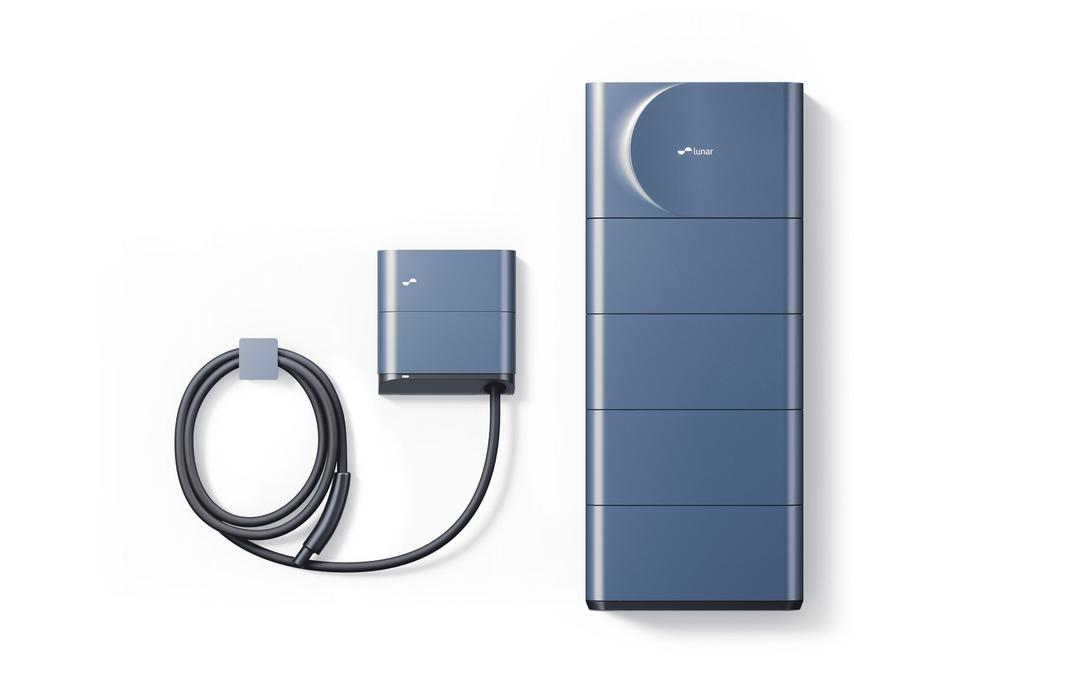
The Lunar Fast Charger (left) connects directly to the Lunar Battery, which holds 10 to 30 kWh per tower. Photo: Lunar Energy
Advertisement
Your EV as a Home Battery
The bigger story is two-way power. An EV battery typically holds several times the energy of a home battery tower, and Lunar wants to put it to work. Lunar's press release says bidirectional charging lets the car "keep a home running through a multi-day blackout," depending on the size of the car's battery and how much power the house uses. It also says vehicle-to-grid could earn owners money as utility programs develop. Lunar's Gridshare software already manages more than 150,000 devices in virtual power plants, including programs in California, Hawaii and Texas, according to Electrek.
The charger also works with Lunar AI, the company's scheduling software. It "dynamically balances rooftop solar, stored battery energy, and off-peak utility rates" to charge the car at the lowest cost, per the release. Sam Wevers, Lunar's director of product, said: "Automating fast charging and discharging with solar, storage and cheap grid power can dramatically reduce the cost to power your drive."
"Automating fast charging and discharging with solar, storage and cheap grid power can dramatically reduce the cost to power your drive."
Sam Wevers, Director of Product, Lunar Energy
Advertisement
The New Lunar System Behind It
The charger is an add-on to Lunar's updated home battery, which arrives first, with customer installations starting in early 2027.
Inverter: 13.4 kW continuous (15.3 kW maximum off-grid), enough, Lunar says, to run a whole home at once.
Storage: 10 to 30 kWh per tower in 5 kWh modules; towers placed side by side reach up to 300 kWh.
Solar: works with new panels using Lunar Maximizer optimizers, with an existing solar array, or with no solar at all.
Business version: pad-mounted configurations up to 1 MWh.
Made in: assembled in California, Georgia, Idaho and Washington.
How It Compares to Other Bidirectional Home Chargers
Several automakers already let an EV back up a house, but most route power through AC hardware that only works with their own vehicles.
System
Type
Charging
Home backup
Vehicles
Lunar Fast Charger
DC
25 kW
Yes (output not stated)
Not announced (CCS/NACS)
Ford Charge Station Pro + Home Integration System
AC
19.2 kW (80 A)
Up to 9.6 kW
F-150 Lightning
GM Energy PowerShift Charger + V2H Enablement Kit
AC
19.2 kW (80 A)
Yes
V2H-capable GM EVs, from Lyriq to Silverado EV
Tesla Powershare + Powerwall 3
Vehicle inverter
Wall Connector
11.52 kW max continuous
Cybertruck; new Model 3 and Model Y ordered from Oct. 1, 2026
Wallbox Quasar 2
DC
12.8 kW
Up to 12.8 kW
Kia EV9
Ford's Home Integration System listed at $3,895 plus installation when it launched in 2022, on top of the $1,310 Charge Station Pro for trucks that didn't include it. GM doesn't list a base price on its PowerShift page, and Wallbox takes a $100 deposit for the Quasar 2. Tesla's Model 3 and Model Y Powershare is U.S.-only and does not yet support selling power to the grid.
What we still don't know
Price: Lunar hasn't said what the charger, or the charger plus a Lunar System, will cost.
Which EVs can discharge: two-way DC power needs the car's cooperation. Few U.S. EVs support it today, and Lunar hasn't named compatible models.
Home backup output: Lunar hasn't said how many kilowatts the car can send to the house.
800-volt cars: the listed 500-volt output ceiling suits 400-volt EVs; Lunar hasn't detailed how it handles 800-volt models.
V2G pay: depends on utility programs that don't yet exist in most areas.
Who should pay attention
Homeowners already planning solar and a battery who also drive an EV.
Households facing a costly electrical panel upgrade to add a Level 2 charger.
Drivers in outage-prone areas who want their car to double as backup power.
People on time-of-use rates who want charging scheduled automatically.
The bottom line: Lunar's Fast Charger brings 25 kW DC charging into the garage, more than double a typical home charger, and promises to turn a parked EV into a house battery. It is one of the few home DC chargers aimed at mainstream buyers, and it supports both CCS and NACS. But it is tied to Lunar's own battery system, it won't ship until later in 2027, and the two numbers that matter most, price and compatible cars, are still missing. Until those arrive, treat it as a promising preview, not a purchase decision.